Showing posts with label Affordable Knives. Show all posts

Tuesday, December 29, 2015

Knife Review: Mora: Morakniv HighQ Allround Knife

Introduction:
Morakniv HighQ Allround knife with sheath

When I started doing these knife reviews, a part of my motivation was to provide suggestions for affordable good quality knives.  In that vein, I am finally getting around to reviewing a Mora knife.  If you were to spend far too many hours reading about various types of knives for camping and bushcraft on various knife forums (as some of us do), there would be certain knife brands that you would hear mentioned repeatedly as top performers.  The Mora knives are absolutely one that I read people raving about, but what I didn't realize at first was that they are also extremely affordable.  When it comes to affordability in a general purpose knife, I don't think you can really beat a Mora.

Most of the knives I have been reviewing tend to be fairly expensive.  Some of them are very expensive, but not this one.  You can pick up a Morakniv HighQ Allround for less than $15.  This is a quality knife that you can pick up at a disposable knife price.  But in reality, you probably won't pick up this exact knife since the model that I am reviewing was recently discontinued, but there are newer models that are very similar.  If you would like a handy primer on the different styles of Mora knives there is a handy one here, from Ramblin' Jim.  As Jim says, at these prices you can just pick up a few and try them out.  Amazon has bundles of different Mora models for sale.


The TL;DR review summary: 


If you really aren't interested in reading the whole review, then let me just say that I started out just wanting to see if the Mora could handle some of the tasks that I had done with other bushcraft knives.  It was such a pleasure to use I ended up carving a spoon.

This is the first spoon I have ever carved, and I did it entirely with the Mora I am reviewing here (well, I also used sandpaper, but it was the only knife I used)


Let's Start With the Specs:


(Knife Specifications from Knife Center)


  • Blade Length: 3.75" (95 mm)
  • Blade Steel: High Carbon Steel, 59-60HRC
  • Blade Thickness: 2 mm
  • Overall Length: 8.2" (208 mm)
  • Handle Material: Rubber
  • Weight: 3.7 oz. (105 g)
  • Made in Sweden

I'm not going to go into the specs too much here, especially since this exact knife is discontinued, but the followup models are very similar.  

What I think is probably most noteworthy is the steel.  This particular knife that I reviewed is not stainless, it is high carbon.  I accidentally left it outside for a few weeks after I had taken the photos I used for the review, and it definitely rusted.  The rust was just superficial, and it cleaned off, but it left stains.  And this type of steel does stain.  After using the knife for a while the steel will turn grey, even if you take care of it, that is just the way it goes.  The discoloration is called a patina, and lots of people actually really like the patina.  There are many discussions online devoted to different types of forced patinas, and how to get different colors.  I personally prefer stainless myself, but carbon steel is often better performing than less expensive stainless steels.  

Mora also has a good reputation for their heat treatment of their stainless steels, and the use Sandvik steels for their stainless.  But that is not what I am reviewing, because Mora has a particularly good reputation for the heat treatment on their carbon steel blades, and my experience is that the reputation is well earned.  Carbon steels might discolor easier, and they require cleaning and oiling to maintain optimally, but a good high carbon steel can have as good or superior edge holding and toughness than a stainless super-steel at a much lower price.  If you want excellent performance for a low cost, and you are willing to take care of your tools, then a high-carbon steel can be an excellent choice. 


A Note on the Sheath:


I really liked the sheath for this knife.  It is not fancy looking, but it is not a fancy knife.  The sheath is easy to clip on to your belt, but it stays on securely.  The knife fits snugly into place in the sheath with no wiggle or rattle.  It stays secure without needing an additional snap or loop to hold the knife in place.  As an extra bonus, and showing the origin of the knife as a construction/work knife, the sheath is designed to stack with other Mora sheathes, so if you needed two different knives you could have them stacked.


Review:


Steel:


As I stated earlier, the steel is high carbon.  Morakniv does not provide a more precise description than that.  Whatever the exact steel recipe is, when combined with their heat treatment is makes for an outstanding performing blade steel.  A lot of the hardness, edge holding, and resistance to chipping in a knife comes down to having a good heat treatment.  The many decades in the making reputation of knives from Mora, Sweden is in large part due to the heat treatment.

I found the knife to hold an excellent edge, even when I abused the edge.  And one of the benefits of carbon steel as opposed to stainless steel is that it is easier to sharpen.  So after I managed to wear out the initial edge to the point where it just was not performing as well, it was a breeze to put a new edge on the knife.


Blade Finish:


The blade finish is nothing to write home about.  It is a standard, somewhat polished, finish.  The knife is a work knife, it is going to get scratched, and since it is a carbon steel blade it is going to get a patina.  Some other Mora knives have coatings or special finishes, this one does not.


Blade:


So a big part of what makes this knife (and most of Mora's lineup) perform so well while maintaining sturdiness is the Scandi Ground blade.  The scandi grind is a great geometry for a utility knife.  Different types of tasks can be easier with different grinds, I for one strongly prefer full flat grinds for kitchen knives as an example.  The scandi is especially good for wood working, which is handy for a knife you intend to use for camping or bushcraft.

A big part of the reason the scandi grind works so well for cutting into materials like wood is the lack of a secondary bevel.  The primary bevel on the blade goes right to the edge, so the blade does not shoulder until the blade is at least as far in as the edge of the primary bevel.  I worry that this might be getting a little jargon-rich/technical, so I will just say that I like the grind.  If you want to know more about grinds I wrote about them in my article Knives: A Primer a while back.  I also link to an interesting video that explains blade geometry and shouldering in more depth in that article.

The blade on this knife is pretty small.  It is less than four inches long, and pretty thin.  The blade feels more than solid enough for any task I asked of it, but it is not a big tank of a blade.  It is a handy, nimble size, good for general tasks, but it is not a big chopper.

I did do a little batoning with the knife, just because I figured that it really wouldn't have been a big deal if the knife broke.  The knife held up just fine, but with such a short blade you are pretty much limited to splitting wood that is already kindling.  If you have read my other reviews then you know that I am not a fan of batoning, but it is very "in" right now.

The one big drawback to the thinness of the blade is that it ended up giving me blisters on my left hand from pressing on the back of the blade while carving.


Handle:


The handle is one of the best things about this knife.  It is not pretty, or flashy, but it is comfy.  The handle is plastic covered with a rubber layer.  It is soft, grippy, and ergonomically excellent.  This knife really feels good in the hand, even after you have been using it for quite a while.


Deployment:


This is a fixed blade, not a folder, so deployment is really just taking it out of the sheath.  The sheath is well designed, and it is quick and easy to take out the knife.


Fit and Finish:


Fine for a $12 knife.  This really isn't a fancy knife.  All I cared about was the sharpness of the knife, and that everything solid.  The bevel were even on the knife.  It came very sharp.  I have absolutely no complaints.


Use Review:


I took a fair number of photos, so I will let the pictures do most of the use review talking.  The one thing I will say, which I feel perfectly sums up how I felt about this knife in use, is that I had originally planned to give this knife away after I was done with the review, but I ended up liking it so much that I decided to keep it.  I like whittling, and it is a great whittler.  It also makes a great extra backup knife.  When I am out in the field, people often need to borrow a knife.  The Mora is a good one to be able to loan out.


The Mora is not really a kitchen knife (though Mora does make kitchen knives) but it does fine.  It's really at it's best handling paring or boning tasks, it's not a real food prep knife.


I loved this knife for wood working.  I used it here to drill out a hole for a fire board.


It bit right into the wood for the notch.


Made quick work of the notch.


You can see in this picture that I ended up getting too enthusiastic with the knife.  I found that it was not totally ineffective at chopping (this knife is NOT a chopper, but it did better than I expected).  But the small size and light weight lulled me into not taking it seriously.  I ended up chopping into my fingertip.  Always remember, knives are not toys, and this one was sharp.  That cut was 100% user error.  My fault.


Cut through a branch to make a spindle for a fire drill.


This is the process of cutting through.


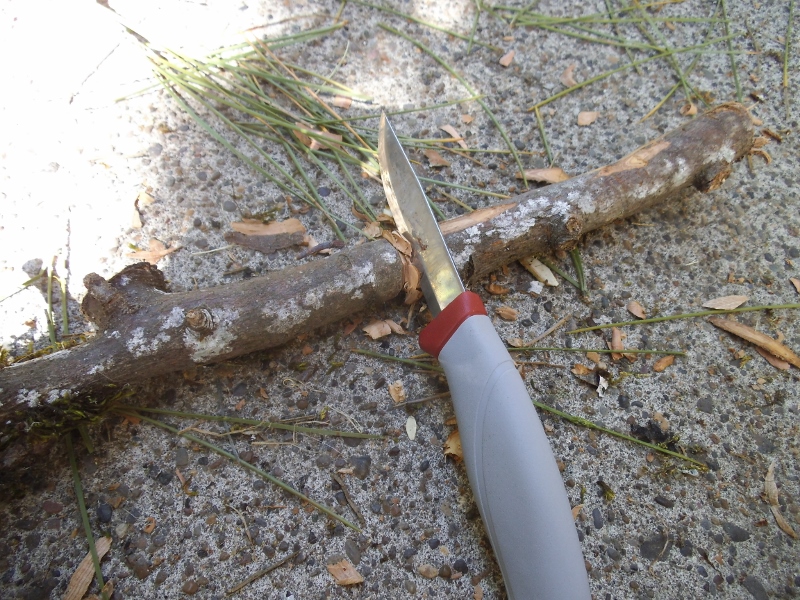
Just a shot of the knife surrounded shavings and evidence of using it.


Summary:

I highly recommend these knives.

If you are looking for a good quality all around knife, and you don't want to pay a lot, this is the knife for you.  Heck, even if you are willing to spend a lot of money, consider picking up a Mora, it might change your mind.  They aren't fancy, they aren't flashy, but they are extremely affordable and very good quality.  Frankly mine is a pleasure to use.

Moras are a great example of a quality tool that you can find for a great price.  And the best part is, you can use it as roughly as you want, since even if you did manage to break the knife you are only out the cost of a couple Big Macs.

Thursday, July 23, 2015

Knife Review: Kershaw Scrambler Review

The Kershaw Scrambler, designed by RJ Martin

Introduction:

The Kershaw Scrambler is a knife that I have had for a while, and I have been meaning to write a review of the knife for months, but I am just finally getting around to actually writing the review up.  A big part of the delay on my part is due to the simple fact that I have no major criticisms of the knife, and even find it aesthetically pleasing, but I find myself feeling ambivalent toward the knife.

The TL;DR review summary:  The Kershaw Scrambler is a well made, aesthetically pleasing knife at an affordable price point.  The assisted opening deployment is possibly the best feeling assisted open I have experienced.  The drawback to the knife is that somehow, in person, this knife seems to scare people, making it problematic for daily carry in mixed company.

The Kershaw Scrambler is designed by the award winning knife maker, RJ Martin.  RJ Martin has won the award for Best Tactical Folder at Blade Show (the biggest industry show, in Atlanta annually).  He has actually won the award on four separate occasions (2007, 2008, 2009, and 2010).  The Scrambler is visually similar to the Q-36 which is the knife that won the award in 2007.  The Scrambler is significantly different knife (swedged blade, framelock, G-10 scale, different steel, etc.), but the design lineage is apparent.  The Scrambler is also available in the $30-40 price range, which is roughly 1/20th of the price of a Q-36.

RJ Martin was an aircraft designer for 17 years, which I think explains why his designs appeal to me on a visual level.  Aircraft design encourages the avoidance of design features that do not serve a function.  This means that the design aesthetics need to be consistent with function.  I do not like a lot of extraneous doo-dads on my knives, and RJ Martin's designs tend to be sleek and fairly minimalist.

Let's Start With the Specs:

From the Kershaw Website

  • SpeedSafe assisted opening
  • Frame lock
  • Flipper
  • Reversible pocketclip (tip-up/tip-down) (This is incorrect, there is no tip down option)
  • Steel: 8Cr13MoV, titanium carbo-nitride coating
  • Handle: Textured G-10/steel bolster front, 410 steel back, titanium carbo nitride coating
  • Blade length: 3.5 in. (8.9 cm)
  • Closed length: 4.4 in. (11.1 cm)
  • Overall length: 7.9 in. (20 cm)
  • Weight: 5.2 oz. (147.4 g)

The weight of this knife is listed as 5.2 oz.  This knife is not a lightweight, but is not a total brick either.  The weight falls into a middle ground for me where it does not feel like I constantly have something tugging my pants down, but I never forget that I have a knife in my pocket.  I'd say that, for me, the weight is not a deal breaker, but it is not a selling point either.  The weight helps provide a solid feeling in the hand, but it is a little more than I ideally like from a folding knife.

The Titanium carbo-nitride (TiCN) coating is a hard wearing coating that has a Vickers hardness in the 3000 range (Diamond is 10,000, Zirconium Nitride is 2800, steel usually falls in the 55-180 range).  This provides a very tough exterior coating that reduces shine and protects against damage.  Additionally, unlike Zirconium Nitride which has a friction coefficient on par with unlubricated steel, TiCN actually has a lower friction coefficient of 0.4 (unlubricated steel is around 0.5, teflon 0.04, and rubber 1-2), which means that the coating actually provides a kind of dry lubrication.  This is handy for slicing tasks since less friction means easier cutting.  I'm not crazy about the darkness of the coating, but it is a functionally excellent choice for a blade coating.

The steel is the perfectly acceptable, often Chinese made, 8Cr13MoV.  The name 8Cr13MoV describes the composition of the steel, 0.8% Carbon, 13% Chromium (which is what makes it stainless), Molybdenum, and Vandium.  8Cr13MoV was supposed to be the Chinese equivalent to 440C steel, but in actual performance is more comparable to 440B or AUS-8.  These are all perfectly respectable stainless steels with good performance, but they are not science-magic-super-steels like some of the other knives I have reviewed.  My experiences with 8Cr13MoV have been positive.  I have had some knives (Kershaw Cryo G-10) where this steel has far exceeded my expectations, but for the most part the edge retention and toughness of this steel has been very good, but not revelatory.

This knife has a flipper tab, which also serves as a finger guard when the knife is open, as it's means of deployment.  There are no thumbstuds on this knife, and it really doesn't need them.


A Note on the Clip:

The Scrambler has a tip up carry clip.  The company specs claim that it is reversible to tip down, but the only pre-drilled holes are for right/left tip up carry.  This means that for practical purposes the knife can be carried in either front pocket (depending on which side you put the clip on), but it is not appropriate for back pocket carry.  It is always a good idea to either carry a folding knife so that the blade would open into a seam in your pocket rather than opening up into the pocket itself, for safety.  If you reach into your pocket and the knife has opened up you can cut yourself badly.  I personally feel that this consideration is especially important when dealing with an assisted opening knife.  The other option is to carry the knife in a sheath.

The clip itself is a standard Kershaw clip.  The retention is adequate.  It is easy to clip on and off from your pocket.  The clip is fairly unobtrusive in the hand, but it does not add to the ergonomics of the handle.

Review:

Steel:

As already described, 8Cr13MoV is a decent steel.  The biggest benefit of this steel is that it is a near optimal value steel.  The steel is a solid performing steel that allows for a good quality knife to be made at a relatively low price.  This means that you can afford to get a knife designed by RJ Martin for around the $30-40 range, and be confident that it will perform well.

Blade Finish:

The TiCN coating replaces any textural finish to the steel.  The steel is stainless, so it doesn't require a coating, but the coating does provide additional scratch resistance and slight lubrication as described earlier.  The dark color of the coating adds to the "tactical" appearance of the knife, which can be either a positive or negative depending on your perspective.

Blade:

The blade shape is sleek and stylish in overall appearance.  The primary bevel is hollow ground, which means that you may want to avoid prying with the edge of your knife.  Of course you shouldn't be prying with the edge of any folding knife, unless you like having a wobbly knife.  The hollow grind makes this knife an effective slicer while allowing for a thick central spine for lateral rigidity and a swedged spine for a diamond shaped cross-section to aid penetration.  This provides a useful balance between tactical design and real world functionality.  The blade is an effective stabber, but also slices things like packing tape effectively.

The hollow grind optimizes slicing for thin things, but not necessarily thick hard things like carrots.  That is why many hunting knives are hollow ground, but most kitchen knives are full flat ground.  The hollow grind allows for a stout blade that slices really well to about a half inch, whereas a full-flat grind is better for a knife that needs to pass fully through things.

The blade edge is very slightly recurved, which looks cool, but can make sharpening the knife a little more challenging.  I did not find the slight recurve to be a significant problem during resharpening, but your mileage may vary.

Handle:

The handle has a sleek appearance.  The back spacer has some file work that adds a neat subtle decorative touch (I actually didn't notice it until I had the knife for about a week).  The G-10 scale on the presentation side provides decent grip, but is not so rough that it would tear up your pocket.  The frame-lock side is a metal frame-lock...  It is what it is.

Locking Mechanism:


The locking mechanism on the Scrambler is a frame lock, which means that one side of the handle is an all metal frame, a portion if which acts as a spring which slides into place holding the blade open.  I purchased this knife specifically because I wanted to try a frame lock.  The frame lock style is quite popular among high end knives (pioneered by the Chris Reeve Sebenza).  This frame lock compares well to other frame locks I have used.  The handle is big enough that your fingers don't interfere with the lock-bar.  The lockup is solid, though the lockup is fairly deep, around 60%.

One of the attractive things about a frame lock is that when you are holding the handle your hand places extra pressure on the lock-bar.  The exposed lock-bar also looks cool.  The thickness of the metal also makes the lock appear and feel very strong.  However, I don't think that the frame lock is actually any stronger than a liner lock since the cut-out where the lock bar is bent is just as thin as a well made liner lock on every knife I have seen.  Ultimately this means that at the likely point of catastrophic failure there is no real difference in strength.  That said, if you are not being stupid with your knife, the point of catastrophic failure is not going to be an issue.

It's a folding knife, use it as such.  If the frame lock apeals to you then this lock is definitely a plus.  I personally am partial to the liner lock because I like to have non-metal handle scales on both sides of my knife.  I don't really like metal handles, which is why I have personally moved away from frame locks for the most part.  But based on the popularity of frame locks I am pretty sure I am in the minority on this topic.

Deployment:

The Scrambler is an assisted opening knife.  That means that when you press on the flipper tab, a spring helps propel the blade to fully open.  Pressure from the lock-bar against the blade keeps the knife from opening by itself, this pressure that needs to be overcome is called the detent.  Your finger pressing on the tab (which is a part of the blade) overcomes the detent and the spring does the rest of the work.

The difference between an assisted opening knife and a switchblade is that a switchblade is activated by pressing a button or switch on the handle.  It's a silly arbitrary distinction, but it is the difference between a knife that is legal most places where people are allowed to carry pocket-knives and an illegal switchblade.  The difference is silly and arbitrary because there is no real difference in function, but the laws against switchblades are silly and arbitrary because the laws were passed essentially because of mid-20th Century hysteria about the scourge of teenaged gangs and movies like "On the Waterfront."  If you want a little more info you can find it here and as a more in depth and entertaining article here.

Out of the assisted opening knives I have used, the Scrambler is the nicest feeling.  I prefer the assisted opening on this knife to assisted opening knives that cost five times as much.  The opening is swift, easy, and smooth.  There is a satisfying authority to the opening, but it does not feel like it wants to jump out of your hand, it's kind of a magic medium.

Fit and Finish:

The fit and finish on this knife are excellent for the price.  I did not find any flaws with the knife.  The blade was centered.  There were no scratches or mistakes on the knife when I got it.  There was no play to the blade (there is a very slight side to side play now after moderately extensive use).  Lockup is good.  I would be happy with the fit and finish quality of this knife if it were four times as expensive easily.  Of course if it were a Chinese made knife that cost four times as much I would expect a super steel and titanium frame, but I am looking at the quality of workmanship, not materials.  The materials are appropriate to the price point, and the workmanship is excellent.

Use Review:

This knife worked quite well whenever I used it.  The blade sliced things well.  The handle is ergonomic and the deployment was quite nice.  Ultimately however, I did not find myself using this knife a lot.

I strongly prefer back pocket carry, which is a big part of why I didn't carry this knife much.  I feel like if the knife had been tip down I would have probably carried it a lot more.

But ultimately what kept me from using and carrying this knife more, and the reason that I feel ambivalent about the knife, is the reactions this knife in particular provokes.  When I would pull this knife out to cut cords or open boxes people would flat out jump sometimes.  When I loaned this knife and the Kershaw Cryo to a friend so that he could try out some different options, he gave me a great quote, "This knife [Cryo], I pull it out and it is a little pocket knife.  This knife [Scrambler] makes children cry."  When I look at the knife it does not seem particularly threatening or over the top tacticool.  But for some reason people act like you just pulled out a chainsaw/machete/uzi when you open it.  It also seems very big in person, even though I have larger knives that do not seem to inspire fear.

My regular EDC knife is the Lone Wolf T2.  The T2 is bigger in all dimensions than the Scrambler.  The T2 has extensive jimping.  And yet for some reason the T2 does not seem to scare people.  Maybe it's because the T2 has wooden handle scales vs. the Scrambler's dark coated blade.  I don't know.

Ultimately, for whatever reason, I got negative reactions when I would use the Scrambler.  I think it is pretty, but it just bugged me too much to have to people scared of my pocket knife.  Some might argue that it is not my problem if people are irrationally scared of my knife, but I prefer to avoid scaring people.  I am a big bearded guy, I prefer to give people as few other reasons to be scared of me as possible.

The knife cuts well.  Sits in the hand well.  It also makes kids cry.

Summary:

So there you have it.  The Scrambler is affordable.  It has a nice level of refinement in an aesthetically pleasing package and it won't break the bank.  It has a handle big enough for a large handed guy like myself, but not a huge handle.  The blade is a very useful length of 3 1/2 inches (though it somehow seems bigger).  The knife feels big and solid, but is not actually terribly large or unusually heavy.

And it scares people.

I don't know why it does.  It is not actually huge.  It doesn't have skulls on it.  It doesn't have extraneous spikes sticking out of it.  There is no reason that I can see for the reactions the knife got when I and my friend carried it.

The quality of the knife is top notch for the price.  It's a good knife.  But if you pull it out to open a letter and people act like you are threatening to go on a rampage for no reason, don't say I didn't warn you.  And that is why I am ultimately ambivalent about the knife.  The knife is very good.  Based solely on knife quality, I would absolutely recommend it.  But considering the rather large size and weight of the knife combined with some people's reactions to the knife, I feel torn.  But you could do a lot worse for the cost.  So if the look of the knife appeals to you, I'd say go for it.


Wednesday, February 25, 2015

Knife Review: Kershaw Cryo G10

The Kershaw Cryo G10.  A really good little knife.
My review of the Kershaw Cryo G10 has recieved a fair amount of traffic since I posted it, so I wanted to update the review, and provide some pictures.

If you want a one sentence review:  This is a good little knife available for a very affordable price.

If you want more, read on.


Background:

I originally bought the Kershaw Cryo G10 (I'll just call it the G10 from here on out) because I was having a hard time getting my hands on a Lone Wolf T1, and the G10 fit a lot of the criteria I wanted for a very affordable price.  The small size of the knife and affordable price makes it a good choice for travelling.  If it get's lost it's not going to be the end of the world.  There is no shortage of varying knife laws around the country and world, but for travelling purposes I think that the 2.5 inch blade on this knife would help avoid legal trouble.

This should not be taken as any kind of official claim regarding knife laws in any jurisdiction.  There are laws in some places against carrying a locking blade.  There are laws against assisted opening knives.  There are laws against carrying any kind of knife in some places.  So be aware of the laws wherever you might travel with a knife.

When I traveled to Easter Island for archaeological work, I read up on what I could find regarding knife laws in Chile (Easter Island is a part of Chile).  In at least Santiago, it is illegal to carry a knife, but small pocket knives are generally given a pass.  I figured that of the various knives I owned at the time, that the G10 would be the least likely to cause any problems.  So for my trip to Easter Island the G10 was my knife, and it ended up performing excellently.

While in Easter Island I needed to prepare my own food, and the knives that were provided were very dull.  I ended up using the G10 for all of my food prep needs as well as normal pocketknife duties.  The G10 turned out ot be a very capable slicer, and the handle was comfortable during extended use.  In terms of a knife for everyday carry (EDC) this knife proved to be capable of everything I threw at it despite its small size.

Specs:

From the Kershaw website
  • Flipper, thumbstud
  • SpeedSafe® assisted opening
  • Frame lock, lock bar stabilizer
  • 4-position deep-carry pocketclip
  • Steel: Stainless steel, stonewashed finish
  • Handle: G-10 front, 410 back, stonewashed finish
  • Blade length: 2.75 in. (7 cm)
  • Closed length: 3.75 in. (9.5 cm)
  • Weight: 3.7 oz. (104.9 g)
The G10 is a version of the Kershaw Cryo that has a G10 (resin reinforced with layered fiberglass) handle scale on the non-locking side.  This provides grippier handle than the all metal construction of the original Cryo.

The knife was designed by Rick Hinderer, and looks like his knives.  It also has his patented lock stabilizer.

The blade material is listed as stainless steel on the Kershaw site, but is described elsewhere as 8Cr13Mov.  I own a few knives with 8Cr13Mov blades, and I have to say that the steel on my G10 has performed better than any of my other 8Cr13Mov knives.

The clip is described as a four position clip, but on my knife at least, there were only two positions pre-drilled.  Right handed tip up or right handed tip down.

The clip is also a deep-carry clip, which can be a problem in some places because almost all of the knife is concealed when it is in your pocket.

Review:

Cons: 

Too short:

Another quarter inch of blade and handle would make this a much better fit for me.  I have pretty big hands, and this does not fill my hand.

Opening Mechanics:

The assisted open seems unnecessary, it also makes the thumbstuds totally superfluous.  The thumbstuds are a hazard on this knife.  They make it harder to get out of your pocket, tear up the pocket, and if you do try to open the knife with the thumbstuds it is very easy to cut your thumb due to the amount of force needed and the small size of the knife.

Semi-con:

Stiff:

Everything about this knife is stiff out of the box, and use doesn’t change that much.  The assisted open is stiff.  The thumbstuds are too stiff to use.  The frame lock is stout and stiff.  But the blade is stiff when deployed.  The stiffness also seems to translate to a solidity when the knife is deployed.  I would ideally like easier deployment, but this is not a big deal on this knife.

After several months of heavy use in a variety of environments the stiffness really has not changed.  This isn't a terribly smooth knife, but as I said, the knife performs just fine.  This is not a $300 knife, it is a knife available for less than $30.  It performs admirably for the price range.


Jimping:

If you've read my blog posts you may have noticed that I have a bit of a fixation on jimping.  I really like the additional grip that good jimping provides, and I like the look of it.  Unfortunately, on the G10, the jimping is pretty much just for looks.  The edges of the jimping on the handle are smooted out, which means that they are easy on the hand, but don't provide any real additional grip.  The jimping on the thumb-ramp of the blade is also pretty smoothed, and does not stand out enough from the handle to provide any use.

The jimping looks good on the knife, but it doesn't really offer any performance.

Pros:

Out of the Box Sharpness:

This knife came literally shaving sharp.  I had been working with trees the day it came in the mail and had some pitch in my arm hair, so I decided to see if the knife would shave off the pitch tangled hairs, it did no problem.

Edge retention and Cutting Ability:

Very good.  I know that 8Cr13Mov is not the most amazing steel, but I have been impressed with its performance on this knife.  After a month of heavy use remained nicely sharp. 

I brought this knife with me to Easter Island since I figured its small size would avoid any legal difficulties for a pocket knife.  I was in a fairly remote location, and the accommodations required we do food prep ourselves, unfortunately all the knives provided were extremely dull, so for several weeks I used this pocket knife to do all of my cooking on top of regular EDC duty.  This knife performed far better than I would have expected.  I had already found the knife to be surprisingly good for field duty, I didn’t think it would be any use for the kitchen, but it performed admirably.  I had not expected to be using this knife so heavily while in Chile, so I was very grateful for how well the edge has stood up to a lot more use than I anticipated.  The edge was not razor sharp after a few weeks, but still significantly sharper than any of the other knives that were available.  It was still sharp enough to handle tomatoes cleanly without serration, I’d call that usably sharp.

The edge stayed very sharp until two days before I left Easter Island.  Two days before I left I barbecued.  The cut of meat I barbecued was a big chunk of beef that had a lot of connective tissue and fascia.  I decided to separate the connective tissue.  Trimming the meat off of the connective tissue puts a lot of wear on an edge, so I was not surprised that it really dulled the knife.  The knife was still sharper than anything else in the kitchen afterward, but it had lost the fine edge.  It still cut a tomato, but with a little squishing.  Still for a knife that I bought for less than $40 I think this was tremendous performance and edge retention.

After I returned home I resharpened the knife.  After only a few minutes I was able to get the knife back to shaving sharpness.  Just a few passes on the fine side of my whetstone and a touch up with a steel, the knife was back to where it started.

So to sum up, excellent performance from the steel, and good cutting mechanics for a variety of uses.

Weight:

Feels nice in the hand, but light in the pocket.  Good for hiking and everyday activities, but with enough heft to feel right for heavier use than its size might indicate.

Lockup:

Solid.  Rock solid.  If you try to use the thumbstuds the lockup can get sticky because it causes the frame lock to engage late, but with the assisted open the lockup is neither too late nor too early.  It’s like Goldi-Locks, just right.

Grip and Jimping:

The G10 scale gives this knife good grippiness.  Sadly the jimping seems to be more decorative than functional.  The jimping on the blade in particular does not stand out sufficiently from the handle and is not sharp enough to provide good grip.  But the blade is short enough that choking up on the blade is not a real issue.  Still, a nice looking satisfyingly grippy handle.


Overall: 

This knife is easily available for around $30 and can be found for less.  The knife is small, with a blade around 2.5 inches, and the handle is proportionate.  The small size means that you can't really get a full hand grip on the knife, but the good ergonomics of the knife make it a very capable tool despite it's small size.  I also think it is a good looking knife.

The G10 is not a perfect knife, but for the price range it is sold at it is a great value.  This knife won't break the bank, and I think you'll be happy with it.