Showing posts with label Presidential Elections. Show all posts

Wednesday, December 7, 2016

Dear Liberals, Stop Saying Pence is Worse Than Trump

Dear Liberals,

Please stop saying that Pence is as bad/worse than Trump.  To put it simply, Pence is a conservative, Trump is a fascist.  If you can't tell the difference then that is a you problem, not a Pence problem.  Yes, Pence is an extreme Religious Conservative, but you know what, conservatives get to win elections too.  If you can't differentiate between a threat to our democracy and a politician you disagree with it makes opposition to Trump come across as sour grapes.

Trump ran on a platform in direct opposition to the Constitution (Here's another better link), in collusion with foreign powers, is a walking conflict of interest, is a threat to the rule of law, and with his reckless belligerency is endangering human life on this planet.  That is not conservative, that is madness, and that is far worse than a very conservative president who acts within the law.  Anything that a President does that leaves the rule of law and our system of government with its checks and balances in place can be undone when the pendulum swings again.  That is how it works.
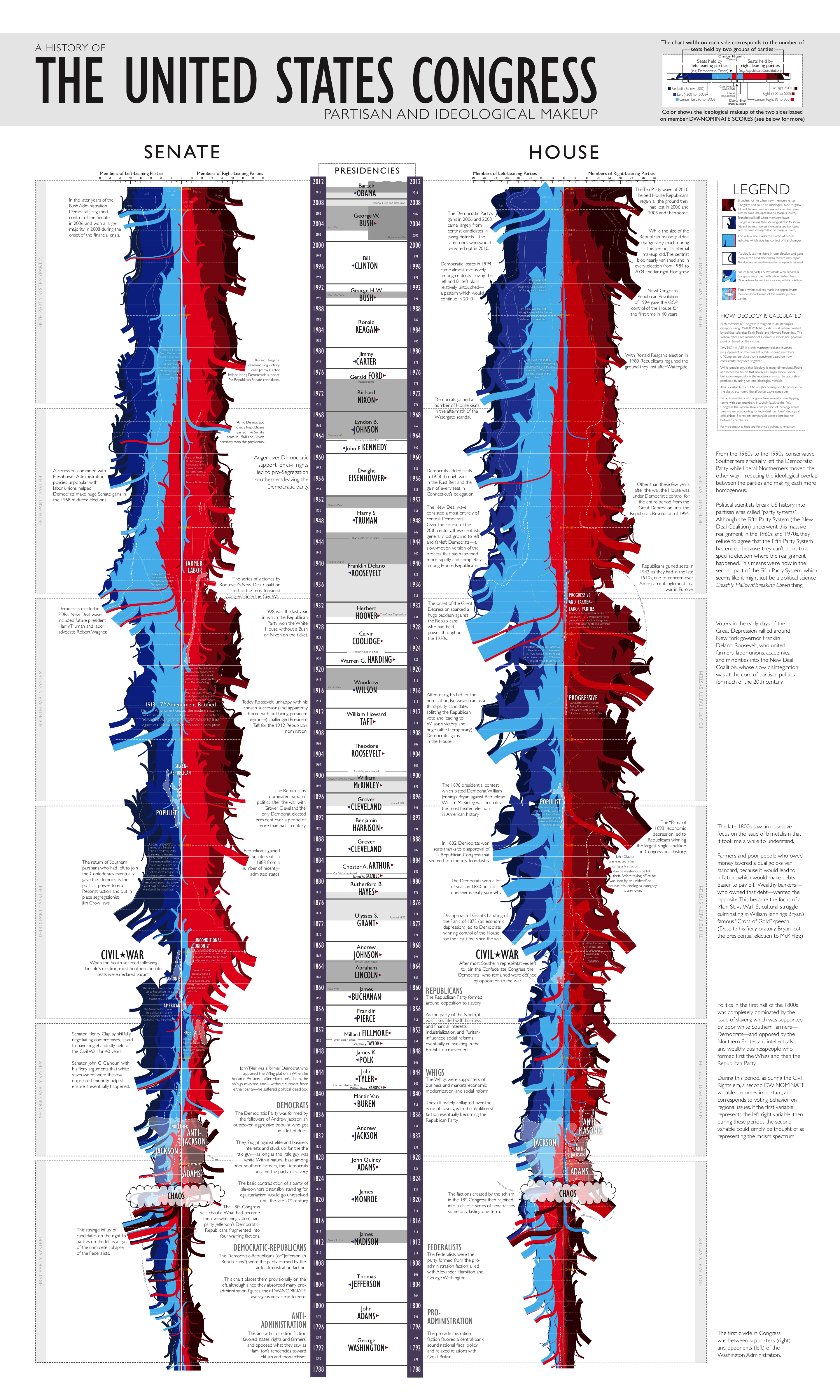
I always try to include a graphic, and this fabulous, detailed and huge infographic by Randall Munroe does an excellent job of capturing the complex, ever-changing ebb and flow of the left-right pendulum swings of our government.
I am not trying to downplay how bad Pence would be for a lot of people, particularly the LGBT community.  Yes, Pence hates gay people, wants to take away their rights to marriage and adoption, and has in the past appeared to support conversion therapy (if you are unfamiliar with conversion therapy, some methods have included electroshock, but I have not found any actual clear unambiguous support of conversion therapy by Pence).  So yes, Pence doesn't like gay people and doesn't think that they deserve or are entitled to equal rights and protections, but Pence is far from alone in this.

It is fortunately true that homophobia is in sharp decline in the US, and the majority of Americans believe in equal rights for homosexuals.  However, there was always going to be hard pushback on gay rights.  If Hillary had won the election it would not have meant that politicians who wanted to deny gay people the right to marry and who wanted to break up non-traditional families were never going to win again.  This was always going to happen, it was just a question of when.  That doesn't mean that the LGBT community should just say "oh well, no problem if you want to take my rights away Mr. Pence," of course the coming assaults on equal rights for all Americans need to be fought, I am simply arguing that you can't fool yourself into thinking that Pence is a wild aberration.

Pence is extremely conservative, but so is the majority of the Republican party (thanks to the ascendance of the Tea Party), and about half of the country is conservative.  And even if it was a smaller portion of the population that was conservative, we have a liberal democracy in this country which is designed to prevent the majority from trampling over the rights and voices of the minority.  We are all used to thinking of groups like African Americans and the LGBT community as minorities, but the Anti-LGBT crowd is actually a minority now, and they still wield significant power.  The same system that keeps anti-gay politicians from rounding up and imprisoning the homosexual minority also keeps the majority of Americans who think that all Americans deserve equal rights from silencing those who want to eradicate homosexuality.

The good news is that the majority of Americans no longer side with people like Pence (on LGBT issues), but the bad news is that anti-gay rhetoric is still very popular among the Republican base, which means it isn't going away.  It is division politics in its clearest form.  By catering to people who hate gays you can win your primary, and then once you have won your primary you have other wedge issues to campaign on to ensure that the unpopularity of homophobia doesn't cost you the election.  Anti-gay politics is not going away until the Republican party breaks from it cleanly, which will fracture the religious vote.  The last time a similar policy pivot was made by a major party was when the Democratic party abandoned segregation.  That shattered Democratic power in the South, and continues to this day, and that Democratic power in the South had been in place since the Civil War.  Decades later the Democratic Party has still not recovered in the South, and the fallout from that decision led to massive changes in the US political system that are still with us today.  This should give you a better idea of why anti-gay politics are not going away.

But I am not trying to convince anyone to support Pence.  I am a centrist, I don't support extremists on either side, and I especially don't support anti-gay politicians.  As far as I am concerned, gay people are human beings; that means that they are entitled to the same rights as anyone else.  I don't really understand how this is a political issue.  But Pence is not "worse than Trump."

If you want to effectively fight the rise of fascism, authoritarianism, and ethnic nationalism in the US then you are going to have to realize that conservative ≠ fascist.  Trump is not the same as other Republicans, and he is not conservative.  If you conflate the two then it means lumping the half of the population (and vast majority of territory) into the same pile.  That "Basket of Deplorables" rhetoric is a big part of what got Trump into office, and if you cannot distinguish between the moral depravity of someone like Steve Bannon and a politician that disagrees with you then it is going to be a very long road back from Trumpism.

I will quote David Frum, a staunchly anti-Trump staunch conservative:


The point of this post is that Trump is not just another conservative, and when you cast conservatives as the same or worse than Trump, then you empower Trump.  More than anything else right now I am struck by how the demonization of political opponents has paved the way for Trump and our scary slide toward authoritarianism.

This didn't start with Trump.  It also didn't start with Obama, but I am going to use Obama to explain why division politics are so dangerous.  Obama came into power on promises to bring change and to undo the authoritarian overreach of Bush II.  Instead, confronted with a steadfastly oppositional legislature, Obama doubled down on the authoritarianism.  Liberals have given him a pass on this since after all, as Benjamin Netanyahu has said to justify his belligerent approach to Palestinians, "there is no one to negotiate with."  When you can just blame the other side for intransigence, any measures taken can be justified.  But politics swing like a pendulum, and when we do not stand up to authoritarianism we invite worse erosion of the rule of law.  You might not have minded Obama's authoritarianism, but his actions have made Trump more dangerous.

Now we need to be clear about what we are opposing when we oppose Trump.  We are not opposing conservative values.  We are opposing fundamentally un-American demagoguery.  We are opposing authoritarianism.  We are opposing fascism.  We are opposing ethnic-nationalism.  We are opposing a short-tempered, corrupt, and unstable politician who will soon have the ability to start nuclear war based on his lack of tact and huffy truculence.

When you say that Pence is worse than Trump you turn all of that into "I don't like Republicans."  Stop it.  You don't have to like Pence, but don't equate him to Trump.

Sincerely,
The Center Gnome
(AKA Jon Krier)


Friday, November 11, 2016

Now Is Not The Time To Run.

I'm not going to tell you that everything is going to be okay.  The chances of everything being okay seem about as good as the proverbial snowball's chance in hell.  Chances are very good that a significant number of Americans (specifically those with serious chronic illnesses) might not survive the next few years of our new government if the protections provided by the ACA are lost.  Chances are good that the families of people I love are going to be torn apart, and that people I care about will lose the right to marry and adopt (I presume that the constitutional protections against retroactive laws will protect the marriages of those already married, but we will see).  The government we have elected campaigned on promises to harm people I love, and that does not even consider the campaign of our presumptive President Elect, Donald Trump.

So no, I can't tell you that everything is going to be okay.  But I do want to tell you not to give up hope.  There is a future, and that future can still be better.

But for that better future to come we will have to stand and fight.

--------------------------------

It has been hard to stay hopeful these last few days.  A man who campaigned on a platform of ethnic nationalism won the US election.  He won that election at a time when unprecedented obstruction by our legislative branch means that he will immediately be able to alter the balance of the Supreme court.  Simultaneously, the Republican party won both the House and the Senate.  This means, in essence, that despite our Constitution's careful system of checks and balances, Donald Trump comes into office with no branch of the government to oppose him.

Trump comes in to power following a campaign that saw unprecedented foreign interference in a US election.  Foreign interference on the part of Russia in support of Donald Trump.

--------------------------------

Long ago, in those far off days of the 1990's the US had a monitoring program set up to keep North Korea from getting nukes in exchange for aid.  It was controversial, but it worked for as long as the US maintained it.  Following the 2000 election, Bush II decided to abandon the monitoring program in favor of stiffer restrictions on North Korea.  Following the 2002 US abandonment of the agreement, North Korea resumed their nuclear program, and in 2006 successfully tested a nuclear warhead.

Today we have a similar monitoring agreement with Iran (which had been on the verge of gaining nuclear capability prior to the agreement) which has kept Iran from gaining nuclear capabilities for the past year.  Donald Trump has promised to violate that agreement.  If Trump keeps his word, then it seems almost certain that we will have a nuclear armed Iran shortly thereafter.

-------------------------------

Talking about Iran and North Korea might seem like a digression, but I bring the issue of nuclear armaments up because I fear that if the US ceases to act as a restriction to Russia's ability to act more openly and violently, particularly against Muslims, that we could end up facing a true clash of civilizations (If you are not familiar with Samuel Huntington's article The Clash of Civilizations? I suggest you familiarize yourself with it).  If that clash does occur, and if it involves nuclear armed nations on both sides, nuclear war is as likely as it has been since the end of the Cold War.

-------------------------------

So how do those of us who value human rights and cultural diversity find hope?  Well I can't speak for you, but I can speak for myself.

My immediate reaction to Trump's victory was to start thinking about moving to Canada.  I know that this seems like a trite bit of hand-wringing, but I am serious.  I am a dual-citizen of the US and Canada, as is my daughter.  I actually can go.  I was motivated in my fear by the shocking rise in antisemitism I have seen in this country over the course of the Trump campaign.  Thousands of years of history also suggest that when ethnic nationalism picks up things get dangerous for Jews.  My immediate thought was that I don't want to wait for our synagogue to get firebombed before I get my family to safety.

But that is a false choice.  There is nowhere far-away enough in this world to protect us from nuclear war.  And even if the people who want to harm my family have been empowered, we are not on Trump's hit-list.  At least not yet.

Not everyone can say that.  My gay friends ARE on the GOP's hit-list.  My chronically ill friends ARE on the GOP's hit-list.  My Muslim friends ARE on Trump's hit-list.  And my Latin American friends and family ARE on Trump's hit-list.

Considering all the people who ARE in harm's way right now, it would be cowardly to run because danger MIGHT come my family's way.

If WWIII happens, then Canada won't be far enough away to protect us.  And if WWIII does not come, then we need to do what we can to protect those who are vulnerable.  In the face of this wave of dehumanization there is no moral choice but to fight.  I spoke to my ex-wife following the election to see if she had plans to move back to Canada.  I think she said it well when she said "There is no running away from this.  Neither do I want to, I think it's better to stay and be the change."

---------------------------------

I can't tell you how to fight just yet.  I am still getting my bearings.  This is an uncomfortable place for me to be.  I have no choice but to consider the GOP the enemy until they repudiate ethnic nationalism.  And with the defeat of Hillary it seems that the liberal wing of the Democratic party is ascendant.  For a centrist like myself who doesn't particularly care for all of Bernie Sander's Democratic Socialism this is extra hard.  Yes, I support human rights, cultural openness, and environmentalism, but I don't really think of those things as political values, I think of those things as human values.  On the things that I do consider political values (economic policies, limited government, gun rights, reproductive rights, etc.) I am a mixture of positions.  There is no political home for me right now.

When it comes to how best to organize from here on out, I am not yet sure.  But I do know that we have to be vigilant, and ready to fight.  We cannot stand by idly when our government moves to harm people in our name.

To end off I will quote my friend Eric:

----------------------------------


P.S. On the topic of people lobbying to try to get Electors to vote unfaithfully.  Yes, I understand that the electoral college was created explicitly to prevent someone like Trump from gaining power, but I feel very strongly that electoral college shenanigans could trigger civil war right now.  Trump is set to harm a lot of people, but open armed conflict in this country would hurt a lot more people.  This feels like a perilous time.  I do not support trying to subvert the electoral system. (I also consider there to be other value in having the Electoral College.  You might not agree, but here is a video that captures what I normally like about the system.)

Tuesday, October 11, 2016

Who Should You Vote For if You Hate Trump AND Clinton? (Especially if you are in Alaska)

Who should you vote for?  It depends...


Mike Rowe makes a good argument in support of the idea that if you cannot be bothered to educate yourself on issues and political worldviews, then perhaps you should not vote.  He argues that voting is a right, like the 2nd Amendment; and, like the 2nd amendment, that right is not a duty.  You are not obligated to own a gun that you do not know how to use, and you are not obligated to vote for leaders whose positions you do not understand.

I take a different view.  It is perhaps not a coincidence that I think that gun safety training should be mandatory for all Americans.  Because I believe that in a country where gun ownership is a right, you have the obligation to gain a functional understanding of what guns are and how they work even if you choose not to own or operate them.  Likewise, I believe that all Americans have an obligation to educate themselves about our political system and to make their voices heard, even if they do not choose to vote for one of the two major party candidates.

Even if your vote goes against mine.

Even if your vote is for someone who can't win.

In fact, especially if your vote is for someone who can't win.


This is probably the image you have of US electoral maps.  The 2004 electoral map that was seared into the American consciousness as the modern normal polarization.  The common phrase in 2004 was the United States of Canada and Jesusland.  For the last quarter century this has essentially been the political partitioning of the USA.  In any given election there has been variation in battlefield states, but the essential shape of the geographic divisions stays pretty stable.  2004 was unusual in having all of the battleground states vote Republican, but this is essentially the electoral world that more than 60% of Americans have known.  If you are under 46 then you have not voted in an election where the outcome was not dictated largely by geographically determined tribalism mixed with a smattering of battleground states.  For most of us, presidential elections have essentially been the urban archipelago against the rest of the country.

Sure, in any given election there are factors that can sway certain individual states.  Bill Clinton was able to swing more Southern States along the Mississippi than subsequent Democrats, but even in 2012's very lopsided electoral victory, the basic shape of the American divide remains visible.


But it wasn't always this way.  The major parties did not always have the luxury of simply having to appeal to fractured demographics.  Once upon a time Politicians tried to persuade the whole county that they were the better candidate.  We used to see electoral maps like:
or

While geography clearly played a role in the 1964 election, it played a much smaller role.

--------------------------------------------

But this doesn't answer the question of who you should vote for, or why.

Obviously, if you feel that one of the two major party candidates truly represents a political philosophy that you support then you should vote for that candidate.  However, since both candidates have majority unfavorable ratings, the chances are very good that you do not feel that either candidate is a good candidate.

(In the interest of full disclosure, I actually do like Hillary Clinton, and I think she is an excellent candidate, as I have written in the past.  However, my personal support of Hillary in this election, and my abhorrence of Trump is not the basis for this post, nor is it tied to the party affiliation of either candidate.)

For a great many Americans pondering the candidates this election, the idea of choosing between the lesser of two evils has never been more extreme.  If, as immortalized in the ERB between Barack Obama and Mitt Romney, the 2012 election was seen as choosing the "shiniest of two turds," the 2016 election is seen by many as choosing between two world devouring devils.  Do you vote for the evil treasonous Killary, or the racist nationalist Drumpf?

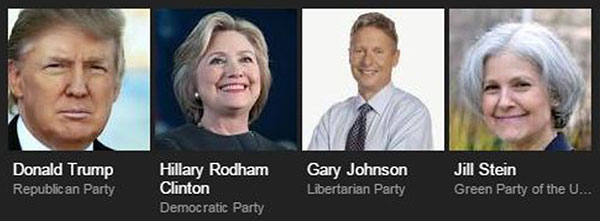
My position is that, if you feel that way, you should vote Libertarian.  It is never wrong to vote your conscience, and if you cannot bring yourself to vote for any of these three options, then feel free to write or vote for the candidate of your choice.  But a vote for Johnson should not be viewed as simply a vote against either of the two main candidates, it can be a vote for a future in which the parties actually have to appeal to the country, not just their bases.

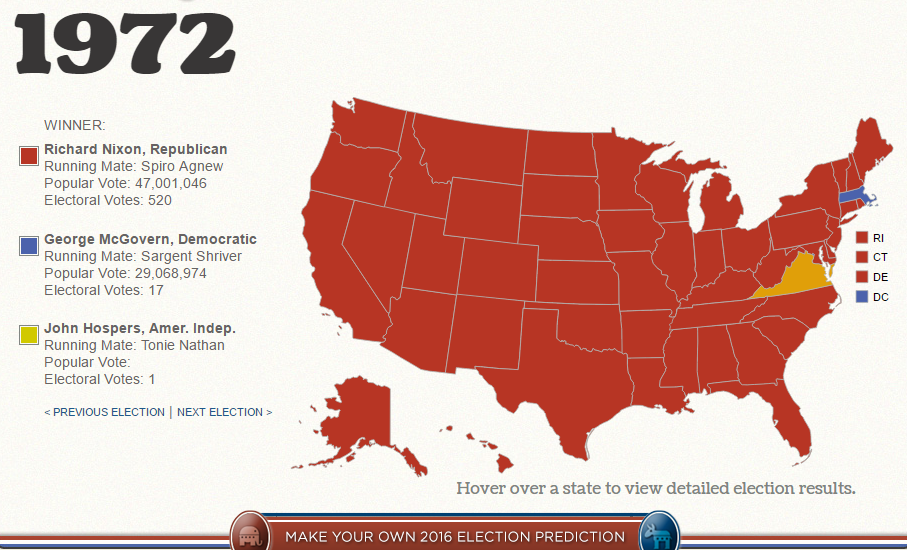
The widespread dissatisfaction with the two main parties is nothing new.  And yet, despite quadrennial griping about choosing between the lesser of two evils, in election after election only two candidates get any electoral votes.  The last time that any third party candidate got an electoral vote was 44 years ago.  And in that election the American Independent Party (AIP) won as many states as the Democratic Party.

(If it is unclear what issue the AIP campaigned on, the 1968 electoral map should make it clear.  The AIP began as a segregationist party working to undo the Civil Rights Movement.)

Both of these maps reveal a very different America from the one we know today.  It should come as no surprise that rapid change in issues surrounding civil rights can cause major instability.  The 1960's were marked by massive social changes and upheaval, and that upheaval marked the last time that large numbers of Americans were angry enough to act against the two party system.

--------------------------------------------------

In a lot of ways we are at a similar point today.  We are a country locked into ongoing expensive foreign wars for opaque reasons.  There is major conflict over civil rights, including friction over extending the definition of who can marry (back then it was about miscegenation rather than gay marriage, but the arguments on both sides were the same).  And then, as now, unrest over police brutality and racism was leading to massive protests and frequent rioting (people opposed to contemporary civil rights reform like to pretend that the 60's civil rights movement was all MLK, sunshine, and rainbows, but that is a patently false misrepresentation).

In the late 1960's neither major party was willing to be the party of segregation and Jim Crow, and so that led to a fracturing and the emergence of the AIP.  Whereas the Republican party has remained steadfastly against Gay Rights, the Equal Rights Amendment, women's reproductive rights, police reform, and addressing racial inequality.  The Republican party has also been trading heavily on anti-Muslim sentiment.  All together this has meant that the even though the Republican elites had maintained a more measured practical stance on governing based on small government and free market they were pandering rhetorically to a socially regressive base.

In this election cycle the decades of divisive rhetoric resulted in the Republican party nominating a candidate who is essentially running on an AIP platform.  In fact, Donald Trump and Pence are in fact the AIP nominees in this election.  Rather than trying to appeal to the majority of the population, the nomination process has become so centered on division politics that the Republican candidate for President is literally the same person as the American Independent Party candidate.

In a political ecosystem dominated by division politics, the extremists determine the shape of the national debate.  Neither party is trying to represent the entire country.  In earlier eras extremist and fringe political movements were the third parties.  Today the major political parties pander to the Fringe elements while trying to actually nominate far more centrist candidates.  The nomination of Trump and the major insurgent movement by Bernie Sanders illustrate the ways that the division politics ecosystem has made political positions that were once fringe into powerful elements of the parties' bases (I am not equating Sanders to Trump, but Sanders as a Democratic Socialist does represent a set of positions far to the left of traditional Democratic nominees for the last 80 years or so).

In the past third parties represented the fringe.  Today the major parties represent the Fringe and no one represents the majority of the population.  Today we need an empowered third party to drive the major parties back to campaigning on governance, rather than on division.  The largest third party in the US is the Libertarian Party.

-------------------------------------

The Libertarian Party is not really very centrist, but if they can capture a significant portion of the vote it could force a more diverse set of voices into US political debate.  The Trump campaign is seriously threatening the cohesion and viability of the GOP.  The Libertarian Platform is in many ways closer to a traditional Republican platform than Trump's platform.  If enough voters abandon the major party candidates it could lead to a fracturing of the Republican party.  I doubt the GOP would be supplanted by the Libertarian Party, but it would necessitate a major shake up.  My hope is that it could lead to a more powerful centrist party.

But the only way that we as a country can get parties that do not campaign based on dividing the country into Balkanized tribes is by forcing a realignment.  The best way to do that is to vote in large numbers for a third party.

Realistically, barring some Earth-shattering revelations the chances of Trump winning are minuscule at this point.  As of the writing of this post, Trump is polling so badly that Arizona is potentially in play as a battleground state, and Arizona has only voted for a Democrat once in the last half century.  A vote for Trump is not realistically a vote against Hillary at this point, it is just a vote for Trump.  But a vote for Johnson is a vote against the system that gave us the choice of Trump or Hillary.

I'll admit that Johnson has not shown himself to be adequately informed or prepared to be President of the United States of America, but I cannot conceive of a scenario that allowed him to win the election.  But if Johnson could win a state it would be a major moment in US political history, and it could loosen the stranglehold of the current political system.

-------------------------------

Why is this particularly important if you are Alaskan?

Alaska has a history of voting heavily for third party candidates.   In 2000 a full 20% of the Alaskan vote was for Nader.  That was 4 times as large a percentage as the closest state.  In current polls Johnson is not far behind the two main candidates in Alaska, and by some polls third party votes might actually be beating Hillary.  Johnson has a real chance to win Alaska.

Alaska is not likely to ever decide a national election, but if Alaska did vote for a third party it would send a very strong message, and it would change the nature of the the 2020 Presidential Race since it would show that third party candidates can win states in modern America.

----------------------------

So to sum up, if you actually support a candidate, vote for that candidate.  If you like Trump, vote for him.  If you like Clinton, vote for her.  If you like Johnson or Stein, vote for them.  But if you are really just angry at the system that gave you Trump and Clinton, I think you should vote for Johnson.