Showing posts with label Guns. Show all posts

Sunday, October 4, 2015

Why Does the US Have the Worst Murder Rate In The Advanced World? It Does Not.

There has been another public mass shooting at a US school.  This time is was in my home state of Oregon.  Immediately afterward everybody fell back to their angry positions, and rather than taking a day or two to process the grief and tragedy of yet another random massacre, the angry yelling of prepared "arguments" began.  I do not want to write about gun control, or gun rights, or terrorism, or enter into the "debate" in any way right now, I merely want to draw attention to a ubiquitous lie founded on racism and prejudice.

-------------------------------

I wish that the focus in the immediate aftermath of a tragedy could be on the lives lost, rather than being an excuse for the angry resumption of cultural debates.  The debate is worth having, but not before we even know how many people are dead.  In this case, not counting the shooter, the number is 9, and each of them has a name and a story.

----------------------------------

The basic outlines of this "debate" should be clear to everyone.  On one side you have the argument for gun control, and on the other you have the argument for gun rights.  But these two basic camps are not representative of the actual arguments that are made by either side.  The majority of Americans may fall into the range of people who want things like universal background checks for gun purchases, along with waiting periods, but the arguments that are made by either side of the debate have nothing to do with the middle ground.  Both sides base their "arguments" on emotional appeals, distortions, half-truths, and outright falsehoods.  This post is about one of those outright falsehoods, the often stated claim that the US is the only "advanced" country where this kind of violence occurs.

The claim that the US is exceptional in its rates of murder/violence/gun-violence comes in a variety of false flavors.  The degree to which the various claims about US gun violence being exceptional among the nations of the world are false varies.  There are the ridiculous claims that should be self evidently absurdly false to anyone, claims like "the US has the highest murder rate in the world."  The US is not even among the top 50% of national murder rates.  But the lie that is being circulated most aggressively right now is the various flavors of the claim that the US has the highest murder rate among advanced countries (other variations include: only country where mass shootings occur regularly, highest rate of gun deaths, highest rate of gun violence, etc.).  The one thing that all of these claims has in common is that the only way that they could be considered true is if you construct a definition of "advanced" (or "developed," or "modern") that defines "advanced" as having a lower gun violence rate.

Fortunately for proponents of this idea, there is an easy group to use for this formulation, NATO (plus Japan).  The term "advanced," as used, means: Majority white, Western European Dominated Culture, preferably a colonial power, and NOT Eastern European (plus Japan).  Any formulation of the definition of "advanced" has to exclude Russia in order to make the statement true, since Russia has fewer guns, strict gun laws, more murders (both by rate AND by total despite having less than half the population of the US), and still has periodic mass shootings.

What would Russia have to do to be considered advanced?  Would it need to have one of the largest economies in the world, Check; one of the most powerful militiaries, check; huge cultural sphere, check; a permanent seat on the UN security council, check.  The list can go on, there is no definition of "advanced" that I can think of other than "Russians don't count" that could exclude Russia while including the US, unless part of the definition of "advanced" is "plays nicely with us."

Of course it goes without saying that "advanced" does not apply to brown people.  Brown people live in places that are for colonization, they are incapable of being advanced.  So Brazil is right out despite having the 8th largest economy in the world (7th largest if you go by Purchasing Power Parity) and being the 5th largest country by population and area.

What I am trying to drive home, is that the term "advanced" as it is used to describe countries, is not based on reality, it is based on prejudice.  Countries we don't like are not considered modern, nor are countries that are non-white.

But what about Japan?  Japan has a murder rate of 0.3 per 100,000 compared to the US 4.7, and they are usually included though they are not white.  This is a case where cross cultural comparisons are not very reliable.  First you have to understand that it is a cultural truth that in Japan all murders are solved, one can simply accept that at face value, or one can ask if perhaps some unknowable number of the suicides (which occur at twice the rate of the US) are in fact unsolved murders.  It seems more likely to me that a combination of lower homicide rate and fudging of official statistics is at play.
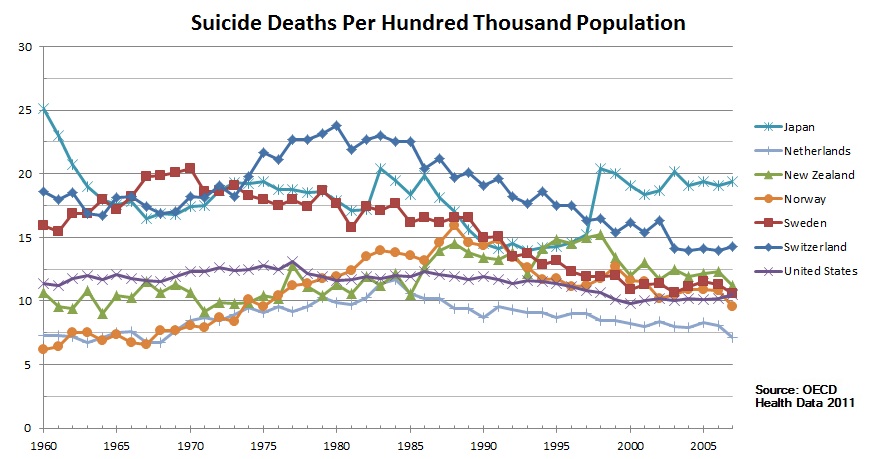
Suicide rates of a few countries

If we combine suicides and homicides the combined rate for Japan is 20.2, the combined rate for the US is 14.8.  Since the majority of gun deaths are suicides in the US, by a 2 to 1 margin, this would be a more honest comparison of the death rates from violence (if we include self harm as violence).

This reveals just a little bit of the complexity of trying to engage in cross cultural comparisons of statistics.  Different cultures organize statistics differently, and different cultures have stronger aversions to different things.  Some countries (*cough* China *cough*) publish official statistics that seem to have no reliable relationship to reality, and others publish numbers that seem fudged.

Some countries, for religious reasons have stronger aversions to suicide.  Mexico is an example of this, they are kind of the inverse of Japan.  Mexico, like most Catholic countries, has a very low suicide rate.  The rate of suicide in Mexico is only 4.4, less than half that of the US.  One can accept that at face value, or one can think that perhaps the true rate of suicide is fudged by lumping ambiguous or unsolved incidents in with murder (combined rate 25.9).

---------------------------------------

Making sweeping global statements about violence is extremely problematic.  Particularly when one tries to make simple cross cultural comparisons of issues that are viewed differently in other cultures.

---------------------------------------

Of course, sometimes direct comparisons are possible.  Some countries, like Canada, are similar enough to the US both culturally, legally, transparency, and in statistical gathering methodology to facilitate direct comparisons.  Canada does have a much lower murder rate than the US, 1.6 to the US' 4.7.  The Canadian suicide rate runs almost identical to the US, 10.2 to the US' 10.1 (this would seem to indicate that the ease of access to guns does not have a strong effect on suicide rates overall, but this is an even murkier subject than the gun/homicide link.  I would not advise trying to draw conclusions).  So we can see that even when we combine suicide and homicide, Canada does significantly better than the US.

Which brings me to my last point.  Don't read this as a blanket argument against having a meaningful discussion about gun-control or the role of violence in our society.  We should be trying to improve.  We do have a problem.  But propagating lies does not help the discussion, it simply exacerbates the Balkanization of positions on this issue.

Let's be clear here.  The Umpqua shooting did not take place in a "Gun Free Zone," because Oregon colleges cannot legally be "Gun Free Zones."  The pro-gun claims that this is the result of gun prohibition are every bit as false as the "advanced country" bit.

But this article is not an attempt to address gun control in the US, nor is it an attempt to address violence in the US.  It is simply an attempt to call out a pervasive falsehood.

Sunday, June 29, 2014

Who is Going to Kill You? A Statistical Examination: Part I

If you get killed, who will kill you?

Let’s start this off by saying that if you die for some reason other than old age or illness then statistically you are not going to be murdered.  Overall, if you die of injuries, you are going to die in a car.  It shouldn't come as a surprise that activities you engage in frequently are more likely to end up going horribly wrong.  Cars are very dangerous, but we use them every day.  We hurtle along at speeds far in excess of what our bodies can withstand in metal contraptions weighing thousands of pounds.  We are driving in various states of competence, experience, and impairment with thousands of other people of varying rates of competence, experience, and impairment.  These heavy metal contraptions we hurtle along in are stuffed full of explosives, and contain plenty of flammable material.  But despite the undeniable danger we place ourselves in every time we get in a car or walk near cars they aren't that scary.

But why aren't cars that scary?  Statistically a car is going to kill you.  I would argue that we aren't scared of cars because we are familiar enough with them that we are able to see that even though they are dangerous a car probably won’t kill us right now.  Because we know that cars are not waiting outside our doors to kill us we tend to underestimate just how dangerous they are, but that is just how our minds work.  Familiar daily dangers seem less scary than the dangers that seem to come out of nowhere.

(This entry is really just a digest of this interesting chart http://www.cdc.gov/injury/wisqars/pdf/10LCID_Unintentional_Deaths_2010-a.pdf)

Now, you might think that “OK, cars are going to kill me, but right after that it has to be crazed gunmen killing indiscriminately.”  Nope.  After cars comes unintentional poisoning.  If you are between the ages of 25 and 64 you are actually more likely to die of poisoning than cars!  Before age 24 cars are number one, and after age 65 the number one cause of accidental injury death is falling down.  “Falling down might kill old people, but what about me?”  You ask.  Well, falls are the number three killer. 

At this point I think it would behoove us to look at numbers.  The numbers I’m using are not rates, they are totals from 2010.  The numbers were provided by the CDC.  The numbers do not include illness.  They numbers are for “unintentional injury death,” though I’m not sure what definition of “unintentional” is being used since suicide and homicide certainly seem intentional to me.  The number for motor vehicle deaths in 2010 was 33,687, and the numbers for unintentional poisoning were 33,041.  Considering that we live in a country of 300 million, the difference there seems pretty negligible.  For unintentional falls the number is 26,009.  So here we see a significant drop of over 9,000 from the previous total.  But this number is actually misleading since 21,649 of those falls were by the over 65 crowd.  So I guess you could say, that even though falls are number three, if you are under 65 falls probably aren't that big of a risk to you.
Onto number four, Suicide with a firearm.  19,392. 

(Before we go any further I want to point out that suicide is divided up by mechanism.  Homicide is as well.  This entry will not go fully into the significance of this, but as we continue on with this series I will examine mechanism of homicide more in depth.  I think it is important.)

Number five, Homicide with a firearm.  11,078.  We finally get to killing, but you might have noticed that suicide is almost twice as common as homicide.  In fact the numbers for gun deaths (http://www.cdc.gov/nchs/data/nvsr/nvsr61/nvsr61_04.pdf) are ~60% are suicides and ~35% are homicides.  Of the remainder ~3% are accidents, and a good chunk of what’s left are “legal interventions.”  If you get killed by a police officer it doesn't count as a homicide, it’s a legal intervention (I have a whole tangent I’d like to go on here, but I’ll spare you).

Do you know what the next two are?  Suicide and Suicide.  Suicide by suffocation (if you’re trying to figure out how people commit suicide with a pillow, try thinking hanging or jumping off a bridge), at 9,493; and Suicide by Poisoning, at 6,599.

If you want to know what the last three of the top ten injury deaths are they are:  Unintentional suffocation, 6,165 (3,400 are the over 65’s); Unintentional unspecified, 5,688 (4,596 are the over 65’s); and Unintentional drowning, 3,782.  Homicide by means other than guns is not in the top ten for the overall population, though if you look at the chart you can see that other forms do pop up for certain age groups.
Now you might have noticed something.  If you add up the top three methods of suicide the total is 35,484.   That’s more than cars.  That means that you are more than three times as likely to kill yourself as you are to be killed by an assailant with a gun.  320% more likely in fact.

You are more likely to be killed by a car than by any other mechanism, but cars have no agency.  Your car doesn't want you dead, it’s just a thing.

But the numbers show that there is a killer stalking you.  When we think about dying we often think about “who” more than “what.”  Suicide is more likely than other forms of injury death.  And most accidents are going to be things that you cause for yourself.  Who is going to kill you?  You are.


Statistically speaking anyway.

Thursday, June 26, 2014

Guns Kill Twice as Many Kids as Cancer, and Swimming Pools Kill Ten Times as Many Kids as Guns

One of the constant wedge issue conversations I get drawn into is gun violence and gun regulation.  As an unabashed gun rights advocate I definitely tend to end up siding with Conservative voices on this topic, but it bugs me that this issue has been turned into a Left/Right issue when I don’t think it is at all.

(As and aside:  Every time I write or hear the phrase “gun rights” my first response is a mental giggle and the thought “civilians aren’t allowed to own artillery pieces.”  I know that the colloquial usage of gun refers to any projectile firearm using explosives for propellant, but the military uses rather different definitions.  Definitions are important, and advocates on both sides of the debate deliberately skew the meanings of the words they use.)

With this entry I wanted to start weighing in on the gun debate, but I have way too much to say on the topic to encompass it all in a single post.  So this will be a topic that I will return to frequently.  Not the least because it is inextricable from a large number of related topics like violence, rights, self-defense, paranoia, demonization (or otherization) of groups, racism, inequality, differing ways of life, urban-rural divides, and a pronounced failure of our educational system in this country.

The particular failure of our educational system that I am going to focus on in this article is a lack of understanding of statistics.  This goes right in hand with the lack of scientific literacy our educational system produces.  Now, I am not claiming to be a statistical wiz, but I do want to promote a more critical attitude toward the reading of statistics.

An excellent example of the emotionally appealing, but misleading use of statistics is captured in an anti-gun image that I saw recently.  The picture was of a little blond girl holding a stuffed animal and a revolver with the caption “Guns kill twice as many kids as cancer.”  This may be true.  Since there was no source provided for the “statistic” it is hard to directly evaluate, but we can simply accept that the number is accurate for some given definitions of “guns,” “kids,” and “cancer.”  But the image and caption itself are very misleading, and so this blog entry is focused on looking at the idea that is presented by the image and the reality of what the image is claiming.

This is a great example of a statement that is true, but misleading.  Guns kill twice as many kids as cancer…  And swimming pools kill ten times as many kids as guns! (at least during ages 1-4, after that it's mostly cars).  The appeal of the claim is emotional, because everyone knows that cancer is a major killer in our society, so the idea that guns could be killing twice as many kids as cancer is horrifying.  But childhood cancers are very rare.  The rate of childhood cancer in 2003 was 14.8 per 100,000.  That equates to roughly 0.015% of children get cancer.  Of those children who get cancer a little over 10% die.  So let’s call that a rate of 1.5 per 100,000, or a 0.0015% chance that a given child will die of cancer.  That would mean that there is a 0.003% chance that an average child will die of a gun.  That actually seems a bit low to me, but that would be the claim made by the image.  (Links for this paragraph below)

Now, what I said about swimming pools is true.  Swimming pools kill a lot of kids.  But the primary time that they kill kids is when they are small.  The primary time that guns kill minors is when they are adolescents.  If you make it 0-19 and include suicide with a firearm and homicide with a firearm, then drowning kills half as many minors as firearms. Firearms are even responsible for 3/4 as many deaths as cars for 0-19's and almost twice as many as SIDS. http://www.childdeathreview.org/nationalchildmortalitydata.htm

            If you want to see something really horrible and soul crushing look at this infosheet http://www.childrenssafetynetwork.org/sites/childrenssafetynetwork.org/files/UnitedStates2012FactSheet.pdf
 It makes it pretty clear that being Native is probably the biggest risk for early death by accident or suicide. And that by age 15 death by homicide is a third as likely as all forms of accidental death for all groups, which is very scary. The sheet doesn't include ethnicity info for homicide unfortunately, but if it did that would also tell a very sad story.

           The issues facing Natives are also true in Canada, but in Canada the difference between native and non-native rates is even more striking.  Since Native rates in Canada are comparable to the rates for Natives in the US, but not for non-natives.  For the rest of Canadians rates of death from accidents and homicide are way lower. I was a little surprised while watching the news this week in Canada that alcohol related driving deaths in Canada are 1/20 of the US, even though Canada has 1/10 the population. Even when it comes to drunk driving Canadians do twice as well as the US.

            But this blog entry is about guns, and people usually think about homicide (which is 35% of "gun deaths") when they think about guns.  Here we go, for youth homicide it's actually not worst to be Native in the US…  http://www.cdc.gov/violenceprevention/youthviolence/stats_at-a_glance/hr_age-race.html

           If you break it down by mechanism it's even more dramatic. If you're young and white you're twice as likely to die of firearms than knives or other means, if you're Native chances are about even for guns and other forms, but if you're black you are 1125% more likely to die of gun violence than other forms of homicide. http://www.cdc.gov/.../you.../stats_at-a_glance/hr_male.html

           Here is an interesting article. Even though homicide is at one of the lowest historical rates in the US the reduction in homicide has not been uniform. Reduction in gun homicide has been slower than for other mechanisms, slower for males than females, and slowest for blacks. So if you are a white female you are safer from being stabbed or beaten to death than ever, but if you are a black male then you're shit outta luck http://www.cdc.gov/mmwr/preview/mmwrhtml/mm6227a1.htm

So when we look at the image that inspired this post, the image is of a little blond girl.  It suggests that little white girls are in serious danger from guns.  But the statistics do not bear that out.  One can assume well-meaning behind the use of a white girl and suppose that the idea was simply to present a child of the majority ethnicity when talking about gun deaths.  Or one could take a more cynical view and assume that the person who made the image assumes that people are not going to react as strongly to an image of a black boy.


I’ll write more on this topic, but this is a start.  This entry is already too long and rambling.  I’ll try to write more focused entries going forward.