Showing posts with label Islam. Show all posts

Friday, November 11, 2016

Now Is Not The Time To Run.

I'm not going to tell you that everything is going to be okay.  The chances of everything being okay seem about as good as the proverbial snowball's chance in hell.  Chances are very good that a significant number of Americans (specifically those with serious chronic illnesses) might not survive the next few years of our new government if the protections provided by the ACA are lost.  Chances are good that the families of people I love are going to be torn apart, and that people I care about will lose the right to marry and adopt (I presume that the constitutional protections against retroactive laws will protect the marriages of those already married, but we will see).  The government we have elected campaigned on promises to harm people I love, and that does not even consider the campaign of our presumptive President Elect, Donald Trump.

So no, I can't tell you that everything is going to be okay.  But I do want to tell you not to give up hope.  There is a future, and that future can still be better.

But for that better future to come we will have to stand and fight.

--------------------------------

It has been hard to stay hopeful these last few days.  A man who campaigned on a platform of ethnic nationalism won the US election.  He won that election at a time when unprecedented obstruction by our legislative branch means that he will immediately be able to alter the balance of the Supreme court.  Simultaneously, the Republican party won both the House and the Senate.  This means, in essence, that despite our Constitution's careful system of checks and balances, Donald Trump comes into office with no branch of the government to oppose him.

Trump comes in to power following a campaign that saw unprecedented foreign interference in a US election.  Foreign interference on the part of Russia in support of Donald Trump.

--------------------------------

Long ago, in those far off days of the 1990's the US had a monitoring program set up to keep North Korea from getting nukes in exchange for aid.  It was controversial, but it worked for as long as the US maintained it.  Following the 2000 election, Bush II decided to abandon the monitoring program in favor of stiffer restrictions on North Korea.  Following the 2002 US abandonment of the agreement, North Korea resumed their nuclear program, and in 2006 successfully tested a nuclear warhead.

Today we have a similar monitoring agreement with Iran (which had been on the verge of gaining nuclear capability prior to the agreement) which has kept Iran from gaining nuclear capabilities for the past year.  Donald Trump has promised to violate that agreement.  If Trump keeps his word, then it seems almost certain that we will have a nuclear armed Iran shortly thereafter.

-------------------------------

Talking about Iran and North Korea might seem like a digression, but I bring the issue of nuclear armaments up because I fear that if the US ceases to act as a restriction to Russia's ability to act more openly and violently, particularly against Muslims, that we could end up facing a true clash of civilizations (If you are not familiar with Samuel Huntington's article The Clash of Civilizations? I suggest you familiarize yourself with it).  If that clash does occur, and if it involves nuclear armed nations on both sides, nuclear war is as likely as it has been since the end of the Cold War.

-------------------------------

So how do those of us who value human rights and cultural diversity find hope?  Well I can't speak for you, but I can speak for myself.

My immediate reaction to Trump's victory was to start thinking about moving to Canada.  I know that this seems like a trite bit of hand-wringing, but I am serious.  I am a dual-citizen of the US and Canada, as is my daughter.  I actually can go.  I was motivated in my fear by the shocking rise in antisemitism I have seen in this country over the course of the Trump campaign.  Thousands of years of history also suggest that when ethnic nationalism picks up things get dangerous for Jews.  My immediate thought was that I don't want to wait for our synagogue to get firebombed before I get my family to safety.

But that is a false choice.  There is nowhere far-away enough in this world to protect us from nuclear war.  And even if the people who want to harm my family have been empowered, we are not on Trump's hit-list.  At least not yet.

Not everyone can say that.  My gay friends ARE on the GOP's hit-list.  My chronically ill friends ARE on the GOP's hit-list.  My Muslim friends ARE on Trump's hit-list.  And my Latin American friends and family ARE on Trump's hit-list.

Considering all the people who ARE in harm's way right now, it would be cowardly to run because danger MIGHT come my family's way.

If WWIII happens, then Canada won't be far enough away to protect us.  And if WWIII does not come, then we need to do what we can to protect those who are vulnerable.  In the face of this wave of dehumanization there is no moral choice but to fight.  I spoke to my ex-wife following the election to see if she had plans to move back to Canada.  I think she said it well when she said "There is no running away from this.  Neither do I want to, I think it's better to stay and be the change."

---------------------------------

I can't tell you how to fight just yet.  I am still getting my bearings.  This is an uncomfortable place for me to be.  I have no choice but to consider the GOP the enemy until they repudiate ethnic nationalism.  And with the defeat of Hillary it seems that the liberal wing of the Democratic party is ascendant.  For a centrist like myself who doesn't particularly care for all of Bernie Sander's Democratic Socialism this is extra hard.  Yes, I support human rights, cultural openness, and environmentalism, but I don't really think of those things as political values, I think of those things as human values.  On the things that I do consider political values (economic policies, limited government, gun rights, reproductive rights, etc.) I am a mixture of positions.  There is no political home for me right now.

When it comes to how best to organize from here on out, I am not yet sure.  But I do know that we have to be vigilant, and ready to fight.  We cannot stand by idly when our government moves to harm people in our name.

To end off I will quote my friend Eric:

----------------------------------


P.S. On the topic of people lobbying to try to get Electors to vote unfaithfully.  Yes, I understand that the electoral college was created explicitly to prevent someone like Trump from gaining power, but I feel very strongly that electoral college shenanigans could trigger civil war right now.  Trump is set to harm a lot of people, but open armed conflict in this country would hurt a lot more people.  This feels like a perilous time.  I do not support trying to subvert the electoral system. (I also consider there to be other value in having the Electoral College.  You might not agree, but here is a video that captures what I normally like about the system.)

Monday, October 31, 2016

Why I Can No Longer Morally Justify Voting for Republican Candidates

I usually avoid really sharply partisan posts in this blog, but I feel like I have something to say.  Plus, at this point, everybody has their mind made up about the Presidential Race.  I don't imagine I will change any minds, but I have things I want to say.

--------------------------------------

It seems like there have been a lot of things that have upset me lately.  It makes it hard to figure out what I want to write about when everything just seems to pile onto the mass of anger and sorrow I have been feeling.  The acquittal of the Malheur Occupiers a few days ago certainly triggered a major surge of anger for me.  The idea that armed occupiers who had seized control of the wildlife refuge for 40 days, while damaging public property, stealing government equipment, damaging archaeological sites, and interfering with curated archaeological materials, all while publicly documenting their actions and publicly proclaiming their intention to permanently take control of the refuge away from the government could somehow be found innocent by a jury of their peers boggles my mind.  When the handling of the Malheur Occupiers and their subsequent exoneration is compared with the ongoing #NoDAPL protests and the stunning relative lack of media coverage as hundreds are arrested while trying to protect water and cultural sites the irony takes on the aura of a surreal caricaturization of injustice rooted in institutional and individual racism.

The acquittal of the Malheur Occupiers makes me question the integrity of our legal system.

Have the forces of division and disunity in our culture become so pervasive that even the matter of guilt in the commission of publicly documented crimes can be denied by a jury?  It's as if the nature of reality is a partisan construct.  That is the only way I can understand the verdict.

The in-your-face racism of the response to the Dakota Access Pipeline protests makes me question whether our culture is progressing to a more racially equal society.

The apparent lack of interest among those outside of indigenous circles, the brutality with which the protesters are being treated, and even the (unsubstantiated) law enforcement claims that the protesters have been doing things like shooting arrows at helicopters is amazing.  The worst part is that the total lack of real media coverage means that all that can be known about the situation is essentially competing unsubstantiated claims and social media memes.

---------------------------------

But I think that the crescendo of anger, sorrow, and frustration that I have felt over the last few days was not just in response to the news, it was also rooted in a deeply personal space that may seem strange to some of my readers: For the first time in my voting life I did not vote for any Republicans.

I'm sure that for many people that would not feel like a cause for sorrow, but for me it is.  I couldn't bring myself to vote just for Democrats, but I feel that there is no morally justifiable way to vote for Republicans at this point.  Even as the Republican party has steadily lurched toward Constitution shredding institutionalized corporatocracy while flogging the pony of theocracy, I have been able to feel like there were enough individual Republicans trying to do good work for good reasons, that I could justify voting for individual Republicans.  But this election cycle has changed that for me.

Growing up, and throughout my young adulthood I always thought of the GOP as the grown-up party.  Yes, I disliked the explicit linkage of Christianity and politics (particularly linking Christianity with economic and social policies that are the diametric opposites of those espoused by Jesus), but I believed (and still believe) that empowered individuals, limited government, and personal responsibility are fundamental keys to a free society.  And I think that freedom is a virtue.  Despite the cleaving of the GOP to Evangelical Christianity, I still thought of the GOP as the party of limited government, prudence, and personal responsibility.  So even though I am a centrist, and have never been totally on board with modern Republican planks, I retained a fondness and partiality to the Republican party.  I'm not a conservative, but there are certainly conservative values that I feel at least partial agreement with.  If you want to understand the kind of conservatism I value, this article by Russell Kirk is a good example.

That was why the George W. Bush years felt like such a betrayal.  It wouldn't have felt like a betrayal for the Democrats to shred the Constitution, engage in wars of aggressive choice, and tolerate massive graft because that would have been more in line with what I would have expected from the party of Tammany Hall.  But from the Republicans it felt even worse.  Still, I could vote for individual Republicans.  I looked at people like Senator McCain and thought, there are still principled Republicans committed to good governance who understand the need for compromise.

Then I felt deep conflict in 2008 when the candidate I had wanted for president in 2000, McCain, finally got his chance.  But I felt that the leadership of the Republicans had taken the country into dire straits, and I wanted a regime change.  Sadly, Clinton did not win the 2008 nomination, but I was sure that Obama would still be better than four more years of Republican evisceration of the Constitution, rampant secrecy, and executive overreach.  After all, he promised to be more open, to pursue compromise, and to close Guantanamo.

In 2008, for the first time ever, I voted for a major party candidate for President of the United States of America.  I voted for Obama.  For change.  Instead I got Obama.  Who did not close Guantanamo.  Who did not curtail executive overreach, but instead doubled down on signing statements and executive actions.  Who did not govern more openly, but instead became the most secretive president in history.  Who did not rein in the transgressions against the rights of US citizens and shredding of the Constitution represented by the Patriot Act.  Who did not end the practice of Presidents waging unending wars at the sole discretion of the executive against nations that do not threaten us, instead he broadened the unilateral war making of Bush II into new countries and added assassination via drone to the US arsenal.  In short, Obama doubled down on everything that I had hated about Bush II.

But it didn't feel quite like a betrayal the same way.  In 2012, when the GOP nominated a candidate that promised no improvement on anything I cared about, reactive rollbacks of social liberties, and an even more irresponsible economic policy, I returned to my roots and voted for Johnson (Libertarian, my usual POTUS vote).

Yet I was unprepared for the 2016 primaries.  To make a long story short, the 2016 Republican field was narrowed down to a choice between a toddler and a fascist.  Cruz's whole platform is that he won't cooperate with anyone and he doesn't compromise.  That isn't conservatism, that is being a toddler.  I have a toddler at home, I know what I am talking about.

Then there was Trump.  Surely Trump had no chance.  This was America.  We fought against people who proposed ethnic cleansing as government policy.  We stood for religious freedom.  We stood for democracy and decorum.  We were the moral compass, the shining city on a hill.  We were America, and America was exceptional.  There is no way that the GOP could ever nominate a candidate who stood in opposition to every value I had ever associated with American virtue.

----------------------------------

The nomination of Trump has shaken my belief in American exceptionalism.

If a man like Trump could become a major party candidate then the US was not exceptional.  We have no moral core to our beliefs that keeps us from becoming endlessly debased, corrupt, and violent.  Could it really be true that there is no moral and spiritual core to the American people that makes us any better than the forces of authoritarianism, totalitarianism, and ethnic nationalism we once fought so hard against?

----------------------------------

I am not quite ready to abandon the idea of American Exceptionalism.  I still believe in the values of freedom, democracy, and personal liberty, and I still believe that the US has a singular importance in promoting those values and opportunities for all of humanity.  Let's be clear, I don't believe that the US has ever lived up to those values fully.  Nor do I believe that other nations are incapable of such values or leadership.  But I do believe that the US has had a unique spirit of always trying to perfect our union.  A spirit of always trying to live up to our values.

Because I do not think that the values that we must try to achieve are truly achievable.  Perfect freedom, equality, democracy, and personal liberty are ideals we strive for.  But one of the keys to truly becoming better, as individuals or as a country, is to always have our guiding principles be aspirational.  If you can actually live up to your own standards, then there is no room to improve yourself.  You cannot become better than what you are unless you accept your own imperfection and then try to improve your flaws.  Your reach must always exceed your grasp if you want to become better.

And that is what I feel is the truly exceptional and uniquely American value that makes us exceptional, our reach.

The very first line of the US Constitution is "We the People of the United States, in Order to form a more perfect Union..."

(The full Preamble: We the People of the United States, in Order to form a more perfect Union, establish Justice, insure domestic Tranquility, provide for the common defence, promote the general Welfare, and secure the Blessings of Liberty to ourselves and our Posterity, do ordain and establish this Constitution for the United States of America.)

The first line of the founding document of our government and nation is a statement of a People reaching for the ungraspable.

You cannot make things better unless you first acknowledge that they are not perfect.  This means on the one hand that hypocrisy is essential to improvement.  We cannot demand moral perfection as a prerequisite of those trying to make things better.  That also means that denying problems is an obstacle to the betterment of our society.  You can't fight racism if you deny it exists.  You cannot repair the relationship between the public and the police if you deny that there are problems on both sides.  And you can't improve the public's relationship with the government if you deny the need for a government.

That for me is the heart of American Exceptionalism, and that is what I have believed has made our nation great.  It is not wealth or military might that makes America great.  It is not even, as Hillary likes to say, our goodness.  What makes America great is constantly trying to be better than we are.  That means that it is our patriotic duty to acknowledge our imperfections, but the belief that we CAN be better is what allows us to in fact become better.

-------------------------------------

Donald Trump does not believe in American Exceptionalism.  He is not alone.  I have many friends and colleagues who no not believe in American exceptionalism.  In fact I expect that I will catch a lot of flack from my Anthropological peers for defending the idea.  But I do believe that the US is special, and historically, the political home of that belief has been the Republican Party.

But no more.  The GOP has nominated a candidate who disbelieves in the greatness of our society.

Donald Trump wants to bar Muslims from entering the country.  He wants to bar almost a quarter of the world's population from the US.  That is clearly in direct contravention of the first line of the first amendment: "Congress shall make no law respecting an establishment of religion, or prohibiting the free exercise thereof."  The US certainly does not have a spotless record when it comes to freedom of religion, but to my knowledge Trump is the first candidate to run on a platform that includes doing away with the First Amendment protection of religious liberty.

But that is not what scares me most about Trump.  Trump's promotion of ethnic nationalism scares me much more, and that starts with another constitutional amendment that Trump wants to do away with, the 14th amendment.  The first line of that one is "All persons born or naturalized in the United States, and subject to the jurisdiction thereof, are citizens of the United States and of the State wherein they reside."  Trump wants to get rid of birthright citizenship.  The worst part is that this is not just Trump, it seems that much of the Republican party has decided that American-ness is an ethnically derived quality.  Just witness the rhetoric around the idea of an "Anchor Baby."  The very concept of an anchor baby is that such children are not true Americans.  In an immigrant nation that is a pretty astounding claim.  If that idea had held currency in the past then no one who is not of Native American ancestry would be a real American.  The idea that there is some group that can be considered "real Americans" is the very heart of ethnic nationalism.

Nationalism is the idea that a nation is made up of a people (As opposed to being made up of people).  A separate, defined people, different from all others in the world.  For example, the Jewish People, the Ethiopian People, the German People, the Chinese People, etc.  The idea is that each of these peoples should have their own country independent of other people.  In order for there to be "real Americans," rather than just American citizens, it means that there has to be a distinct people who make up the entirety of the American People, and that those American People have the right to exclude all others from the nation.

For an example of this idea in action, consider Trump's claim that a US born judge was incapable of judging him fairly because he was a Mexican.  Trump believed that the ancestry of the judge precluded him from being an American.

But Trump does not simply stop at the promotion of ethnic nationalism.  What I find scariest about Trump is that he actively promotes ethnic cleansing, and his supporters love him for it.

Make no mistake, when you claim that Mexican is an ethnicity that is not American, and then you call for a force to be created dedicated to the rounding up and deportation of "illegals" you are calling for ethnic cleansing.  There is no two ways about it.  And there is no moral justification for ethnic cleansing.

--------------------------------------

When Trump calls for a wall between the US and Mexico, he is calling for a physical manifestation of the other-ness of Mexicans.  A physical proof that those people belong on that side, and we belong on this side.

When he calls for a halt to Muslims entering the US, he is calling for an explicitly religious partitioning of humanity.  And he is making the claim that Americans inherently cannot be Muslim.

When Trump says that he will make "America Great Again" he is arguing that the root of America's greatness is ethnic in nature.  That there is something in the American ethnicity that has been contaminated and debased by immigrants and Muslims.  And he is arguing that the way to restore American greatness is through cleansing America of those ethnic contaminants.

------------------------------------

Of course, no scapegoating ethnic-nationalist ethos is ever satisfied with just labeling people as others.  The world is full of examples of what happens when ethnic-nationalists come to power.  In the US we tend to go straight to Nazis, but they are far from the only group to engage in ethnic cleansing, even limiting ourselves to the 20th century we have examples all over the world.  There is no continent or religion that has been immune to nationalism.  For example, there is a tendency in the US to think of Buddhism as somehow above such things, but the Sri Lankan Civil War is an excellent example of Buddhist ethnic nationalism and ethnic cleansing.

Unlike Trump supporters, I can not think of the ethnic others as strangers.  In particular, as an archaeologist and father of a Jewish family, I can't help but think of the history of ethnic nationalism in the West.  Everybody gets fixated on the Nazis, but for roughly the last 2000 years, every time a Western power has whipped up the fires of ethnic nationalism the Jews have burned in those fires.  The closest that the Jews came to extermination was not actually the Nazis, it was the Romans.  According to Constantine's Sword the grand total ended up being about 90% of Jews being killed by the Romans, and the remainder were sent into diaspora.

And from that time on there was a seemingly endless series of atrocities and pogroms.  In the Crusades, while Muslims may have been the main enemy, Jews were also collateral targets.  I won't go through a list (you can find a partial list here if you want), but the example that comes to my mind is the Spanish Reconquista.  The Reconquista was the cleansing of Muslims from the Iberian Peninsula; but, as is always the case, the ethnic cleansing did not stay tightly focused.  Jews were persecuted and murdered for centuries.  The Spanish Inquisition was famously brutal and terrible in their persecutions.

But you might wonder what 2000 years of repeating history has to do with today.  Okay, you are probably only wondering that if you don't like history, but let's get to specifics.  Trump has not explicitly called for violence against Jews.  Sure, he re-tweeted an obviously antisemitic anti-Hillary picture, but he claimed it was supposed to be a "Sherrif's Star."  And Donald Trump actually has Jewish grandchildren thanks to Ivanka converting and marrying Jared Kushner.  But that has not stopped Trump from repeating claims by Alex Jones.  And that has not stopped Trump spokespeople like AJ Delgado from re-tweeting things from prominent antisemitic voices.  A specific example my friend Ben brought to my attention was:


By itself, this tweet seems innocent enough.  But if you go to TheRightStuff's feed you can see the tweet they put out before that one:


And if TheRightStuff's other tweet doesn't seem that bad to you, then I will state that TheRightStuff is also the originator of the alt-right movement to put (((echoes))) around the names of Jewish journalists.  And if that still isn't enough for you I will point out that TheRightStuff's avatar is an oven.

A fucking oven.

But surely I am catastrophizing.  Surely, even though Trump is advocating ethnic cleansing, even though Trump is advocating religious criteria for being American, even though Trump and his proxies pander to antisemitic groups, and retweet antisemitic messages, surely conflating all of that with a pattern that has been pretty reliable for thousands of years I am being needlessly alarmist.  Just because Trump retweets crap from people who apparently want my daughter put in an oven doesn't mean that there is anything antisemitic about his movement...  right.

-------------------------------------

Let's be clear here.  I don't think Trump hates Jews.  I just think he doesn't care enough to not stoke the flames if he thinks it helps him.  And he certainly has helped bring antisemitism back in a big way.  Speaking anecdotally, a few years back I was telling a story to a group of my college classmates that involved the derogatory term "kike."  None of those 20 somethings even knew what the word meant.  Today I get to hear about 20 somethings getting called "kike."

Trump is advocating for the ethnic cleansing of Mexicans and Muslims.  The problem with ethnic nationalism is that it does not obey rules, and it doesn't stick to scripts.  It is an ugly problem endemic to all human cultures.

But I had always thought that the US was an exception there.  I didn't think that ethnic nationalism could take hold here.  That the great American melting pot could turn into a refinery.

But Trump doesn't believe in American Exceptionalism.  He doesn't believe in freedom of religion.  He doesn't believe in pluralism.

And the Republican Party nominated him for President.  And that is a betrayal I cannot forgive.

---------------------------------------

At this point I cannot imagine anything less than a radical reordering of the GOP that would make me feel comfortable voting for them again.  No party that is willing to stand behind a candidate advocating for ethnic cleansing can be supported.

Trump stands in opposition to just about every American virtue I can think of.  He stands in opposition to the values that the Republicans have claimed for decades.  Trump stands in opposition to fundamental human decency.

And a party that stands with Trump is a party that needs to end.

-----------------------------------------

Maybe someday I will get to feel morally okay with voting for a Republican again, but that won't happen until the Republicans abandon the Trump base.  I would like the party of Lincoln to stand for American values and our exceptional reach once again.  I'm not about to become a Democrat, but I can't imagine voting for a Republican any time soon.

And for now:

Good night, and good luck.

Thursday, November 19, 2015

As Human Beings, We Cannot Turn Away Syrian Refugees

In the 1940's when the family of nations turned their backs to refugees, millions of them died. In the 1970's when nations turned their backs to Cambodian refugees, millions of them died. I would like to live in a world that does not do this again.

------------------------------------------------------
Taken Without Permission from Facebook - Ralia, 7, and Rahaf, 13, in Beirut, Lebanon
Ralia, 7, and Rahaf, 13, live on the streets of Beirut. They are from Damascus, where a grenade killed their mother and brother. Along with their father they have been sleeping rough for a year. They huddle close together on their cardboard boxes. Rahaf says she is scared of “bad boys,” at which Ralia starts crying.
Copyright - Magnus Wennman / Aftonbladet / REX Shutterstock


I have not had time to write for this blog lately.  I have more I want to say, and this topic requires much more, but this is the essence of what I want to say.

We cannot make the world a better place by allowing millions of people to die for want of a home.  We cannot make the world a better place by closing our hearts and borders to refugees.

In the wake of the Paris attacks, it seems that far too many people want to just let the Aegean Sea swallow the waves of desperate humanity.  Closing our eyes and hearts to the suffering of other humans will not make us safer.  And denying succor to those refugees is a betrayal of fundamental humanity.

On a coldly practical level, one can certainly argue that allowing Muslims to die by the millions will be a great marketing campaign for ISIS.  If one wanted to hurry along a planet razing clash of civilizations that dwarfed any previous conflict in human history, aiding in the dying of helpless Muslims would be a good way to go about it.  So in the interest of the survival of our society, pure self interest should motivate you to support helping the refugees.

But we should not need to look at the political costs of abandoning humanity to understand that we cannot abandon our humanity.

There are 60 million human beings displaced right now.  Our climate is in flux.  War is rendering millions homeless.  At no time since the end of WWII have more people been displaced.  We owe it to the world's refugees to help them.  Not because of what it means for us.  Not because of politics.  But because they are humans.

Turning our backs on the refugees is a way of murdering them.   Turning our backs on millions of Syrians would be an act of negligent genocide.

The Syrian refugees, and all the other people fleeing from horrors, are people.  That should be all the reason you need to know that you cannot abandon them.

Monday, September 7, 2015

The Toddler In The Surf

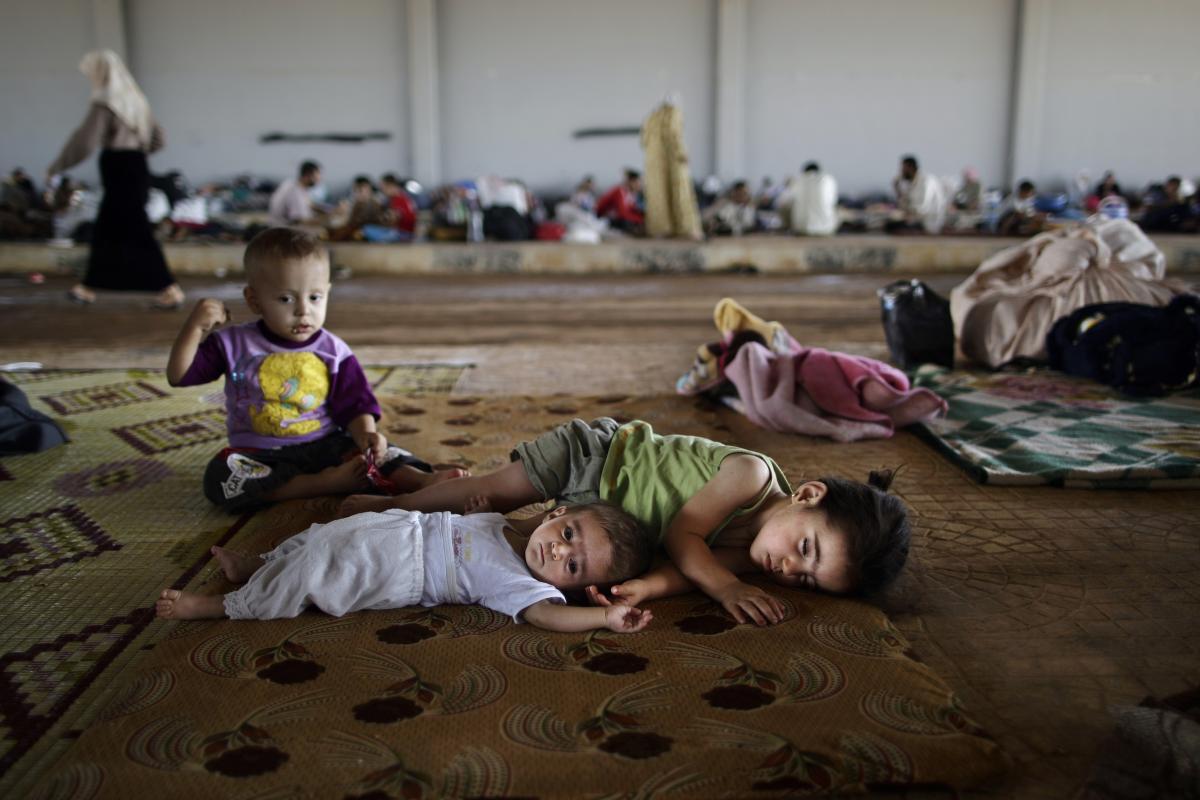
The Zaatari Refugee camp on the border of Jordan.  Just one of the camps for the more than 4 million refugees from the Syrian Civil War.  Source:  The Telegraph

There is a picture on the internet. (Click through the link if you want to see the picture, but don't say I didn't warn you)  It is a picture that I cannot bring myself to look squarely at, and that I cannot bring myself to put on my blog.

It is a picture of a boy, about three years old, dead on the beach in the surf.  He drowned, along with his mother and brother (though his father survived), trying to reach the safety of a place not torn apart by a civil war of unimaginable cruelty.

Perhaps this picture hits me harder than most because I have a toddler myself, but I don't think that is the only reason.  The photo has inspired hundreds of thousands of words of writing.  The little dead boy has inspired soul searching in Western countries.  The whole world doesn't have a toddler.

I think that this little dead boy strikes a chord because the world knows that the little boy didn't hurt anyone.  He wasn't a rebel.  He wasn't a soldier of an evil regime gassing civilians.  He was not an ISIS militant raping and enslaving women and slaughtering innocents.   He wasn't even a not-so-good guy that littered and cheated on his wife.  He was just a little boy, trying to reach a place where he wouldn't have to worry about people trying to kill him and his family.

But he didn't make it.  Like many refugees don't make it.  But a lot more people have died long before they even started to seek refuge.  And that is what the Syrian refugee crisis is about, people, regular people, seeking refuge from slaughter and depravity.

Syrian Refugees entering Iraq back in 2013.  Source: Times of Israel

If you follow the news superficially it might seem like the Syrian refugee crisis is a new thing.  Like it is some new humanitarian crisis that has blown up out of nowhere like a summer rainstorm.  But it isn't new.  It has been years in the making, and we (the West, the US, the voting public) are not innocent in this crisis.  What is different about this crisis now is that it has expanded to the point where the wealthy nations can no longer ignore the human cost of their apathy and myopic meddling.

Syrian Refugee children from back in 2013.  Source: Occupy.com

The challenge in trying to understand something as vastly catastrophic as the Syrian Civil War, or the concommitant rise of ISIS, is that there is always more context and more factors than can be held in any one mind at one time.  The challenge is exacerbated by the inability of the human mind to truly grasp tragedies on a grand scale.  The horrors of millions displaced and hundreds of thousands dead is so far beyond the scope of our ability to grasp that the human mind just resets back to zero.  The death of one person can touch us profoundly, but when the numbers climb it becomes harder to truly feel the tragedy.  So when we are confronted with a little dead boy face down in the surf, it hits harder than the photos of tens of thousands of tents.

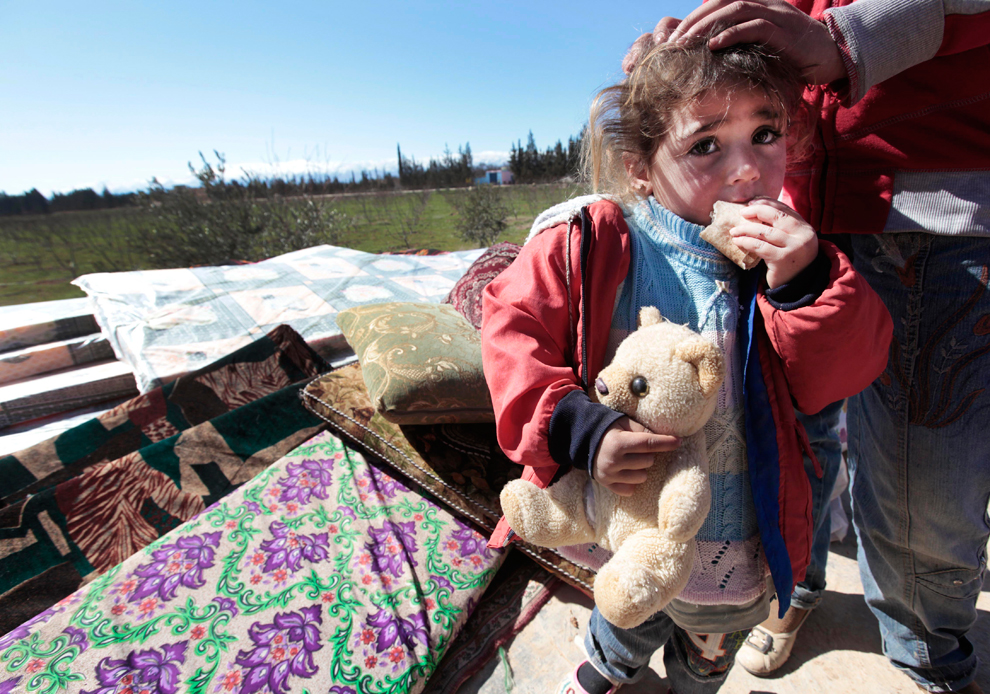
Syrian refugee girl, from 2012.  Source: Boston.com

The Syrian Civil War may well have been precipitated by social stresses created by a severe drought, and that drought may have been a result of human-caused climate change.  The post-apocalyptic flavor of bloodthirsty tyrants and maniacal murder-cults of movies like Mad Max seems to be made flesh in Syria.  And fittingly, if Syria is an example of a nation brought to collapse by climate change this could be a whirlwind that much of the world will ultimately reap.

But the humanitarian crisis that faces the world right now cannot simply be chalked up to global forces of nature beyond human control.  Global warming may have precipitated this mess, but failures of leadership here in the US and in the West at large have contributed to the ongoing nature of the disaster.

I could harp again on my hobby horse about the way that the failures of the US and the West to deal concretely with ISIS are creating a monster.  But I've already written a blog post about how the US is half-assing its way to catastrophy (and if ISIS has its way we will half-ass our way into armageddon).  But that would be unfair, because at this point ISIS has become too large, Iraq has become too weak, as has Syria, that a military solution to ISIS would require coherent and cohesive military and economic cooperation to avoid creating further regional destabilization.  In short, we half-assed things long enough that we can't just go stomp on ISIS anymore.

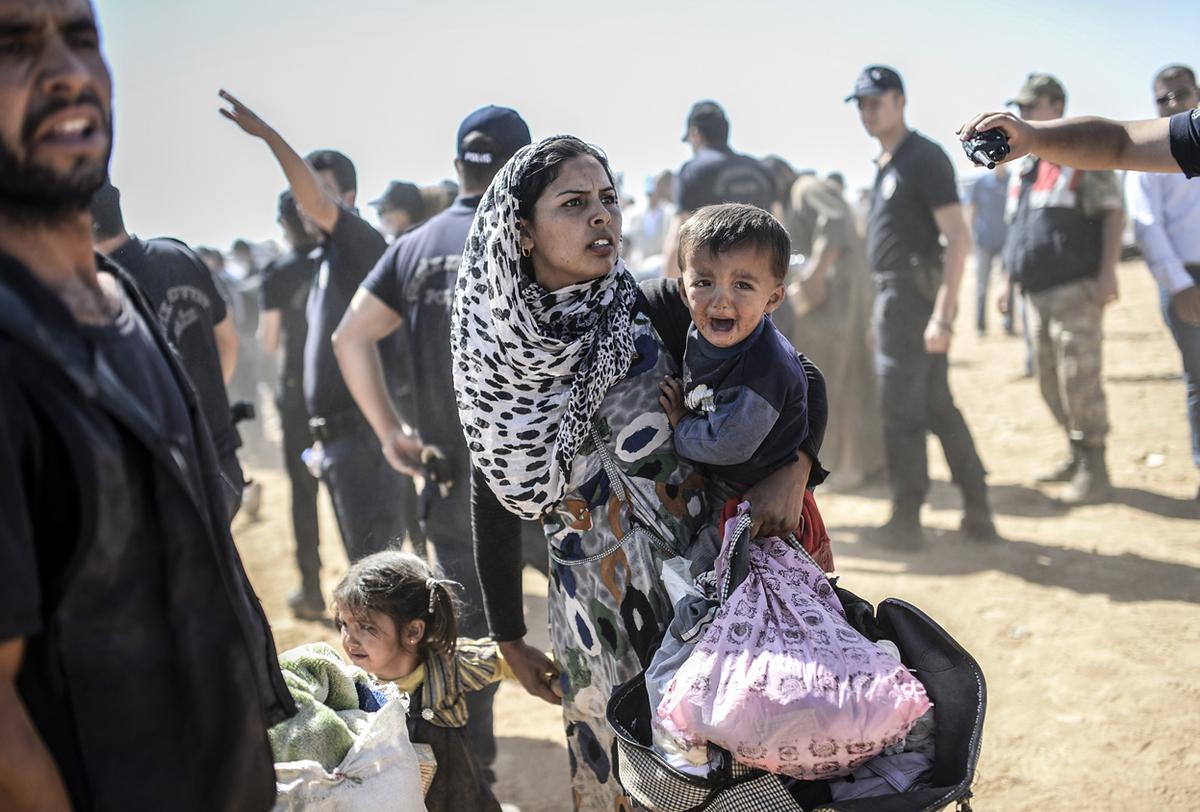
A Syrian Kurdish women and children fleeing across the Turkish border to escape ISIS advance in 2014.  Source:  The Atlantic

So instead I will harp on another one of my hobby horses, division politics.  It is seriously arguable that the humanitarian crisis in Syria has reached its current magnitude thanks in large part to US part politics.  The Syrian Civil War did not have to be allowed to spin out into a poly-polar mess of dozens of factions fighting for myriad goals.  Of course avoiding the mess would have required doing two extremely politically poisonous things: One, at least tacitly supporting Assad; and Two, minimally not working against Russia.

Really, in order to avoid this current humanitarian crisis, the US could have simply stepped aside and let Russia more actively assist Assad with the brutal suppression of the Syrian uprising.  It might have seemed heartless at the time, but it was already clear years ago that the rebels were no better, and probably worse, than Assad's regime.

You may recall the debate and bluster about "Red Lines" a few years ago when Obama was wanting to establish boundaries that would be unacceptable for Assad to cross.  Obama was like Gandalf at the bridge in Moria saying "YOU SHALL NOT GAS!!!"

Of course it wasn't a movie, and Assad did use chemical weapons, but it looked like the rebels did too.

Both parties had been making a lot of noise about Syria and how bad Assad was.  Some people said that we should back the rebels.  Some people said that Obama was recklessly getting us involved in yet another Mideast military mistake.  Some people said Obama was being too soft on Assad.  Some people, who were very much in the minority at the time were saying, "umm, Assad might be bad and all, but this whole Arab Spring thing and the rebels in Syria might not be in our best interests."

But you have to remember that at the beginning, back in 2012, the Syrian Civil war didn't really seem like that big of a deal.  The Arab Spring was bringing democracy to the Mideast.  It was very popular in Washington to hop on the "Democracy good, Dictators bad" bandwagon.  Getting into philosophical arguments about whether or not we should support "democratic" movements that seek to install democratically elected theocracies is the kind of nuanced debate that doesn't make for easily digestible soundbites.  The shorthand we tend to use in this country is "Democracy good," but what we really mean is "Liberal Democracy Done Our Way good."  After all, Hamas is the democratically elected leadership of Gaza.  The Iraqi democracy, that we installed, decided to elect leaders that oppressed the Sunni minority.  The examples go on, but it is the kind of thing that doesn't sound good in political debates.  Whereas calling a political opponent anti-democracy does sound great in political debates.

So against this backdrop, a civil war breaking out in an Arab country that had seemed very stable seemed like...  I dunno, democracy maybe, minor maybe, who knows, where is Syria anyway?

But then news reports started painting a picture of awfulness.  It was sometime in 2012 that an Al Jazeera report first started really scarring my psyche with coverage of the Syrian Civil War.  I had gotten into the habit of watching Al Jazeera reports on current events because the coverage often felt very immediate and raw.  The day that an Al Jazeera report cut to footage of an infant bleeding out from a bullet wound convinced me that maybe I liked my news a little less raw.  But once again it was the children of this war that broke my heart at the start and continue to haunt my thoughts today.

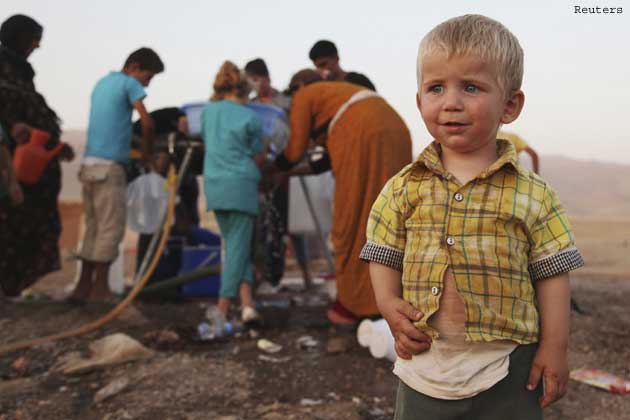
A Syrian Refugee boy in Turkey.  Reuters

With all this awfulness happening, and "Dictators bad" in everyone's mind, eyes turned to Obama.  What was he going to do about it?  And here is where division politics in the US can take a tragedy on the other side of the planet and help it grow into a humanitarian catastrophe that destabilizes a region and then spills out over the world.

Obama couldn't just do nothing, or the Republicans would accuse him of failing to lead.  But Obama couldn't just let Russia pursue their Agenda, especially since that would also help Iran.  Backing Assad would have given the Republicans tremendous ammunition, plus most Democrats wouldn't feel comfortable backing a nasty dictator.  So in order to back Assad, Obama would have had to risk attack on all sides domestically.  But there was never going to be a realistic possibility of the US invading Syria and trying to set up another Iraq (remember, ISIS had not made the news yet, so Iraq was still being sold as a semi-success).  Obama was caught between an emerging crisis and a political opposition that was poised to pounce on whatever action or inaction Obama took.

Obama essentially decided to avoid decisive action.  In order to avoid entering into a politically costly war, Obama simply expanded the use of tremendously expensive air-power.  Our politicians locked in their zero-sum game of musical chairs can all seem to agree that planes are really cool, and gee-whiz sci-fi technology like drones are fun ways to show how powerful the US is.  So Obama "took action" by dropping bombs.

Aww Yiss!!!  Mutha fukin planes 'n shit!!!  Time to drop some liberty on Syria!  Source: The Telegraph

Of course you can't bomb a country into having working infrastructure and the rule of law, and pretty much all of the dozens of factions (other than the Kurds) involved in the civil war are bad guys from the US perspective, so as logic would predict, a bombing campaign that couldn't actually support a side in a conflict failed to make anything better.

Source:  Russia Insider

The US geopolitical position made standing aside a non-option, while domestic political rivalries made any meaningful action problematic.  So the path of least political resistance was to drop bombs and ignore the problem as much as possible.

Back to the kids.  Syrian Refugee children in Iraq.  Source: Rescue.org
All of this writing and finger pointing and political hobby-horsing of mine finally brings us back to the real issue, the human cost of the Syrian Civil War.  I don't want to simply say "tsk tsk, Obama messed up, and the Republicans helped."  I don't think that assigning blame is as important as acknowledging that we all have a share in this problem, and that we all have a responsibility to do what we can about it.

And the good news is that we actually do have a variety of things we can do, even as individuals, particularly in the US.  After several hundred words crapping on the US for hamfisted meddling and apathy, I think it is only fair to remind readers that we do a lot of good as well.  We are far enough away from Syria, geographically, that we don't get a lot of direct refugees (the same goes for the Old World in general); however, the US does lead the world in the resettling of refugees.  Generally speaking, only about 1% of the world's refugees are eligible for permanent resettlement, but the US resettles more than half of that number.  Out of the entire world, the US permanently resettles more refugees than the entire rest of the world combined.

We are a country of superlatives, usually it seems like the superlatives that get focused on are things like most money spent on military, and most shootings (that one is popular to say, but not actually true by a long shot, even among developed countries), and other negative superlatives; but we are also an exceedingly generous country, and we do integrate the most refugees into our society.  And unlike many nations, the US focuses on integration, not housing refugees.  In many countries refugees never get to own property or integrate into society,  For instance, there are many Palestinians who are third and fourth generation refugees still living in refugee camps since the 1947 war of Israeli independence.  For those refugees, almost 70 years later, they are still people without a country.

And the comparison to Palestinians is potentially quite apt, because the nature of the Syrian Civil War is such that it is very possible that millions of the Syrian Refugees may never have a home to return to.  Usually, most refugees are able to return to their countries of origin after some period of time, however some refugees are permanently unable to return to their homes out of fear of death and/or persecution based on religion, political opinion, race, nationality, or membership in a particular social group.  Considering that both ISIS and the Syrian government seem intent on persecuting and killing large swathes of the Syrian population, it is likely that an unprecedentedly large number of Syrian Refugees may become as permanently stateless as the Palestinian refugees have.  What this means in practical terms, is that the permanent resettlement of potentially millions of Syrians may be necessary to avoid an ongoing intractable conflict like the Israeli/Palestinian conflict.

Syrian refugee from Deir Ezzor with his children in tears of joy after arriving in an inflatable boat crammed with about 15 people.  Source: Mirror

It is too late to avoid the Syrian Civil War.  We can't go back and undo the circumstances that led to this crisis.  What we can do is try to keep this crisis from turning into a crisis that never ends.  I wish that I could say that it would be possible to avoid this sort of calamity occurring again, but short of direct intervention by an omnibenevolent omniscient omnipotent force, I fail to see how all future humanitarian crises can be avoided.  The best we can do is the best we can do with what we know and what we have now.

In the immediate term, here in the US, if you want to do something to help, but you don't want to spend money, you can make a difference by writing to your congresspeople.  It might seem trite, but it really is a meaningful step you can take with a minimum of effort.  Far more meaningful than any shared statuses or retweets.  If you want to use a preset form, here is one all ready for you.  That link is to support bills to help refugees, the site is the US Committee for Refugees and Immigrants at Refugees.org.

If you want to do more, and you can afford to give some money there are a number of worthwhile options.  Here is an PRI article listing a number of organizations doing vital work on the Syrian refugee crisis.  There are good options for donations.  This article also contains a link to the Save the Children PSA which I will link to below, I think this video is profoundly affecting.  It captures the reality of an everyday existence torn apart, and I think that is important to bear in mind when thinking about the Syrian crisis.  Syria was not some turbulent backwater, it was for decades one of the most stable of Middle Eastern countries.  It had one of the worst human rights records in the world, but it was stable.  Stable enough for people to build lives that have been torn apart by this war.


Another option, if you are willing to truly take on some personal obligations, is you can consider sponsoring refugees.  The US Department of State deals with Refugees, however the sponsoring of refugees is done through nine non-governmental organizations (NGOs)(per the State Department website), but as an indication of how opaque this process is, I cannot seem to find out what those "nine NGOs" are.  There is some worthwhile information to be found, but the US system is confusing and decentralized enough that I feel it is beyond the scope of this blog post to try to explain how to sponsor people.  That said, if you are in Oregon (as I am) Sponsors Organized to Assist Refugees (SOAR) through the Ecumenical Ministries of Oregon seems to be a viable option.

The refugee sponsorship option might actually be a better fit for organizations that you may be a part of, whether a religious community or social organization.  If you are a member of an organization consider getting your organization involved in trying to help.  The focus should not even necessarily be on sponsoring refugees at this time.  Europe (and countries like Germany in particular) are currently seeing an enormous surge in refugees.  Supporting groups like Refugees Welcome is a way to help soften the impact of the costs of caring for refugees in countries like Germany and Britain.  And Charity Navigator offers a handy cheat-sheet for NGOs to donate to.

I wish that I could offer a workable solution to the entire Syrian Civil War, but I can't.  But we can all do little, and not-so-little things to help.  We can apply pressure on our politicians to seriously address the Syrian crisis.  We can donate.  Geography means that we here in the US can't give our time or labor to assist this crisis as easily, but we can try to assist those helping the refugees.

We can't make all the problems go away, but it is good to find ways to do something.  There will undoubtedly be more awful images that will come from this war.  The Syrian Civil War is ongoing.  The refugees overflowing the Middle East and spilling onto the shores of the Mediterranean are largely landing in countries still reeling from financial crises.  When we see refugees struggling with police it can feel bewildering, and that bewilderment can leave us feeling helpless.

When we are faced with images of toddlers face down in the surf it is a sickening feeling to be unable to do anything.  We can't do as much as we might like, but we can do some things.  I hope that this post helps you identify something that you can do.  Because when we can help other human beings it makes the darkness of these kinds of tragedies feel a little lighter.

Friday, October 24, 2014

Is Islam Anathema to Western Society?

The School of Athens (Escola de Atenas) - Raphael - This image represents thinkers key to the Renaissance. 
The short answer is: No.

But if we are being honest then we have to admit that there is a problem.  Saying that Muslim extremists comprise only a minority of Muslims is factually accurate.  Suggesting that the minority of extremists does not mean that there is a problem with Islam for the West is wrong.

---------------------------------

There is a commonly used chestnut that "Hitler was democratically elected."  In reality, the Nazis only got ~1/3 of the vote.  The Nazis were a minority in Germany leading up to WWII.  That didn't mean the world didn't have a Germany problem.

Marxist rebels were a minority in Russia before the October Revolution, that didn't mean the Tsar didn't have a Marxism problem.

Less than 50% of the white population of the original 13 colonies that formed the US supported independence, but Britain certainly had a revolutionary problem.

Just because an agitating group is a minority within a larger group does not insulate the larger group from blame.  If the larger group does not actively work against the minority agitators then it only takes a minority to effect change.  This doesn't just apply to negative things.  In the US, the majority didn't approve of interracial marriage until the late 1990's, but the minority fighting for equal rights was able to make interracial marriage legal in all states in the US in 1967 when approval of interracial marriage was less than 20%.  It was a minority agitating for change, but the anti-miscegenation crowd had an equality problem.

So let us acknowledge that extremists being a minority is a functionally meaningless issue.  Historically it doesn't matter if an opinion is held my a minority or a majority, it matters what the majority does about it.  Let us contrast interracial marriage with gay marriage.  The majority in the US has favored gay marriage for several years now, but gay marriage is still not fully legal in the US.  It took 30 years of legality for interracial marriage to achieve the levels of approval that gay marriage has, but up until the last few years the majority has acted decisively against gay marriage, and even now the majority is not acting decisively in favor of gay marriage.

---------------------------------

I make this argument so that we can start to approach to the larger question of why the West has an Islam problem.  There is a perception among many that Islam and Western secular society are fundamentally incompatible, but this is not true.  You may wonder how I can state as fact that Islam and Western society/thought are not incompatible right after arguing that there is a conflict between Islam and the West.  To begin with, modern secular Western culture owes its existence to Islam.

That's right, without Islam there is no Western society as we know it.

------------------------------------

Following the fall of the Roman Empire, Western Europe descended into the dark ages.  Illiteracy and religious fundamentalism were the rules of the time.  Western culture stagnated.  Barbarism and tribal conflict ruled the West.  Pagan philosophy and thought, like the writings of the ancient Greeks and the Romans were quashed and destroyed.  Religious diversity was brutally suppressed.

Women's legal rights were largely non-existent.  European women were covered head to toe with only their faces showing for almost a thousand years.  Even the hair was covered.  The stereotypical nun's habit with its wimple is a familiar vestige of this long era of the severe oppression of women.

When Genghis Khan conquered his way west across Asia he reached Poland.  He won a costly battle, but found nothing worth taking.  He turned his armies around and left Europe to itself.  Europe was too materially impoverished to even be worth conquering.

Even the art of this period was far cruder than the art of the Greeks and Romans.

Then our history books tell us that there was a miraculous reawakening in Europe.  The Renaissance.  Art, culture, trade, and thought flourished.  Classical philosophers like Aristotle, Socrates, and Plato were rediscovered.  Engineering and science exploded.  But where did the knowledge necessary for this reawakening come from?

The Muslim world.

During the long dark period of absolute religious fundamentalism the flame of Western thought and culture had been kept alive by Islam.  Greek and Roman writings were preserved and translated.  During the dark ages Muslim cities had lighted streets.  A hospital founded in Cairo in the late 9th century AD had a library with thousands of book, a pharmacy, licensed physicians, and male and female attendants treating men and women.  A Baghdad hospital of a similar vintage had fountains designed to cool the air inside the hospital.  While Britain was fighting Vikings, Baghdad had air conditioning.

Even our numbering system, so vital to modern science, was introduced to the West from the Muslim world.  The Italian Fibonacci introduced Arabic numerals to Europe in 1202.

A close up on Averroes from Escola de Atenas.  Averroes is a latinization of Ibn Rushd, a Muslim Philosopher

-----------------------------------

One thousand years ago two cultures clashed.  One culture was impoverished and largely illiterate.  That culture provided few or no legal rights to women, who were covered head to toe in clothing.  They regularly engaged in murderous atrocities against religious minorities.  They were dominated by a religion that taught them to hate and battle infidels.  That was Europe.

European culture clashed against another that they viewed as ungodly and decadent.  This other culture granted legal rights and protections to women and religious minorities to a degree not seen before.  They were rich, literate, scientific, and Muslim.  The clash was called the Crusades.

The Christians slaughtered men women and children.  They committed many atrocities.  But the majority of Christians never killed Muslims in the Middle East.  Most European Christians never even met a Muslim.  Nonetheless Islam still had a Christianity problem.

It seems ironic doesn't it that positions seem reversed today.

--------------------------------------

The rise of Islam was in many ways as large a moment in the development of human rights and rule of law as the Code of Hammurabi.  As strange as it might seem to many of us today, Sharia law was extraordinarily progressive for its time.  Sharia was particularly progressive in the area of women's rights.  It wasn't until the 20th century that women in Western countries received rights equivalent to the rights provided in Islamic law.  It seems truly bizarre (at least to my mind) to think of Islam as being pro-women, but by the standards of the time in the Middle-East Sharia was practically women's lib.

In the area of religious tolerance early Sharia was also pretty progressive.  While the classical definition of Dhimmi was reserved for Christians and Jews, as the areas of Muslim control grew the idea came to include non-monotheists like Hindus and Buddhists.  A Dhimmi was a second class citizen, but they were still a citizen with protected rights.

It is truly strange to me that the Muslim Revivalist movements of the 20th century seem to focus on an Islam stricter than the Islam that pertained during the time of Mohammad or the following centuries.  When I read about early Islam it seems very different than the vision espoused by ISIS (Salafism) or the Muslim Brotherhood.  It makes me wish that there was a popular Muslim movement to recapture the progressive spirit of early Islam, rather than a regressive repressive version of Islamic law.

--------------------------------

The conflict between modern Western society and Islam is not a matter of fundamental incompatibility.  I feel like anyone who has met a significant number of Muslims should be able to see that.  I've known too many Muslims to believe that Islam is any more fundamentally incompatible with our culture than any other religion as a whole.  In many ways our modern secular society was cradled by a tolerant early Islam, more than by an intolerant early Christianity.

But that doesn't necessarily mean that the current conflicts between Western society and Islamic fundamentalism are not religious in nature.  Just like the Crusades were religiously motivated, the current strain of jihadist violence is religiously motivated.  In both cases I think that the religious component is only a part of the overall picture.

I have met people who claim that the Crusades were purely motivated by economics.  I think that idea is too reductive.  You can't reduce something as complicated as a struggle between two cultural groups to a single cause.  These kinds of clashes are not just about economics, nor are they just about water, or even just about religion.  Islam by itself does not result in terrorism any more than Christianity by itself results in terrorism.

-------------------------------------

But even though Christian fundamentalist terrorists have struck at Western nations for centuries, the West does not usually feel like it has a Christianity problem these days.  If you are asking what Christian terrorists there have been, you can look at religiously affiliated nationalist movements like the IRA in Ireland; or the Lord's Resistance Army in Uganda; or religiously motivated groups that bomb abortion clinics; or the Christian Fundamentalist terrorist extraordinaire, John Brown, whose acts helped to precipitate the US Civil War and free the slaves.

And really I think the difference is that Christianity and Western society are pretty synonymous in most people's minds.  For English speakers the conversion of Britain to Christianity predates the development of the English language, so Christianity is privileged in many ways that are so fundamental to the language that they can be hard to spot.  Islam is seen as the other, and increasingly Muslim leaders in the Middle East have been casting themselves as opposition to Western Imperialism.

And it is that idea of opposition to Western Imperialism that gets to the heart of why the West has an Islam problem.  Because here we get back to the issues of the minority versus the majority.

--------------------------------------

A truism I appreciate is that it doesn't matter what's in your heart, it only matters what you do.  We are all familiar with the idea that the road to hell is paved with good intentions.  In life your actions matter more than your inner thoughts.  If Hitler had quietly hated Jews and just tried to take over the world he would not be seen as nearly the monster that he is.  But that was not the case.  Perhaps most Germans during WWII disliked the idea of killing off Jews, but their actions didn't prevent the Holocaust.  Inaction can be just as bad as action, and it doesn't matter whether or not people see themselves as good or decent if their actions do not seek to stop injustice.

I don't mean to compare Islam to Nazism, Nazis are just an easy target.  And because everyone is familiar with them and pretty much everybody hates them, they make an easy allegory.

The comparison I want to draw here is about people saying that they do not support something while they do nothing to oppose it.  When there is not widespread condemnation among Muslim groups of the goals and tactics of extremists it does not matter whether or not extremists are a minority.  A silent majority empowers a vocal and active minority.

---------------------------------------

Islam and the West are not incompatible at their cores.  They are not even unrelated.  But if we close our eyes to the problems growing between Islam and the West then we all contribute to the rise of fundamentalism and terrorism.  We in the West need to look honestly at what conditions in the Middle East are contributing to conflict, and what actions of ours exacerbate the problems.  We can't do that if we are trying to be politically correct and deny that there is a problem.

And in the Muslim world people can't just say that extremists are a minority.  I know that speaking and acting out against the extremists can be very dangerous for individuals.  We are all familiar at this point with the price Malala Yousafzai paid for daring to try to get an education, and she survived.  Many other individuals who have tried to stand up to Muslim extremists have died.  And as long as the majority stays silent and quiescent that will not change.

The extremists are the minority, even where they are in power.  That doesn't matter.  Actions matter, not thoughts.  The extremists act while the majority stands by.  That is how it always is pretty much everywhere.  The majority is harder to organize than a minority.  It is easier to find agreement in a minority.  And an organized minority is stronger than a disorganized majority.

In a leadership and organizational vacuum, whoever is organized and prepared to lead can thrive.  In Gaza, Hamas thrives.  In Syria and Iraq, ISIS is thriving.  ISIS is not thriving because people there don't want to live in peace, or don't love their children, or don't want nice things.  ISIS and similar organizations like the Taliban, thrive because the majority that just wants to lead their lives in peace are disorganized and unled.  Islam is not to blame for the power vacuums that currently obtain in much of the Middle East, but it does provide an easy rallying point for organizations that want to fill that vacuum.

Air strikes weren't successful in Vietnam.  They weren't successful between the Gulf War and 9/11.  And they aren't going to be successful now.  Likewise casting any criticism of Islam as racist is not going to fix the problems.

If we want to stop ISIS and other groups of that ilk from gaining power we need to be able to talk about why they are able to rise to power.  We can't get there if we treat Islam as anathema to our society.  We also can't get there if we are stuck on politically correct evasions.  Looking honestly at the consequences of our actions and refusing to accept blame shifting can do a lot more than trying to be superficially sensitive or dropping bombs.