Showing posts with label Conservation. Show all posts

Friday, January 15, 2016

Not Racism, Or At Least Not Entirely: Why the Malheur Occupiers are Still Alive

I will go into more depth here, but I will summarize why the Federal forces are taking a kid gloves approach to the the militants who are currently occupying the Malheur National Wildlife Refuge, and I will do it with an image.
This little girl was Baylee Almon.  She was one year and one day old when this picture was taken in 1995.  She didn't get any more days.

That image is of Baylee Almon in the arms of a firefighter who pulled her from the wreckage of the Oklahoma City Federal building after the deadliest terrorist attack on American soil, other than 9/11.  That bombing attack, which killed 168 people (19 of whom were under the age of 6) and injured 680 others, was carried out in retaliation for the violent responses to anti-government militants earlier in the 1990's.
The Oklahoma City Bombing

Is the reluctance of the FBI to start slaughtering occupiers due to racism?  I would argue no, it is due to the very high body counts that have historically resulted from violent suppression of anti-government extremists, and the high chance of retaliatory terrorism.

The extreme-right brand of anti-government militancy is closely tied to extreme religious conservatism as well.  Despite our society's fixation on Islamic terrorism, it is actually Christian terrorism that historically was responsible for more deaths in the US.  One need merely look at the ongoing incidents of Anti-Abortion Violence for examples.  Murder, abductions, arson, bombings, and ramming buildings with cars are all actions that continue to occur.  Just a month and a half ago three people were killed in a shooting attack on a Planned Parenthood.

This is not to say that the Bundy Militants are abortion clinic bombers, but they are a part of a broader cultural segment that views the use of violence and threats to force their views on others as acceptable.  Of course, one could argue that the people arguing that the government should go in and kill all the occupiers are doing the same.  And I would argue that there is a great degree of truth to that, but there is a difference.  One side is arguing that only non-governmental groups and individuals have the right to kill and seize through force of arms in pursuit of political goals, and the other side argues that only governmental groups and individuals have the right to kill and seize through force of arms in pursuit of political goals.  Both sides are essentially arguing that people who disagree with them should be killed or at least threatened with violence, the disagreement is just on who is allowed to kill and threaten people.

Back in the early 1990's the Federal government clearly acted on the assumption that violent suppression of anti-government groups was the way to go.  This led first to the Ruby Ridge standoff.  A violent and deadly episode that resulted in acquittal for the people who were charged, but not before an agent, a dog, and a boy were killed.  There was a wrongful death suit that followed as well.

The End of the Waco Seige

The next year another anti-government/religious group got into a dispute with the Federal government.  This time it was the Branch Davidians in Waco Texas.  In this case, the Branch Davidians were suspected of stockpiling weapons... in a state where it was not a crime to stockpile weapons.  The end result was 82 dead Branch Davidians (76 in the fiery end, 5 in a shootout, and one other killed by agents) and 4 dead agents.  A large number of the dead in this case were also children.

The Oklahoma City Bombing was in 1995.  The massive scale of that violence shook the nation.

The next year, 1996, when Federal forces again had a confrontation with anti-government/religious extremists things went a little differently.  This time it was the Montana Freemen.  The standoff was resolved peacefully.  After 5 agent deaths and scores of anti-government types dead in two years the Federal government had decided that perhaps using a softer approach might be more effective.  A long period of relative peace between anti-government types and the government ensued for almost 20 years.

Enter the Bundys.

In 2014, 20 years of law-breaking on the part of Cliven Bundy resulted in the government trying to get him to stop illegally grazing his cattle on Federally owned land.  This led to a standoff between armed anti-government/Christian forces and Federal agents.  Including snipers aiming their weapons at agents.  The Feds backed down, and the Bundys kept breaking the law.  They are still using those federal lands without a permit.

(As an aside, under the land laws that apply most everywhere in the English speaking world, if anyone other than the government owned the land Cliven Bundy is using, at this point he would have a very strong adverse possession case, particularly after facing down the government.  The Bundys and their philosophical kin make frequent appeals to common law, and under common law the fact that the Feds backed down fully legitimized their flouting of federal regulations, as well as giving them possession of the land they have been unlawfully using.)

Part of the problem is that the roots of the anti-government/Christian movement go back a long way in our country's history.  How long you ask?  How about 1791?

In 1791, three years after the ratification of the US Constitution, Western Ranchers Farmers rose up against the federal government in opposition to what they saw as unconstitutional abuse of power in the form of taxing whiskey.  This was called the Whiskey Rebellion.  And from that point on the US government was pretty consistent in using lethal force to suppress acts of open rebellion.

When John Brown seized the Harpers Ferry Armory the Feds brought the hammer.  This raid helped trigger the US Civil War (itself often cast by supporters of the Confederacy as a dispute over Federal Government power), and most people today side with John Brown as an abolitionist, but we should not lose sight of the fact that John Brown was a religiously motivated extremist with a history of terroristic actions and violence in support of his abolitionist cause.  And while John Brown may have been on the anti-slavery side of the debate, it is worth considering what he was trying to do.  He was trying to start a conflict to end slavery.  He was successful.  Not directly, but as a martyr.

As a martyr John Brown's cause gained strength.  A martyr cannot be discredited.  The ideas that a martyr stands for are bulletproof.  The violent response by the government helped bring about the Civil War.

And that, I think, is part of the mindset that motivated the Bundys.  They see themselves as Godly and moral men fighting for a just cause, and if they are martyred they could trigger violence that could convulse our nation.

The Bundys are the inheritors of a cultural mindset that celebrates the Christian individual, and reviles the rule of law.  This mindset extends to the American Revolution, and after the failures of the Articles of Confederation, it was only three years after the United States became a country that armed conflict resulted from this mindset.  Even the concept of Manifest Destiny, that led to the current territorial extent of the Lower 48 states was tied to a Christian ideology that legitimized the use of force to drive people (Indians) from their homes.  And this anti-government/Christian ideology is on full display in the Republican Presidential nomination race.

(If you want yet another example, take a look at the Bath School Disaster.  The deadliest school massacre in US history was not committed with a gun, it was a bomb set off by a man angry about taxes.  Children often pay the price of this kind of violence.)

The Bundys may be threatening bullies and criminals, but there are a LOT of people in this country that agree with them.  And when the federal government has come down hard on people who stood for movements that had a lot of support it has led to a lot of blood.

After the blood and reprisals of the early 1990's the US government adopted a set of tactics that sought to impose the rule of law, and imprisonment on anti-government militants.  By imprisoning the Freemen they were rendered powerless.  They were not martyrs, they were criminals.  As long as this strategy kept working things didn't get as bloody as they had been,

But then in 2014, the kid gloves approach didn't result in the restoration of the rule of law.  It resulted in the victory of the Bundys, at gunpoint.  The Bundys threatened the US government with violence and the US government backed down.

The Bundys were empowered.

On January 2nd the Bundy opposition to the rule of law took a scary new turn.  After hijacking the cause of a real injustice (the Hammonds), the Bundys seized the Malheur National Wildlife Refuge station.  Now they are stealing and damaging federal property.  They are tearing down fences.  They are making roads across wildlife habitat and archaeological sites.  They are poaching.  Beyond the simple illegal occupation of the site (and of course promoting armed insurrection) there is no shortage of laws the Bundys are breaking now.

Just a small helping of destruction of Federal property...

While the Bundys may claim to be peaceful, they are armed, and if we are being honest, most of the militants at the refuge probably get a lot more range time in than your average law enforcement personnel (despite what you may have seen in movies, guns are not magic, they require practice to use well, and having a badge doesn't make someone a crack shot).  If we were talking about the Bundys standing up to the US Army this wouldn't matter.  With a couple thousand dollars expended in transportation and material costs an artillery strike could end the occupation without any need for soldiers to put themselves at risk.

But that is not what we are talking about.

The Feds want to resolve this by restoring the rule of law.  If the Feds kill all the militants at the Malheur National Wildlife Refuge they will create martyrs.  Martyrs that have a lot of people who agree with them.  And that kind of bloodbath has historically resulted in more bloodbaths.  And more violence  And terrorism (the real kind).
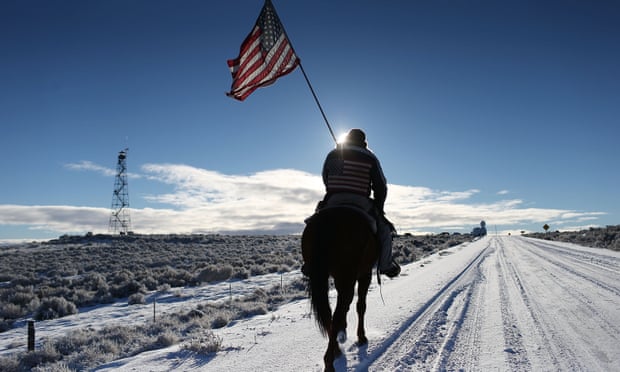
Because while many may see the Bundys as a joke, they see themselves as true patriots fighting in the name of God, justice, and the American Way.  And a lot of people agree with them.
If the Feds can resolve this by arresting and jailing the Bundys and their compatriots, there is a real chance to defuse this dangerous escalation before it turns into the kind of blood we saw two decades ago.

So yeah, maybe the fact that the Bundys are white has something to do with why the government didn't go in guns blazing, but I don't think it is because the Feds are racists.  I think it is because the whiteness of the Bundys helps convince a lot of people that they are right, and that large number of people that support them makes killing the Bundys a very VERY bad idea.

The Bundys want to start a war.  They are opposed to the rule of law, science, Native land claims, protection of the environment, and any authority beyond themselves.  A violent response to their provocations brings the probability of more violence closer.  We should not be feeding into the type of rhetoric that feeds this kind of violent anger.

If there is any constant theme in my writing it is about the danger of divisive politics and rhetoric.  This is a prime example.  The Bundys are bullies and criminals, but when you ridicule them, or call for their killing, or claim that their continued existence is proof of racism, you contribute to the factionalization of our country.  Our history is replete with cautionary examples of what this kind of divisiveness leads to.

Please stop calling for the killing of the Bundys, and start hoping for the peaceful restoration of the rule of law.

Malheur is a breathtaking place.  It is one of the most important habitats in the West for migratory waterfowl.  If you ever get the chance, make the trip.


Thursday, April 9, 2015

Extinction: Pigeons and Rhinos

The World Has No More West African Black Rhinoceroses 

Today the news of the extinction of the West African Rhino was popping up on my Facebook feed.  Sadly this news is not new, the news wasn't even new when the article I linked to above was written. The West African Black Rhino was declared officially extinct in 2011, ten years after the last confirmed sightings by researchers.  In 2001 there were 10 known living West African Black Rhinos.  The last ones were probably poached by 2003.  There are no West African Black Rhinos in captivity.
The West African Black Rhino


Every last one is gone.  They are all dead.  They were hunted to extinction by poachers.  There are still other rhino species around, and even other Black Rhino subspecies, but if you ever wanted to see a West African Black Rhino in the flesh, you are too late.

The glass-half-full perspective is that we don't need to worry about how to save the West African Black Rhino anymore...

But all kidding aside, I find it very sad that without cloning, I will never be able to see one of those amazing mammals.  It got me thinking about another species that I wish I could have seen, the Passenger Pigeon.

The Passenger Pigeon


The World Has Not Had Passenger Pigeons For 101 Years

The passenger pigeon 150 years ago was one of the most abundant land vertebrates in Earth's history.  There were more passenger pigeons than there were human beings at the time.  There were around 5 billion passenger pigeons that lived in the Eastern United States.  They migrated in truly massive flocks that would darken the sky and fill the air with the thunderous sound of their passage.  The flocks were so huge that they could bring their own weather.  Unbroken flocks of passenger pigeons could take 14 hours to pass. These flocks would literally rain bird poop that would cover the areas they passed like snow.  For a bird species that was a little over a foot long and less than a pound, it would have taken truly astronomical numbers to darken the sky, bring their own wind, and cover the landscape in feces.

For the people living in the US in the mid 19th century the idea that anything that humans could ever possibly do would ever be able to seriously affect the passenger pigeon population was laughable.  I would be akin to draining the sea.  Passing flocks contained more birds than there were stars visible in the night sky (literally, you can only see like 10,000 stars at night).  The passenger pigeon was seen as an inexhaustible source of free food.  And up until the Industrial Revolution caught up to the pigeons, that was pretty much true.

It's worth pointing out that until recently in historical terms, most people (at least in the monotheistic parts of the world) believed that it was literally impossible for a species to go extinct.  The impossibility of extinction was a part of the arguments against a long chronology for Earth.  Every species that god created had to still exist, as a point of faith, and as an underlying assumption about the nature of reality.  The idea of extinction was every bit as anathema to many Christians as the more familiar debates of today about evolution, or whether the world is billions of years old or 6,000 years, or whether or not humans are even capable of causing global climate change.

When you think about how efforts to save the passenger pigeon in the later decades of the 19th century were totally disregarded, it is worth remembering that not only was the idea that humans even could wipe out a species like the passenger pigeon seen as laughable, for many people it was at least impossible by their understanding of reality if not blatantly heretical.  For many people in the US today the same is still true regarding topics like evolution and climate change.

Industrial Hunting and Industrial Poaching

With the coming of the railroads and instantaneous communications (telegraph), along with the loss of habitat due to the deforestation of eastern North America, industrial style hunting was able to rapidly transport pigeon meat to new distant markets even as the species found itself losing the habitat it had evolved for.  To give you an idea of the scale of passenger pigeon hunting, at a nesting site in Petoskey, Michigan, in 1878, 50,000 birds were killed each day for nearly five months.  That was just one location, similar things were going on all over the country.  But the proximity of passenger pigeons Great Lakes region nesting grounds to the emerging meat distribution industry hub that developed in the Midwest meant that the heaviest hunting was conducted where it was most devastating.

From a population of billions in the 1850's the last wild passenger pigeon was shot by a boy with a BB gun in 1900.  In 1914 the last captive passenger pigeon, Martha, died.  A powerful proof of the ability for industrialized humanity to alter the planet.

Of course nothing was learned from this.

Buffalo, who once numbered in the millions, were hunted to the brink of extinction by industrial hunting.  Joy killing of musk ox herds from planes in the mid 20th century led to the extirpation of Alaskan musk ox.  The musk ox had to be reintroduced from Canada after US populations were wiped out.  And that is just in the US.

In China, in the Mid 20th century, Mao promoted traditional Chinese Medicine.  This helped lead to an industrial level demand for Rhino horns, among other animal body parts like bear's gall bladders.  Today three of the extant species of Rhino (Black Rhino, Javan Rhino, and Sumatran Rhino) are critically endangered.  The West African Black Rhino was one of four subspecies of the critically endangered black rhino, there are now three populations left, and all are in extreme danger.  The other two species of rhino, White Rhino and Indian Rhino, are near threatened (White Rhino), and vulnerable to extinction (Indian Rhino).

Today in Europe, the "hunting" of migratory songbirds is driving a plurality of species into danger.  Shooting songbirds off of power-lines is a popular pastime in parts of Eastern Europe.  In central and Western Europe similar practices are common.

Commercial over-fishing continues to endanger a number of economically important species.  Some tuna species are threatened.  The list of threatened fish stocks is too vast to begin to touch on here.

Out of the five extant rhino species, the White Rhino is doing the best with a population of over 17,000.  The white rhino is split into two subspecies, the Northern and Southern,  There are 5 Northern White Rhinos in the world.  All the rest of the white rhinos are the Southern White Rhinos.

What is to be done?

So why has the Southern White Rhino done so well despite heavy poaching?  The answer might surprise you, the reason that the Southern White Rhino is doing so well is actually due (in large part) to regulated sport hunting.

A century ago there were 50 Southern White Rhinos.  Today there are an estimated 17,460.  A big part of what helped the white rhino recover was regulated big game hunting.  In 2007 foreign big game hunters spent an average of more than $10,000 per hunter on their hunts, and that number does not include travel and accommodations.  More than $200 MILLION was pumped into the African economy for the opportunity to kill African Big Game.  And that is why sport hunting actually helps preserve species.

(I've actually written another blog post on this topic, you can find it here)

People being willing to spend huge sums of money to kill exotic animals creates an economic incentive to protect populations.  If you live where there are dangerous megafauna, say man-eating lions, you are not likely to be inclined to protect them if all they do is kill your family, compete with/kill your livestock, and in general make your life harder.  But if rich foreigners are willing to spend lots of money to kill those same animals, then there is a reason to not allow them all to die.

Eco-tourists are not likely to pay $10,000 dollars for the chance to take a picture of a rhino, on top of travel and accommodations, but hunters will pay $10,000 for the chance to shoot at one.  In a mind boggling (to me at least) twist of irony, the most effective defense against poachers has been people who want to live out their African Killing Safari Dreams.  Indiscriminate hunting wiped out one of the most numerous vertebrate species in Earth's history, and drove numerous other species to the brink or fully into extinction, and now sport hunting is helping to reverse the trends in some cases.

The value of a rhino horn on the black market is up over $60,000 today.  The price has skyrocketed over the past decade as populations around the world have collapsed.  It takes a pretty hefty price tag to offer an economically valid alternative to poaching when that is the case.  The healthy populations of African megafauna also attract more eco-tourists, but most people need something more concrete than the trickle-down economics of tourist money spent on hotels and trinkets to convince them not to make a quick years salary by going on an illegal hunting trip.

Hunting:  Not just good for Africa

The phenomenon of hunters preserving species is not limited to Africa.  Here in the US, hunters have been hugely important to the preservation of wildlife.  To spare myself some labor, I'll just go ahead and quote myself:
"let's take a look closer to home.  If you enjoy seeing wildlife, and you live in the lower 48, you should thank a hunter.  There were 12.5 million hunters in the US in 2006.  That was a drop of 1.6 million over the preceding period of 15 years.  That means that less than five percent of the population was hunting.  But that five percent accounted for 75% of the funding for state wildlife agencies.  And that does not factor in Federal Duck Stamps which can be thanked for 5.2 million preserved acres (National Geographic, November 2007).  The Fish and Wildlife Service has a little blurb about this.
In the US we have lots of numbers being tracked.  One number that the US Fish and Wildlife Service tracks is how many people are "wildlife watching participants."  Wildlife watching participants are the people who are out enjoying the wildlife and taking pictures.  Those people number 71 million, and comprise 30% of the population.  Six times as many people are engaging in non-hunting wilderness activities, but they provide only a fraction of the revenue from their actions.  It is nice to imagine that hiking and bird-watching do more to protect species than the slaughter of innocent animals, but it is a pretty lie."
Five percent of the population in the US pays for 75% of state wildlife agencies.  Hunters, an extreme minority in the US, provide three times as much money for wildlife management as the other 95% of the population.  It's pretty staggering, and that only counts the governmental funding side of wildlife management.

Additionally non-governmental groups like Ducks Unlimited have had a huge impact on the preservation of migratory waterfowl.  Those types of hunting focused organizations have conserved millions of acres of habitat, and have often found innovative ways to do so.  Things like buying small areas of land that contain key habitats like ponds, or working with developers to find ways to mitigate the impact of development.

This is not to say that non-hunting conservancy organizations do not also have a profound impact.  I'm having trouble finding the numbers, but I do believe that the Sierra Club and the Nature Conservancy have both managed to preserve more total acreage than Ducks Unlimited.  Plus environmental groups are also active in wildlife preservation lobbying, but the out-sized contribution of pro-hunting conservation groups in relation to the population of hunters is pretty staggering.

You don't need to hunt to help preserve species, and god knows that history shows the dangers of unregulated hunting, but if we want to have animals like bears, lions, elephants, and rhinos in this world, along with species like swans, cranes, moose, and musk ox, hunters are an important part of the solution.  But it is not enough to simply say "hunting good."  Indiscriminate, unregulated, and industrial hunting (and fishing) continues to drive species to extinction.  Careful governmental regulation and societal stewardship is vital.  This is not a case where an unregulated free market is a good idea.  Hunters are a key piece of conservation efforts, and can be instrumental on a global scale, but that can only be true with responsible regulation.

Just some things to bear in mind if you like animals.


Monday, July 7, 2014

In Defense of Kendall Jones

My Facebook wall has recently been fairly covered with images and rants (for and against) Kendall Jones.  If you are fortunate enough not to know who Kendall Jones is, she is a Texas Tech cheerleader who hunts big game.  She has generated a lot of controversy by posting pictures of her with her kills, and taking a combative position on her hunting.  There is a Change.org petition to bar her from traveling to Africa (that's a US petition to bar a US citizen from legally travelling to engage in legal activities on a different continent), and there are people literally calling for her to be killed.  Much of the outrage seems to stem from the mistaken belief that non-lethal eco-tourism is a better and more effective way to promote and effect conservation.  Many people who oppose hunting honestly believe that photographing wildlife does more to preserve species than killing them does.  It makes sense, it's logical, it's false.

According to National Geographic the 18,500 hunters that annually travel to Africa to hunt big game animals bring in 200 million dollars a year.  That averages out to US$ 10,810 per hunter.  That is just what they are paying to hunt.  That is not the cost of flights and accommodations.  How many eco-tourists could or would pay ten thousand dollars for a photo tour?

But let's take a look closer to home.  If you enjoy seeing wildlife, and you live in the lower 48, you should thank a hunter.  There were 12.5 million hunters in the US in 2006.  That was a drop of 1.6 million over the preceding period of 15 years.  That means that less than five percent of the population was hunting.  But that five percent accounted for 75% of the funding for state wildlife agencies.  And that does not factor in Federal Duck Stamps which can be thanked for 5.2 million preserved acres (National Geographic, November 2007).  The Fish and Wildlife Service has a little blurb about this.

In the US we have lots of numbers being tracked.  One number that the US Fish and Wildlife Service tracks is how many people are "wildlife watching participants."  Wildlife watching participants are the people who are out enjoying the wildlife and taking pictures.  Those people number 71 million, and comprise 30% of the population.  Six times as many people are engaging in non-hunting wilderness activities, but they provide only a fraction of the revenue from their actions.  It is nice to imagine that hiking and bird-watching do more to protect species than the slaughter of innocent animals, but it is a pretty lie.

On a personal level, I do not understand the desire to hunt predators.  I have not been an active hunter in recent years, though I hope to change that in the relatively near future.  I have killed a number of animals, but for food or to put them out of their misery.  I do not like killing animals.  Every time I have to kill something it is a psychic pain, and for me that pain is managed by knowing that the animal will be used respectfully, or will no longer be suffering.  When I do hunt I am happy to let someone else do the shooting and I'll do the skinning and cleaning.  For me the killing of animals is not fun, and that is true for many people.  That is not true for many hunters, and obviously not for Kendall Jones.

On a deep level I find safari style big game hunts unseemly.

While I do not understand the desire to hunt predators, I am glad that there are people who do along with laws to control their behaviors.  I understand that most people from the Lower 48 have grown up in a setting where the wilderness is contained and their ancestors wiped out most of the animals that would kill them and eat them.  When apex predators are not a part of your life it can be hard to remember that they are in fact dangerous.  It is seductive to believe that nature is naturally balanced and without human interference life simply moves along with all animals at stable levels.  The science does not support this however, animal populations fluctuate. During times of plentiful food prey animal populations rise.  This is followed by predator population rises.  Predators hunt the prey until populations drop to a point where the predators start to stave and die off.

For an example of the effect of predators on prey populations we can look at Yellowstone.  In 1995 the elk population had risen to over 19,000.  That year wolves were reintroduced.  In 2012 there were 4,174.  In 2013 there were 3,915.  If we want to keep a healthy elk population and wolf population we are going to need to control the wolf population.

But back to Kendall and her African safaris.  Is there a measurable benefit to allowing hunters to kill endangered animals?  According to National Geographic there is.  In the same article I linked to earlier National Geographic claims that regulated hunts can be thanked for bringing the white rhino population from 50 to over 11,000 because the hunts gave ranch owners an incentive to repopulate their properties.  This is where we get to the meat of what hunting does for species.

When people just want to take pictures of majestic animals they are not likely to be willing to pay thousands of dollars to take one picture.  Africa is not a continent sized game preserve.  It is a continent with dozens of countries and more than 1.03 billion people on it.  Those are 1.03 billion people who need to eat and don't want to be killed by animals.  If there is no economic incentive to keeping dangerous animals around, how are they going to be protected.  The animals that we like so much (lions, cheetahs, leopards, rhinos, hippos, elephants, etc) are threats to people who live with them.  A lion might be majestic, but the majesty of the lion might be tarnished in your eyes if it ate your children and livestock.  Why would you protect an animal that will only harm you?  If you could make a living off of the management of lions you would have an incentive to protect them.  Maybe you could then afford better housing and protection for your livestock.

Legal big game hunts are vital to the survival of endangered animals.  Maybe someday humanity will be evolved enough that we need no motivation beyond love of wilderness to create adequate protections for animals, but someday is not today.  Right now we still need incentives to live with violent and dangerous animals.

Still, I don't think that the vitriol aimed at Kendall Jones is based on rational thought about the welfare of species.  Kendall occupies a bizarre intersection of feminism and misogyny.  She is a stereotypically attractive young woman.  She has orange skin, lots of makeup, and she is thin; the American ideal.  She also has a bright smile that she flashes in her photos with dead animals.  You can find plenty of article claiming a feminist perspective that characterize her hunting as catering to misogynistic hunter goddess stereotypes.  You can also find plenty of articles that imply that her taking pleasure in the hunt is unwomanly and unseemly.

She also courts controversy.  She posts inflammatory statements.  She makes her hunts a political statement.  It should not be surprising that she has run afoul of a lot of feminists when she has positioned herself in opposition to many progressive values.  But I think it is a bit of hypocrisy to promote female equality and then excoriate a young woman for hunting.  But that is just my perspective.  I consider myself a feminist, but for me the goal of feminism is to make a world where my daughter can choose to live how she wants to live.  I do not want my daughter to feel forced to conform to a feminist ideal of how she should live her life any more than I want her forced to wear a burqua.  That said, I would be much more understanding if she wanted to be a vegetarian lesbian investment banker than if she wanted to wear a burqua...  But I like to think that I would try to give her space to make her choices (please Abby, no burquas).

Kendall Jones seems like a bit of a jerk to me.  I'm fine with her hunting, and helping conservation with her activities.  I'm fine with her pursuing atypical interests.  I'm even fine with her cynical courting of controversy.  But I do not like the conflation of fame and infamy.  But it is not Kendall's fault that being a jerk is just as good as having talent to achieve notoriety in our country.  She is not committing crimes, she is just riling people up.  And in our country riling people up is an effective way to get attention and support.  If you want Kendall Jones to go away, just shut up about her.