Showing posts with label Harsey Knives. Show all posts

Friday, August 19, 2016

Knife Review: Spartan Harsey Folder (SHF)

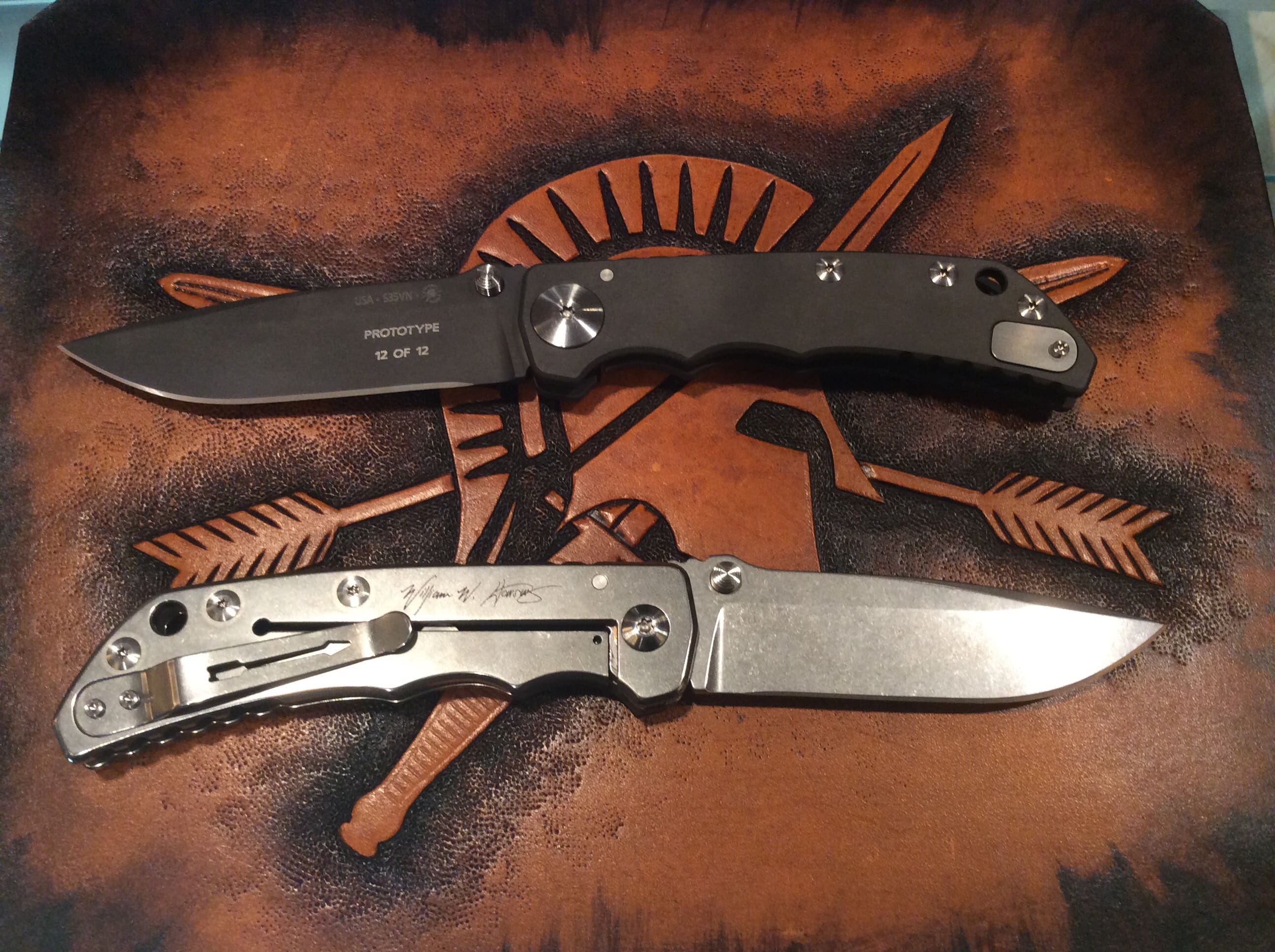
The Spartan Harsey Folder.  This particular one that I reviewed is a custom version that I bought from Spartan Blades.  The standard versions are either all stonewashed or all black.

Introduction:


It's finally here!  My Spartan Harsey Folder, the aptly acronymed SHF.  This is the knife whose future existence I teased in my review of the Lone Wolf T2.  At the time of that review the SHF was still in development.  Now that I finally have mine in hand and have had a month to test it out, I have to say it was worth the wait.  Given the fact that the SHF won 2016 American Made Knife of the Year at Blade Show, I'd say that other people feel the same way.

The SHF is a knife with a lineage.  Renowned knife designer Bill Harsey has designed a number of iterations of knives similar to the SHF over the years, but he really hit a home run with the Lone Wolf T series.  Unfortunately Lone Wolf went out of business, and so the T2 design went defunct.  Bill really wanted to make sure that when he brought the design back that it was an improvement, and the best knife it could be.  After some successful collaborations with Spartan Blades they developed the SHF, which is an all metal, framelock version of the knife.
My little collection of Harsey designed knives.  You could say I am a fan.  From left to right: The Spartan Harsey Difensa, the Gerber Applegate-Fairbairn Combat Folder, the Gerber Applegate-Fairbairn Covert Folder, the Spartan Harsey SHF, the Lone Wolf T2, The Tacops Falcon (designed by Bill Harsey and Chris Reeve), and the Fantoni HB-02
The T2 and the SHF side by side
The result is something more than a remake.  It is a new knife.  Stouter and more, well, spartan, but also refined.  The T2 was an amazing value at the time (the pricing on the resale market for the Lone Wolf T2's is comparable to the SHF these days), it was a great quality knife for the price.  The SHF on the other hand is simply an outstanding knife.  It's price is comparable to other high quality American made knives in its bracket, but there are no compromises made to keep the price down.  So it costs more, but the SHF doesn't have fiberglass reinforced nylon (FRN) handle scales like the base model T2 either.  The SHF shares the fantastic ergonomics of the T2, but there are a lot of little differences.  And this review is about the details.


The TL;DR review summary: 
This knife is a special knife.  It is pretty big, it is not super light.  It is solid and impressive.  It is exquisitely balanced, and a very good slicer, especially for a modern tactical style knife.  The thumbstud deployment takes some getting used to, and the lockup seems a little too early for my tastes.  But on balance, I think this is an outstanding knife.


The Version Reviewed is a Custom:

The SHF usually comes in one of two versions, the all stonewashed version, or the all black physical vapor deposition (PVD) diamond-like carbon (DLC) coated version.  I have a personal distaste for handles that look like the blades (and honestly, a prejudice against metal handles in general), so I didn't really want the all stonewashed version.  On the other hand, I don't like black coated blades either.  I just personally don't like them, and I don't like my knives to be too intimidating to people, and black coated blades seem a little too "tactical" to me.  So I decided to be a little picky.  This knife costs between $450 (stonewashed) and $500 (DLC Coated), so for that kind of money I want to make sure that I get exactly what I want.

Spartan Blades' first production run of the SHF went out as pre-orders to retailers, so there wasn't a chance for me to get a customized one in that first run.  The second production run was when Spartan Blades was able to get their system ready for more rapid production, and since I had been in touch with Spartan on an ongoing basis they let me know when they had more knives coming up for sale.  I asked if it would be possible to get a knife made with the black handle and the stonewashed blade.  Kimberly at customer service told me that they were getting ready to do some customs, and that she would let me know when they were ready to start making them.  I was very surprised that it was just a week later when she let me know that my custom knife was ready.  My patience paid off in the opportunity to have a knife made for me to my specifications, and I am quite happy with it.

This is the most expensive knife I have ever bought, and it is the first custom knife I have had made for me, so it is a first for me in those ways.


Let's Start With the Specs:


  • Blade Length:        4"
  • Overall Length:      8 13/16"
  • Finish:                    Black PVD (Handle), Stonewash (Blade)
  • Blade Thickness:   0.154"
  • Thickness:              0.5"
  • Blade Steel:           CPM S35VN
  • Blade Hardness:    58-60 RHC
  • Frame:                    6AL-4V Titanium
  • Weight:                   5.888 Oz
The SHF is a substantial folding knife.  Coming in with a four inch blade and an overall length of almost nine inches when open.  That said, this knife does not seem overly large.  It is a good sized knife for general use in my opinion.  Some people might prefer a smaller knife (or live in a jurisdiction that bans knives of this size), but for my money this size knife is just right.  Plus the handle size is a great fit for my hand.
The SHF in my hand.  Note, I have pretty big hands which is why I usually avoid having my hands in the picture, but it shows the handle fit for me.
The blade on this knife was given a stonewashed finish, which is one of my favorite finish types.  A stonewash finish is created by... tumbling the knife with pebbles.  It is what it sounds like.  In my experience stonewash finishes feel pretty low friction, and they are more resistant to corrosion than bead blasted finishes.  Additionally the stonewash hides scratches pretty well, which helps keep the blade looking nice.  The stonewash finish also keeps the blade from being too reflective if that is a concern.
I feel like this image captures the stonewash finish nicely.  The bright high-desert sun also captures the subtle prismatic effect of the DLC coating in bright lights.  While no one would call DLC sparkly, it is subtly prismatic for a very subdued iridescent shimmer.  It is really only noticeable in full bright sunlight, but it is one of my favorite minor details.

The steel of the blade itself is the very fancy supersteel CPM S35VN.  This is a very tough, hard wearing, corrosion resistant, stainless steel that is able to take and hold a very keen edge.  It is a particle steel, which as I have written before is made with science magic.  The fantastic performance has something to do with carbides... I think.  I'm no metallurgist.
The blade stock of the SHF seems to be a little thicker than the T2.  I didn't break out my calipers, but I'm pretty sure.

The handle is titanium, which translates to an extremely solid feeling knife.  I was initially surprised that the knife still felt surprisingly (to me) heavy in the hand.  I expected the titanium handle to allow for a very light knife, like with the Fantoni HB 02.  However, the thick slabs of Titanium (while strong) are not milled out at all, and leave the knife with a substantial weight.  I wondered about that heft initially, until I checked the balance:
That balance is right at the index finger groove.
The knife balances right at the index finger groove.  This is the same point of balance one finds on Harsey's knives like the Difensa.  Having the balance a little back of the blade, right at the fulcrum of the index finger provides a lively feel in the hand.  Bill Harsey has made his reputation designing tactical and fighting knives, and this knife reflects that, and manages to capture the same balance point in a folding knife.


A Note on the Clip:

The T2 on top, with it's tip-down clip, and the SHF below with its titanium tip-up clip.
One of the big changes between the T2 and the SHF was changing the pocket clip from an obligatory right-handed tip-down clip to a left/right reversible tip-up pocket clip.  I personally prefer a tip-down clip since I usually carry my knife in my back pocket.  Plus the T2 clip was one of my favorite things about the old design, and it fit my hand more unobtrusively than any other pocket clip I've used, despite the beefiness if the clip.  That said, I actually wanted the SHF for use in the field, and I typically wear pants with back pocket flaps in the field, which makes the front pocket carry of the SHF actually a bonus.  Also, the titanium clip is strong and fairly unobtrusive in the hand.  Plus, the arrow cutout is pretty cool in my opinion.

Review:


Steel:


I feel that CPM S35VN is an excellent steel, and a good fit for a knife in this price range.  I'd say that the steel is an unequivocal positive.  I know that some steel snobs might prefer a more esoteric steel (like S90V or M390), but for balance of metal characteristics I think S35VN is hard to beat in a tactical/EDC knife.  Additionally, Spartan Blades has a proven track record with their heat treatment of S35VN.  They know how to get the most out of the steel, and the performance has been excellent.

Blade Finish:


As I stated earlier, the stonewash finish is one of my favorite finishes for a knife.  It's attractive, hides scratches, and it provides a lower friction coefficient than a DLC/ZRN coated blade, especially when wet.  I like the easier slicing a lot, especially in a blade that has some thickness.

Blade:


I really think the blade on this knife is excellent.  I was initially a little sad that Spartan was not offering a full-flat-grind option on the blade (like my T2 Ranger), but I was willing to accept the modified spear-point sabre-grind blade for an all purpose knife.  It has been my experience that sabre-grind blades tend to not slice as well due to the more obtuse angles and increased thickness.  I was pleasantly surprised to find that the slicing performance of the SHF has been quite impressive.  Even though the SHF is thicker at the terminal bevel than the T2 Ranger was, the terminal bevel grinds and blade geometry work to create a blade that is the equal of the Ranger for the cutting tasks I have put it to.

(The SHF actually is even better at apple slicing than the Ranger, which is handy since my two-year-old demands that I slice up her apples one slice at a time daily)

A final nice feature of the blade is the jimping.  The jimping strikes a neat balance between echoing the jimping of the T2, and also recalling the jimping on Spartan Blades' fighting knives.  The jimping is effective, but not obnoxious, and manages to strike a good balance both in performance and aesthetics.  It is the little things that really make a knife for me.
A look at the jimping


Handle:


The handle, while nice, is one place where I really missed the T2.  The wood handles and radiused edges of the T2 made for a handle that really melted into the hand.  The all-metal handle and chamfered edges of the SHF make for a knife that has a much more positively grippy feel in the hand.  You feel the SHF much more than the T2.  The chamfered metal looks and feels more modern and agressive.  I liked the old fashioned feel and look of the wooden handle.

In actual use I found that the SHF performed nicely, and the handle did not result in hot-spots on my hands.  The handle jimping is attractive and effective.  And the knife is very comfortable to use, and the same excellent ergonomics are there.  But I miss the soft rounded comfort of the T2.  Of course you can't buy a new Lone Wolf T2 anymore, because the company is gone, so the comparison is unfair.  Even more unfair since the wooden handled version was uncommon even when they were getting made.  The SHF handle compares just fine with other production Harsey designs currently on the market, like Fantoni's HB series.

It is worth noting as well that all of the screws and standoffs on the SHF are also made out of titanium.  That detail is a part of the reason for the cost of the knife, but it is a neat detail.


Locking Mechanism:


The locking mechanism on the SHF is an integral frame lock with an internally mounted Hinderer Lockbar Stabilizer (a patented feature licensed for this knife).  Since the handle is also the frame of the knife, a part of the handle functions as a spring and moves in to lock the blade in place.  The mechanism is similar to a liner lock, but with a liner lock there are handle scales over the metal frame.  The advantage of the integral frame lock is that when you hold the knife handle it actually holds the lock in place, which provides additional reliability.  The frame lock is very popular, particularly on high end knives.  I personally prefer liner locks, but that is because I am biased against metal handles, and I dislike having different materials on different sides of the handle.  But this is a detail where my tastes run counter to most folks who buy higher end knives, so I am pretty much out of luck.

(Note on lock terminology: with frame and liner locks, early or late refer to how far the lock travels over the blade tang when the lock engages.  Over time, like years, the metal wears down where the lock engages, and this means that over time the lockup gets later.  An early lockup means that even as the metal wears down there will be plenty of additional surface to ensure secure lockup.  However, if the lockup is too early then the lock can fail to fully engage, which can be dangerous.  Three Sisters Forge has a patented adjustable cam [stop pin] that allows for lockup timing to be adjusted, but they are the only ones I know of with this feature, so in my experience you are mostly stuck with the lockup you get from the factory.)

The locking mechanism on the SHF is probably my biggest issue overall with the knife.  The lockup is very early.  There is no issue if the blade is flipped open using the thumbstud, or simply opened with a little authority, but when the knife is opened gently with two hands the lock fails to engage.  Over time I am sure this will change, and it is not an issue for me in normal use, but when I let people borrow the knife they tend not to be "knife people" and try to be too gentle with the knife, which creates an unsafe situation.


Deployment:


The deployment of the SHF required some learning on my part.  The strong detent and shape of the thumbstuds meant that the knife actually did not work with quite the same hand movements I was used to.  Additionally, the extremely smooth opening (comparable, in my experience, only to a Sebenza) meant that when I did get the knife opening, the blade flew out way faster than I was used to/expecting.  I expected the knife to open exactly the same as my T2:

However, the SHF is not the T2, and nowhere was this more evident than with the deployment:

As you can see, when the thumbstuds are used right, the blade pops right out.  With practice this became easy to do, and quite satisfying, but it did involve a learning curve.  I was used to a controlled opening arc, and the SHF essentially just needs to get launched.  At the end of the SHF video I demonstrate the pinch method that I have found works easiest for me if I want to do a controlled arc.
Note the grooves leading to the thumbstuds.
The best tip that I can offer for opening the SHF is to use the thumbstud access grooves as a guide.  The grooves guide your thumb-tip to the correct angle and position to open the knife with ease, but the mechanics are a little different than I was used to.


Fit and Finish:


The fit and finish of this knife is absolutely outstanding.  My only complaint is the too-early lockup, but otherwise I detected no irregularities, misalignments, assymetries, or flaws.  The knife was literally flawless as far as I can tell.  This is the first knife I have owned that I felt exceeded the build quality of the Fantoni HB 02 (of course the HB 02 costs about half the price, but Fantoni makes fabulous knives).
A comparison photo with the Fantoni HB 02
The factory edge on the knife was very sharp, and is still the only edge put on the knife thus far.  I have had no need to resharpen the knife.  I have been very pleased with the edge on this knife.  The edge seems a great balance of stable geometry and... sliciness (for lack of a better word).  It cuts like a dream.

One last touch that I really liked was having Bill Harsey's signature on the blade.  It is a little touch that makes me very happy.
The William W. Harsey signature.

Use Review:


In use this knife has performed excellently.  It works very well for most every task I have used it for.  As a modern style folder, it simply can't compete with a little old-fashioned slipjoint knife for apple slicing, but even in the apple slicing department it outperforms other similarly sized knives.  The excellent ergonomics make the SHF a very handy all-purpose knife.  It handles most kitchen tasks very well.  Most any cooking task that calls for a petty knife can be handled ably.  And it also slices up cardboard cleanly and chops through blackberry vines nicely.

One particular use where the SHF really outperformed my expectations was in whittling.  I have not really found modern folders to be very handy for whittling for the most part, but the SHF actually makes a pretty decent whittler.  I whittle when bored, and so I am happy that the SHF actually tackles that task ably.

Summary:


The SHF really is a different knife from the old T2.  The shared lineage, similar appearance, and design of the SHF invites comparison, but the two knives feel quite different in use.  The T2 is still my absolute favorite knife of all time, but I really feel like the SHF is actually a nicer knife in almost every way.  The quality of the SHF is certainly top-notch.

The SHF is a spendy knife.  The price is comparable to other high-end mid-tech production knives (Hinderer, Strider, Chris Reeve, etc.), but that price is still awfully high for your average knife buyer.  That said, for myself, I am very happy with this purchase.  I fully expect to get decades of use out of this knife, and I find it a pleasure to carry and use.

The SHF in nature

I just love the green of that high desert lichen

A nice view of the blade with the signature

Knife in nature

Knife in nature


And one last knife in nature

Sunday, January 24, 2016

Knife News: Spartan Blades SHF (Spartan Harsey Folder)

Updated 08-21-2016:  I actually wrote a review of the SHF, so if you would actually like to read what I think about the knife now that I own one, you can read it here.

Updated 07-07-2016:  I didn't really think many people were going to read this preview, but since hundreds of people have read it I thought maybe I should update so things.

If you read my knife reviews you may recall a section at the tail end of my review of the Lone Wolf Harsey T2:
When I posted my original First Impressions Review, Bill Harsey left a comment on my Facebook page informing me that he had finished up prototyping work on a new similar knife.  He said that the new one would have a titanium frame and handle (I'm not personally a big fan of metal handles, but I am willing to reserve judgement).  So this is very exciting news to me.

Unfortunately, I have no idea when this new version might come out, or who would be producing it, or what price it might be sold at.  And there is not even really a guarantee that the knife ever will enter production.  And hopefully Bill won't be mad at me for writing about his Facebook comment here.

But, if a new version of the T2 comes to fruition, I will do everything I can to review it in a timely fashion.  I'm not a particularly well known reviewer, and I don't have much of a following, so it's not like the makers would have a strong motivation to send me a tester.  And the knife will not be cheap, and heading into grad school, money is not something I am swimming in.  So even if the knife came out tomorrow, it might be a while before I could review it.  But if a new one comes out, I will let you all know.

So to sum up, the Lone Wolf T2 is my favorite knife.  I think it is just about perfect, but it is hard to buy, and the prices that they sell for these days can make it hard to justify actually using.  But stay tuned, there may be a resurrection of this knife, and that could truly be an amazing knife. 
 Well the resurrection of the T2 is here in the form of the Spartan Blades SHF (Spartan Harsey Folder).
The new SHF, coming out in a stonewashed finish and black DLC (DiamondLike Coating) finish.
The exciting news is that the knife is finally being released.  The bad news is that it will be some time before I can actually get my grubby mitts on one.

Update:  I have just ordered my SHF, so I will be reviewing it soon.

The SHF is being sold for the prices of $460 for the stonewashed version and $495 for the DLC version.  Those prices, while well within the normal range for US made knives of comparable materials, mean that it is going to take me quite a while to save up the funds to spend on a knife that is essentially a new version of a knife I already have.  But I am going to buy it, it's just going to take a while.  I'm guessing probably at least six months (I don't make big bucks as a grad student, I have some non-discretionary spending coming up, and there are several conferences I need to attend in the next couple months, so six months may be overly optimistic), but I look forward to reviewing the knife when I get it.

Of course having to wait a while is not entirely bad news, but let's talk a bit about the knife first...

Materials:

Like most of the Spartan Blades catalog, the blade of the SHF is made of CPM S35VN.  I have written about this steel a few times, my summary is that it is a science-magic steel.  It's neat stuff, and Spartan Blades knows how to work with it.

The biggest change between the SHF and the T2 is that the SHF is a frame lock.  That means that part of the handle frame actually springs inward to lock the blade in place.  And then the frame is further held in place by your hand as long as you are holding the handle.

The the handle and all the non-blade hardware of the SHF is titanium, which is probably the most exciting part of this new design for me.  The screws, standoffs, blade pivot, and clip are all made out of titanium.  This should be one extraordinarily strong and solidly constructed folding knife.  I am particularly excited about the titanium pivot.  All of the points where failure might occur are going to be made of extremely strong and lightweight material (not that using a folding knife as a knife would lead to failure in a less strongly built knife, but some people like to to silly things with their knives).

Makers:

Spartan Blades is a US company based out of North Carolina.  The company was founded (and is owned) by two retired special forces soldiers, Curtis Iovito and Mark Carey.  In addition to being veteran owned, and employing other veterans, Spartan Blades uses US origin materials for their products.  Not only are the knives made in the US, the materials that make the knives are made in the US.  The sheaths for the knives are made by vendors that are also veteran owned companies that us US origin materials.  And Spartan Blades works with other US veteran owned companies.

The message here is that Spartan Blades is a company that takes "Made in America" seriously at all levels, and has a commitment to service and others who have served.  Being so resolutely US sourced does tend to mean that costs for materials and labor will be higher than if the knives were made and sourced overseas, but I would argue that the additional cost can be well worth paying.

In a country (and world) dominated by the forces of market economics, the dollars we spend are our most concrete forms of real power.  When you spend money on goods you vote with your wallet.  I am not speaking metaphorically, you really are shaping the world you live in with your spending habits.  This is not to say that it is always wrong to buy foreign made goods by any means, but it is to say that price should not always be the only consideration.  Spartan Blades is a company I like to support.

It helps, of course, that Spartan Blades makes excellent quality goods.  I have been quite thrilled with my Spartan Harsey Difensa since I purchased it.  It has actually seen a lot more use than I had initially expected.  It is just a well designed and built piece of equipment.  (And the soldier that I bought Model II for has also been quite happy with it.)

But Back To The SHF:

While I wish I could just buy a SHF right now, it might actually work out better for me to have to wait.  I am excited for the SHF, but there are things that I am not crazy about with these initial models.

The stonewashed finish

I am not crazy about metal handles.  One of my favorite things about my T2 is the wooden handles.  I like the way they feel, and to my mind they feel warmer in the hand than metal handles.  However, I know that Bill Harsey has carried a titanium handled knife for many years, and he seems to like it.  While it is a logical fallacy to simply rely on an appeal to authority, some people really are experts.  I'd count Bill as an expert.  I am willing to give a metal handled knife a chance, particularly since one of the reasons I want the SHF is for when I am working in the field.  I tend to end up working in the high desert fairly frequently, and the gritty sand can do a number on even artificial handles like derlin. The titanium should be able to stand up to that well, plus if I do need the knife repaired I can send it in to Spartan  (unlike the T2, Lone Wolf Knives doesn't exist anymore so if I mess up my knife there is no where to send it).

I like the DLC on the handle, but I really don't like black Blades on my knives. I know a lot of people really like that look, but I am hoping for the option for a stone washed blade in a black handle later this year.  Another option that I hope becomes an option this year is the Flat Dark Earth color ZRN finish. It has a nice golden tone I prefer to black.

Update:  Spartan was finally able to make space for some custom orders for the SHF, and that is why I finally bought mine today.  I will be getting a SHF with the black handle and stonewashed blade.  I have no idea when the FDE blade might be an option.

The other thing that I hope will happen sooner, rather than later, is a full flat grind option like the one on my T2.  I had some questions about the SHF, and I emailed Curtis Iovito, who was kind enough to get back to me promptly. One of the questions I asked was whether or not there would be different blade styles. He told me that there was a possibility of different styles, but there was no current plans to start working on new designs.  It will probably be longer than I want to wait before any new blade geometries come out, but I can hope.

Tip up clip.  You can go left or right, but it is tip up all the way.

One thing that I was sad to see on the SHF was the obligatory tip up clip. I really like the design of the tip down clip on the T2 (though it was one of the aspects of the T2 that I have read the most complaints about online, there are a lot of people that prefer tip up). Despite the large size of the clip on the T2, I have found it to be very unobtrusive in the hand, I worry that the SHF clip will be less comfortable. We will just have to see.

Update:  I got to handle the SHF folders at the Oregon Knife Collectors Association Show this spring, and I found the clip to be totally unobtrusive in the hand.  I seriously did not notice it when I held the knife.  I have also realized that most of the pants that I wear in the field have flaps on the back pockets, so the front pocket carry is going to be actually a plus for me.

Colored hardware

The last thing that I am looking forward to is the different colored hardware that has been shown in the prototype photos that Spartan Blades has put out. The gold and blue colored screws, standoffs, and thumbstuds look like a neat way to add some visual spark to the SHF.

But enough of my rambling on about a knife I haven't actually had a chance to hold.  I've given Spartan Blades enough free advertising for today. I just wanted to share my excitement at the news that the new SHF is finally coming out.


Sunday, June 7, 2015

Lone Wolf Harsey T2 Review


My Lovely Lone Wolf T2

Introduction:

This was my dream knife, my holy grail, the white whale.  And now it's mine.  And it lived up to my expectations, and actually exceeded them.

If you want the TL;DR version:  This knife is close to ideal for me.  I love the looks, the ergos, the materials, everything about it.

The T series of knives was designed by Bill Harsey for Lone Wolf Knives.  Lone Wolf Knives was a company based out of Oregon.  Unfortunately that company is no longer around, so this knife is not being made anymore.

So the sad news is that I am reviewing a knife that you can't buy new, and in particular I am reviewing a version of a discontinued knife that was uncommon even when the knives were actually being made.  Most of the Lone Wolf T series knives were made with black FRN (Fiberglass Reinforced Nylon) handle scales, not wood; and even among the wood handles, most of the handles were done in cocobolo, not walnut.  Additionally, the T series knives came in a few different blade styles, and most of the knives were made with a center-ridged modified spear point design, rather than the full-flat ranger grind of my knife.

But let's get to the actual review.  I'll come back to the topic of availability in the summary.

Let's start with the specs:

Specifications 

Overall Length (inches): 8.80
Blade Length (inches): 3.90
Weight: 4.5 oz
Blade Material: CPM S30V
Blade Detail: Ranger
Blade Finish: Bead Blast
Handle Material: French Walnut
Lock Style: Liner Lock
Carry System: Pocket Clip
Frame: Stainless Steel


This is a big folding knife, though not ridiculously so.  When I originally purchased this knife I had thought that the almost 4 inch blade would be bigger than I would want to carry daily, but since I already had the ~3 inch Fantoni I didn't want to get the smaller T1.  My thought at the time was that I would have a very nice knife that I might use sometimes, since I really didn't think anything was going to shift the Fantoni out of my pocket long term.  As it has turned out, the T2 has moved pretty much every other knife out of my pocket (other than for specific tasks).  The 4 inch blade has proved to be an extremely useful and versatile size and shape.

The T2 is a surprisingly light knife for a steel framed large folder.  It feels satisfyingly sturdy in the hand, but at ~4.5 oz, it rides in your pocket without trouble.  Even though the T2 is a substantial knife, it doesn't drag your pants down.

The blade finish is a bead blasted finish.  A bead blasted finish serves to create a visually pleasing and uniform finish that is also pretty non-reflective.  I appreciate this finish on a "tactical" styled knife in stainless steel.  I prefer the bead-blasted finish to a blade coating because the bead-blast serves to reduce glare without noticeably increasing the friction coefficient of the blade.  I do not like the bead blast as much as stone-washed finishes for two reasons: firstly, bead-blasted finishes increase the likelihood of staining, though with CPM S30V that is not really too much of an issue; and secondly (and more importantly in my mind), the bead-blasted finish can really make any slip-ups in sharpening very obvious.  Bead-blasted finishes are not nearly as bad as mirror finishes for showing scratches, but as I recently accidentally demonstrated, one bad stroke can make a pretty glaring mar on the appearance of the blade.

The handle material for this knife is French Walnut.  Most tactical knives opt for a man-made material for the handles, as did most of the Lone Wolf T-series knives.  Wooden handles might not be as tough as Micarta, G10, or FRN, but for everyday use the Walnut has held up just fine, it feels nice in the hand, and it is pretty.

The steel on this knife is CPM S30V, which is a particle super steel.  These days S30V is not the most cutting edge super steel on the market, but it really isn't far off.  S30V is still a very premium steel, it is essentially the stainless super steel that others are judged against.  10 years ago, when this knife was being designed and manufactured, S30V was about as good as it got, and really, if you're like me, then the incremental differences between high-end steels are pretty hard to actually perceive.

A Note on the Clip:

Ususally I have a note on the sheath at this point, but this is a folding knife with a clip, rather than a sheath.  The T2 has a large stainless steel clip that is surprisingly unobtrusive in the hand.  The clip is not a deep carry clip, which means that about an inch of the handle sticks out of your pocket.  The good thing about this type of clip is that the knife is easy to access, and if you are somewhere where knives can't be "concealed" then this helps avoid trouble on that front.

I have knives with much smaller clips that are actually more obtrusive when the knife is held, I feel like the size actually helps make the clip feel more like a part of the handle and less like a tacked on addition.  In my hand the clip feels more like handle contouring than like a typical clip.  The large clip also helps keep the knife securely in place without being too difficult to pull out/put in.  For me, in terms of function and appearance, the clip is an absolute winner.

One last note on the clip, the clip is an obligatory tip-down clip.  There are no holes for making it tip-up, and the handle scale is actually milled out to accommodate the clip, so you can't flip the clip over to the other side.  Functionally, this means that for safety reasons, you are pretty much limited to right-back-pocket carry, or left front pocket (because it is a good idea to keep the blade against a seam in your pocket in case it opens in your pocket.  You don't want to reach into your pocket and encounter an open knife).  For me this is totally fine since that is what I like anyway, but for some people it is a drawback.
Handle picture showing the clip


Review:

Steel:  

The S30V steel is a very good steel.  The blade has shown good edge holding and stain resistance while I've had it.  I have nothing to complain about on that front.  My only complaint would be that, as with S35VN, I have a harder time sharpening S30V than I do with less fancy steels.  That is one of the things to bear in mind when buying knives with fancy steels.  The same features that make super-steels better performing also make them harder to sharpen.

I don't know what the precise Rockwell hardness of the S30V used for the blade is.  I have not been able to track down that info, and I do not have a tester of my own.

Blade Finish:

As I indicated above, the bead-blasted finish is not my absolute favorite finish, but it is fine.  I do prefer the bead-blast finish to a blade coating for ease of slicing.  In a perfect world, I would probably prefer a stone-washed finish on this knife, but I am happy with the bead-blast.  The bead-blast is aesthetically pleasing, though as I said, when I messed up while sharpening my knife the scratches were very obvious.

Blade:

I cannot stress enough just how overwhelmingly thrilled I am with the blade on this knife.  Size, shape, geometry, jimping, everything.  The whole nine-yards.  I like everything about the design of the blade on this knife.  This knife has proven to be the most versatile knife I have ever owned.  It handles kitchen work amazingly well for a folding knife.  It even works well as a whittling knife.  The full flat grind, combined with the drop point shape, makes for a truly effective and versatile slicer.

One of the things about the way that the blade is designed that amplifies the versatility of the knife is the the angle that the blade sits at in relation to the handle, and the fact that the knife is not a flipper.  Flipper knives have a projecting piece of metal that serves as a finger guard, but in my experience those projections can also make it a little harder to use in the kitchen or for tasks where it is helpful to be able to bring more of the blade horizontal to the cutting surface.  The lack of a flipper helps with this, but as you can see in the photo below, the angle of the blade makes it so that the pivot point of the handle actually sits above a flat surface.  This gives your fingers a little ore room when working on a table or cutting board, which is part of what makes this knife such a pleasure to use.  It is these sorts of subtle features of knife design that really make the difference in my experience.
It's a subtle feature, but very nice.


Handle:

The handle of the T2 is the most comfortable handle of any knife I own, including fixed blades.  This is pretty surprising to me considering that the T2 handle includes a large pocket clip and significant jimping.  A big part of the comfort for me is that the knife is pretty ideally sized for my hand.  In my review of the Spartan Difensa I described how I have a specific preference for knives that allow me to use my pinky to grip, and the T2 really allows me space and a shape that facilitates my grip.


Locking Mechanism:

The T2 has a sturdy liner-lock.  The lockup is early enough that I am confident that there will be many years of life in the lock.  The liner lock is my personal favorite style of folding knife lock.  Other styles like the frame-lock (which is very similar to a liner lock), or the Axis lock (mostly found only on Benchmade knives due to exclusive licensing) may be more hip at the moment, I really like the simplicity and reliability of liner-locks.  The other thing that I like about the liner lock is that it allows the handle scales to just be handle scales.

In the case of My T2, that means that the walnut handle is not just on one side.  The knife is functionally a wooden handled modern tactical folder, which I think is awfully neat.  I think that this characteristic of this particular T2 is also a part of why the knife does not seem to scare people when I pull it out to cut a string the way some other tactical folders do.

Fit and Finish:

The fit and finish of my T2 was fine, though (at risk of sounding like a broken record) not flawless like the Fantoni.  The wooden handle scales are slightly offset from the frame, oddly the offset is opposite for the two sides, but the mismatch is less than half a millimeter on either side.  The frame is also not fully smoothed on the blade side of the handle.  Neither of these issues are significant, and neither affect function at all.  At the original price that the T2's were sold at those very minor flaws would have been perfectly acceptable to my mind.  At the prices I sometimes see Walnut handled T2's selling for these days, I might be a little upset. 

Use Review:

The T2 has proven to be such a pleasure to use that I find myself using it even when I have knives available that are better suited for certain tasks, like cooking.  After having the knife for about half a year I find that I am able to resist the urge to use the T2 for everything a little bit more, but I still find myself using it simply for the pleasure of using the T2.

Chances are good that if you live in a city or town that your pocket knife is mostly going to get used to open boxes and envelopes, and boxes and envelopes don't really require anything special out of a folding knife.  But most people who carry a knife do end up finding that there are a lot of other times that pop up more occasionally where a solid and versatile knife is useful.  Emergencies happen, sometimes you need to cut a strap in a hurry.  When those kind of things happen it is good to have a solidly built and solidly locking knife with a good edge.  Since I got the T2 I have not run into any emergencies, but I feel prepared when I have it.

When it comes to knife performance, I really like to see how knives do in the kitchen.  The kitchen is one of the places where we tend to do most of our day to day cutting.  That is why I have an assortment of nice kitchen knives.  Of course having that assortment of nice knives means that most non-kitchen knives feel deficient to me in the kitchen.  Not so the T2.  I almost immediately found myself using the T2 in the kitchen more than any of my other folders, and for this review I went ahead and used the T2 as my only knife for making a meal.

The T2 really is an excellent slicer.  The blade shape and geometry make the knife comparable to my kitchen knives.


The full flat grind makes slicing vegetables of various textures easy


The Ranger blade style was intended to appropriate for hunting and outdoors uses, and it handles meat as you would expect such a knife to handle meat.


The Bead blasted finish is satisfyingly low friction which also helps with cooking tasks


It even works for cutting pizza


Though to be perfectly honest, my Ulus are better pizza cutters, but I was having fun

For a general use knife, I like a lot of belly, because that is what I tend to use most for cutting boxes and such.  In the kitchen it is usually nicer to have a somewhat straighter edge, like on a chef's knife.  The T2 is obviously not as handy as a chefs knife when it comes to chopping up a bag of carrots, but it does well.

The blade and handle shape make it easy to adjust your grip for a variety of tasks.  In particular, I find the lack of a flipper projection handy when I am whittling with the T2.  I also appreciate the un-swedged drop point when I want to choke way up to do fine work with the point.  I have found the T2 to be very good for fine tasks like cutting stencils and trimming masking tape.  

Straight up, great shape and ergos, and excellent performance.


Summary:

The Lone Wolf T2 is without a doubt, my favorite folding knife that I have used.

The only drawback to the T2, to my mind, is that there is no company to provide warranty service to the knife if I break it.  Perhaps it is silly for me to use and risk damaging a knife that is essentially a collectors item now, but I bought it to use (my intention to use the knife is probably why I was able to get a good deal on the knife from a guy who felt bad about just letting the knife sit in his safe).

So What Happened to Lone Wolf Knives?

It is hard to find complete and reliable info on Lone Wolf Knives, but here is what I have been able to gather (any inaccuracies are mine) though a combination of actual credible information and stuff-some-guy-said-on-a-forum type sources:  Lone Wolf Knives was an upstart company that made very high quality production knives using high-end materials, for a price that was much lower than most comparable knives.  Lone Wolf worked with some very distinguished custom knife makers and designers to create production versions of very nice knives.  Designers like Bob Loveless, Bill Harsey, Paul W. Poehlmann, and Brian Tighe.  They also worked with other companies like Fantoni Knives to produce some of their knives (I have a Loveless designed Lone Wolf integral hunter made by Fantoni, for example).

Apparently, Lone Wolf came up with an exciting design for an OTF (Out The Front) automatic knife (a switchblade that comes straight out rather than swinging open like a regular folding knife) around 2009.  People were very excited about this new knife, and Lone Wolf ended up agreeing to a large number of orders for the knife, but they ran into trouble during production.  They were not able to make the knives in a timely fashion, and could not get more money to cover the unexpected costs, so the company was sold to Benchmade.

Benchmade proceeded to shift the Lone Wolf brand into being an outdoors/hunting brand, and discontinued the earlier product lines.  Presumably they made this move with the brand so that they would not have two brands in direct competition.  The T-series and the D2 automatic folders designed by Harsey were casualties during this period.  Benchmade was going to move at least some of the Harsey folders over to their brand, but that fell through (and I have no idea why, any guess would be total speculation).  The new Lone Wolf knives included some very interesting knives, particularly for people in saltwater environments, but in 2014 it would seem that Benchmade quietly shut down Lone Wolf altogether.  So now there is no Lone Wolf knives being made at all.  Benchmade has launched a new line of knives called Benchmade Hunt, which fills the niche that Lone Wolf used to fill.

I don't want to invent motivations for the way that Benchmade handled the Lone Wolf brand, particularly since I think that Benchmade is an excellent company.  I'm not trying to suggest that Benchmade is bad, or Machiavellian schemers seeking to wipe out competitors.  It really seems like straight up business, if anything I would say that it seems like they did their best to keep Lone Wolf in business.  You can't blame Benchmade for not wanting to undermine their own primary brand, or for deciding to go with their own, more recognizable brand for their outdoorsy knives.

So How do I Get a T2?

You might be asking how to get your hands on a T2 knife now that I have extolled the virtues of the knife and then explained why the knives are no longer being made.  Well if you want a Lone Wolf T-series knife the easiest way to find one is on eBay.  That also tends to be a pretty expensive way to buy your knife, and you have to worry about counterfeits.  You can also do what I did and join Blade Forums and spend a year or so researching and putting out feelers until someone offers you exactly the knife you want at a price you can afford...  but it takes a pretty obsessive approach to go that route.  And you are still kind of rolling the dice hoping for the genuine article in good condition.

But all is not hopeless.

When I posted my original First Impressions Review, Bill Harsey left a comment on my Facebook page informing me that he had finished up prototyping work on a new similar knife.  He said that the new one would have a titanium frame and handle (I'm not personally a big fan of metal handles, but I am willing to reserve judgement).  So this is very exciting news to me.

Unfortunately, I have no idea when this new version might come out, or who would be producing it, or what price it might be sold at.  And there is not even really a guarantee that the knife ever will enter production.  And hopefully Bill won't be mad at me for writing about his Facebook comment here.

But, if a new version of the T2 comes to fruition, I will do everything I can to review it in a timely fashion.  I'm not a particularly well known reviewer, and I don't have much of a following, so it's not like the makers would have a strong motivation to send me a tester.  And the knife will not be cheap, and heading into grad school, money is not something I am swimming in.  So even if the knife came out tomorrow, it might be a while before I could review it.  But if a new one comes out, I will let you all know.

So to sum up, the Lone Wolf T2 is my favorite knife.  I think it is just about perfect, but it is hard to buy, and the prices that they sell for these days can make it hard to justify actually using.  But stay tuned, there may be a resurrection of this knife, and that could truly be an amazing knife. 

Monday, March 2, 2015

Knife Review: Spartan Harsey Difensa: First Impressions

Since my other reviews have had pictures of folding knives with guns, I thought that for my first review of a fixed blade knife I would picture it with a folding gun.  My great-grandfather's .22LR-20Ga. over under.

Introduction:

Even more than my other knives, this knife purchase for me was an extravagance.  The Spartan Harsey knives are a pretty expensive line of knives (the Difensa starts at $425), but I have wanted one for a few years now.  It was actually meeting William Harsey at an archaeological excavation he visited that got me serious about knives again.  And it was this knife, the Spartan Harsey Difensa, that he showed me a prototype of that really captured my imagination.  So when I got paid for my first piece of professional writing, I decided to treat myself.

This is actually the second Spartan Harsey that I have purchased, but this is the first one that I have purchased that I have actually gotten to hold.  The other Spartan knife was a Harsey Model II that is currently residing in the Middle East with the soldier I purchased it for.

This knife was designed for a Canadian special operations force.  The name Difensa comes from the battle of Monte la Difensa in WWII.  This battle was the first combat in the Italian theater for the First Special Service Force, a combined Canada and US elite commando unit.  During the battle of Monte la Difensa the FSSF suffered 77% casualties, but they accomplished their seemingly impossible goal.  Following WWII the FSSF was disbanded, but the Canadian Special Operations Forces trace their lineage to the FSSF, and the Green Berets trace their roots to the FSSF and OSS.

The Spartan Harsey Difensa was designed to be a knife that would serve well in the Canadian forests, as well as in combat.  It's a heck of a knife.

Let's start with the specs:

Specifications (from Spartan Blades Website):
Knife Name:  Spartan Harsey Difensa
Designer:  William Harsey
Overall Length: 11 5/8"
Blade Length: 6 1/4"
Blade Thickness: 3/16"
Blade Steel: CPM S35VN
Blade Hardness: 59-60 HRC
Blade Style: Spear Point - Flat ground main bevel with tapered top edge.
Coating: SpartaCoat - PVD - Tungsten DLC (Black) or ZrN (Flat Dark Earth)
Handle Material: 3D Contoured CE Canvas Micarta® Black or Green
Weight: 0.710 LBS

This is a substantial knife, but not actually as heavy as one might assume.  Despite having a full tang construction, and being ground out of a beefy 3/16" blade stock, the knife still comes in under 3/4 of a pound.

The handle on this knife is made of contoured canvas micarta.  This gives the handle an organic and warm feel in the hand.  One thing that I have found when holding this type of textured micata is that it feels almost soft in the the hand, even though it is actually a very hard and durable material.  Micarta is made by layering organic materials like canvas, linen, or paper with resin and compressing them.  G10 is a similar material, but with fiberglass as the layered material.  The advantage of a canvas micarta, aside from appearance, is that with a rough finish of the type used on this handle, the very outer portions of the canvas can actually absorb a little moisture which means that the handle actually becomes grippier when wet, even though the dimensions and shape of the micarta remain stable.  It is a very subtle feature, but an example of the way that Harsey designs his knives.

The blade coating on my knife is the Flat Dark Earth, which is made of Zirconium Nitride (ZrN).  Zirconium Nitride is a very tough and hard coating material with a Vickers Hardness of 2800.  For comparison steel is apparently generally in the 55-180 Vickers range, while diamond is 10,000.  So the coating is a very durable coating.  It is also an attractive coating with a coloration similar to elemental gold and a subtle sheen.  ZrN also has a respectable friction coefficient of 0.5, which is about on par with raw dry steel.  However, lubricated steel has a coefficient of 0.16, which translates to a noticeable difference in ease of slicing when chopping vegetables since the ZrN coating doesn't behave the same as wet steel.  For comparison teflon has a friction coefficient of 0.04 and rubber has a friction coefficient of 1-2.

The steel itself is the very fancy supersteel CPM S35VN.  This is a very tough, hard wearing, corrosion resistant, stainless steel that is able to take and hold a very keen edge.  It is a particle steel, which as I have written before is made with science magic.  The fantastic performance has something to do with carbides... I think.  I'm no metallurgist.

The CPM S35VN really does not need the blade coating for performance reasons or corrosion protection, the coating is put on the blade to reduce the reflectiveness of the blade.  This knife is designed for tactical use by Canadian Special Forces after all.

A note on the sheath:  I chose to get the MOLLE nylon sheath, rather than the Kydex sheath that is offered.  My reasons for this are that I like the look of the nylon sheath, that is what the version that Bill showed me was in, and I do not plan to be in situations where a fraction of a second difference in how fast I can pull out the knife would make a difference.  But most importantly for my choice was that I like the more traditional sheath appearance of the nylon sheath.  For the Model II that I purchased for that soldier who is currently in a warm place, I chose the Kydex sheath.  Just in case.

Review:

In previous reviews I have made lists of pros and cons.  I have decided to try a different format going forward, I will see how I like it.  I'll go over different aspects of the knife and give my opinion.  In order to avoid stepping on any other knife reviewers toes out there I won't be giving numerical scores (there is a knife reviewer, Everyday Commentary, that uses set categories and numerical values, and makes very excellent knife reviews.  I am trying to find a way to make good knife reviews without ripping him off, but his reviews are really nice.  You can read them here.  I think his reviews are some of the best I've read).

I also want to be clear that I am evaluating this knife differently than I would be evaluating a $30 knife.  This is a $400+ knife, and I am evaluating it as such.  It is by far the most expensive knife I have purchased, so I am quite picky as I review it.

Steel:  

I feel that CPM S35VN is an excellent steel, and a good fit for a knife in this price range.  I'd say that the steel is an unequivocal positive.

Blade Coating:

The ZrN is good looking.  It's tough.  If it gets any apparent marks on it you can just spray it down with WD40 and they'll come right off.  But I'm not really that crazy about it honestly.

I'd be lying if I said that the cool factor of the coating wasn't a big part of what first attracted me to the knife, however now that I have it I feel ambivalent.  I find that the coating is actually difficult to keep clean looking.  The coating has a texture, and that texture makes everything seem to show up on the blade.  I don't know if this will change over the years or not.  Plus, as I discussed earlier I feel like the increased drag of the coating makes the knife less useful for food prep tasks, but it is not really designed to be a kitchen knife.

I can't say that the coating is bad, I just don't find it to be a positive for me, other than the cool factor.  It is very pretty and cool looking, especially in person  (Maybe some day I'll have the juice to get my hands on a Harsey Tactical Trout which is similarly shaped but has an uncoated blade).

Blade:

The blade size is a little large for some tasks.  It is probably about an inch longer than would be ideal for most fixed blade purposes that I would typically subject a hunting knife to.  That said, since I don't buy knives that are going to just sit in the safe, I have started carrying this when I am clearing brush and working in the woods.  What I have found is that the little bit of extra size really actually does make a very perceptible difference when doing things like chopping through small branches.  This is a knife made for heavy use, and it handles the heavy tasks very well indeed.  So while I might want a knife that was going to be for just hunting purposes to be a little smaller (like say the Spartan Harsey Hunter, which I seriously considered buying since it is smaller and hand ground by Bill Harsey, but it is almost $100 more, and I had fallen in love with the Difensa first), but for the use that I have actually been able to put this knife to so far, the extra size has been a bonus.

The blade shape is quite lovely.  The tip comes to a point that is a little more acute than I feel the photos truly capture, which is consistent with the original intended purpose of the knife, but the blade shape remains a good, broadly useful design.  The dropped point brings the point to a very controllable location for fine work.  The blade provides ample belly for slicing tasks.  And the large choil allows the user to choke up on the blade.

The blade geometry is a high flat grind, which is well suited to general and rough use.  The stock that the blade is ground from is a beefy 3/16 inch stock, so the blade gets thicker faster than a blade from thinner stock would, this could also contribute to the less easy kitchen cutting I mentioned previously (also the finger guard gets in the way on a counter, really, it just isn't a kitchen knife, and it is not designed to be).  This is one of the inevitable trade-offs that one encounters when getting a heavy duty knife.  A big beefy tactical utility blade with a full tang is not going to be the same shape as a kitchen knife and neither will perform the same for different tasks.  Different knives have different uses that they are best suited to, and I feel like the Difensa does an admirable job of balancing different needs.

Handle:

When it comes to the handle I have to both praise it, and voice a very specific to me complaint.  First the good.  This handle is very comfortable in the hand.  The texture of the handle feels nice to touch.  The handle is large enough to comfortably accommodate larger hands.  The handle is also designed to work with people wearing gloves (Canada, Eh?), which is very nice for me since I do usually wear gloves when working in the bush.

Also, as a very specific aside on the handle, the full tang of the handle sits flush with the handle scales.  This is in contrast to the Chris Reeve Harsey knives that feature tangs that sit a little proud of the scales.  I find that feature slightly uncomfortable for ungloved use, but it was designed to make it easier to orient the knife in the hand while wearing gloves.  I am grateful that the Difensa does not share that design feature.

So what's the complaint?  Well it has to do with an old injury I suffered.  Some years back I fell off of a roof, broke a bunch of bones and suffered various other collateral injuries.  Specifically, when it comes to using knives, I shattered my right ring finger metacarpal, and broke the right ring finger itself in four places.  This injury isn't particularly noticeable unless I point out that I have no knuckle on that finger, and it waggles.  It is excruciatingly painful to this day for me to grip hard with the right ring finger, so I have adjusted by using the right pinky for grip more than most people.  If you ever notice in my reviews that I pay a lot of attention to whether or not a folding knife allows for a four finger grip, that is why.  For me a three finger is a two finger grip.  That also means that I tend to want a little extra room to position my pinky on a handle, especially on a fixed blade.  The design of the Difensa handle is ergonomically lovely, but it crowds my pinky just a little.  Oddly, this isn't noticeable when I'm wearing gloves, but when I am using the knife bare handed it sometimes bugs me a little.

So that is a hyper specific complaint based on the ways that I adjust my grip on knives.  Take it for what it's worth.

Fit and Finish:

Here is were the judging is most affected by the price tag, as I said earlier, this is a $400+ knife and is judged as such.  My current gold standard for fit and finish is the Fantoni HB 02, which had zero defects I could identify.  The Difensa did not quite match that.

First off, the primary bevel does not appear to be completely symmetrical to me. This is a little surprising to me since my other complaint is that it looks to me like there are some faintly visible CNC milling marks on the primary bevels.  I know that most of their knives are not hand ground, but I would expect computer precision on the primary bevels if the grinding is being done by a CNC machine.

So those are my fit and finish complaints, otherwise this knife is just gorgeous.  Also you may want to bear in mind that these complaints I mentioned are so subtle that I actually could not capture them with my cameras.  The fit and finish is excellent, but I cannot call it flawless like the Fantoni.

Summary:

This is a special knife.  When I was first introduced to this knife a few years ago it was so impressive that it played a big role in rekindling my interest in knives, which had been fairly dormant for a number of years.  When I decided that I was going to use my first check for archaeological writing on something for myself I immediately knew it was going to be this knife.  I had held this knife up as a "someday" aspiration, and it was pretty great to make "someday" into "now."

Now that I have this knife that I had built up into an aspiration in my possession, I am pretty darned happy with it.  I think that is a strong recommendation.  It takes a lot of knife to live up to the expectations and anticipation that I invested in this knife.

If you are looking for a solidly constructed knife for rough use in a variety of environments and purposes that is also aesthetically pleasing, this knife is a good choice.

------------------------------------------------------------

And now the rest of the pictures.  These were taken with a new lens that is better for low light, but I am still getting the hang of it, and the lens cannot zoom.

You can see a little of the wear on the handle from use in the Oregon woods.  This is not a bad thing in my mind, this is just the start of the handle gaining the character I expect it to gain from use.

The Spartan logo and blade steel.

Harsey Difensa

The knife with the MOLLE sheath

A better angle on the knife

The blade has a very Harsey profile, but the tip is a little more needle-like than  even the Fantoni or Applegate-Fairbairn

A view of the texturing of the canvas micarta handle scales

A generous and comfortable handle

A view of the jimping on the thumb ramp.  The large size of the jimping provides for use with a gloved hand.

Just a shot I liked

A view to show the symmetrical balance of the knife, as well as the overall geometry of blade and handle

A lovely shape

Fixed blade and folding gun

One last shot