There is so much I want to talk about right now, but I cannot talk about everything at once.
I've written before about how the social contract between the public and the police in this country needs to be renegotiated. We've never truly come to a real cultural agreement about police in this country. And I think that the lack of a real understanding of what police are leads to these cycles of violence. I wrote that post two years ago during another round of killings by and of police.
I've written before about how gun control, Second Amendment rights, and police militarization are linked and all applied very differently to black people in America.
I've written about how "common sense" type weapons laws are actually used to abuse and persecute minorities.
I've even written about how complicated actually trying to understand violence statistics is, and how many ways there are to mess up data with subtle errors. And that is assuming that there is no agenda, and when people (including myself) write about violence there is almost always an agenda.
And yet there is ever more to talk about.
I want to talk more plainly about things I've already touched on.
I also want to talk about what police go through. The dangers they face, the things they have to experience, and how little attention their heroism and sacrifice receives.
I want to talk about the problems of police being used as revenue generators by governments.
I want to talk about so many things, but what I want to start with today is by trying to explain how structural racism works. I want to explain why complaining about a racist system is not the same as calling police racists. It's not. I realize that I will probably fail to change many minds, but I need to at least be able to say that I've tried.
I'm going to start my explanation with an example and position that I am sure will be seen as wrong by many: The Police Killing of Alton Sterling was justified.
As far as I am concerned, based on the video, the police were totally justified. Despite having two police officers on top of him trying to subdue him, Sterling was still clearly struggling with the officers. Even if he had not been armed (which he was), continuing to resist at that point would have been monumentally inadvisable. Alton Sterling had a gun in his pocket. You can shoot through a pocket. Police were responding to a report that he had already threatened someone with his gun. From the perspective of the police they were going to arrest an armed suspect who had already demonstrated dangerous actions. When you are armed and police are arresting you because of reports of you threatening people with a deadly weapon, continuing to resist goes from being monumentally inadvisable to being suicidally inadvisable.
But notice that I am not saying it was suicidally stupid. Because the question of why anyone in that situation would be so unwise as to foolishly invite lethal actions by the police leads us to try to understand the ways that racism affects people and groups.
Why was Alton Sterling struggling with the police?
He knew he was armed. He knew there were two cops on him. He sure as heck should have been smart enough to realize that you don't get to shoot your way out of a situation with police (at least almost never). And yet he continued to fight. Overwhelmed, outnumbered, and out-gunned, he fought vainly and suicidally. There was no possibility of anything positive coming from his actions, but he struggled.
There is a comparison that I can offer that I draw from my Alaskan upbringing. He fought like he was being mauled by a grizzly. When you are attacked by a grizzly there is really nothing you can realistically do to make yourself survive once they have their jaws and claws on you. You might survive, but not because you really have a chance of killing the bear. And yet people fight back. If you are going to die anyway then maybe you can take the bear with you. And sometimes miracles happen.
I cannot say what was going through Alton Sterling's mind, or whether or not he thought things through when he decided to struggle, but my suspicion is that he wasn't thinking. My suspicion was that he went into fight or flight mode, and flight wasn't an option.
But why?
For myself, if police came to arrest me, I would not resist. Even if they abused me and violated my rights I would not resist, because I know that no good can come from it. Plus, not resisting increases my chances of surviving, and if they do violate my rights it puts me in a better position to turn around an sue them. My underlying assumption is that the police are not going to kill me, and if they break the law I have the resources to sue the police. (This underlying assumption is pretty much the dictionary definition of privilege)
For many white people it is easy to point to the ways that so many people killed by police seem to bring it on themselves. When you assume that the police aren't going to kill you it changes the way you perceive them. To go back to the bear analogy, many white people's relationship with police is a lot like urban environmentalists relationship with bears. People who don't have to worry about getting eaten by bears think of them as beautiful creatures that serve a vital ecological role. People who do have to worry about getting eaten might still appreciate and respect the ecological role that bears serve, but they don't want the bears near them. Because they don't want to get eaten.
If you are one of vast majority of Americans who are statistically less likely to be killed by police it is easy to assume that #blacklivesmatter people are being overly dramatic, and that all people need to do to not get shot by cops is to not do stupid things. But if you are part of the 14.5% (13% African American, 1.2% Native American, source) of Americans that are more than 3 times as likely to be killed by police as white Americans (source) then it doesn't seem so dramatic (Native Americans are actually more likely to be killed by police than blacks).
It just so happens that this week provided an object lesson in why so many dark skinned people fear the police. Philando Castile was a law abiding, licensed firearm carrier, and school employee. He was killed despite following the rules, and complying with the police. Killed by a police officer while in a car with his girlfriend and her four year old daughter. After he was shot he was allowed to bleed out rather than receiving prompt medical attention. The killing of Philando Castile serves to effectively confirm the idea for many people that even if black people follow the rules the police will still kill them.
(Just to be clear here, I do think that the killing of Alton Sterling was justified, and I would be shocked if any inquest found otherwise, but the killing of Philando Castile is unquestionably minimally Manslaughter in my opinion. If the officer who shot Philado Castile is not minimally charged with manslaughter I feel it would be a gross injustice. But I want to avoid going too far down the rabbit hole of parsing what killings are acceptable, and which are not.)
This is where we start to see the real impact of systemic racism. I am NOT talking about the killing of Mr. Castile in this case. While I have no doubt that race played a key part in Mr. Castile's death, that was an individual act. The real impact is in the reinforcement of the narrative that police kill black people for no reason. When black men get killed for no good reason by police officers, and then the police officers get away with it scott free, it supports the idea that cops are looking to kill black people. And that idea of persecution is self-fulfilling. If the cops are just going to kill you anyway then why not go down fighting?
-----------------------------------------------------
We can talk all we want about the importance of respecting police, but you can't really respect someone you think is trying to kill you. It's like respecting bears. You can respect bears, even if you are scared of them, but when they get their claws on you then you can't really respect them in that moment. This is the effect that a racist system has between those who are discriminated against and those who are charged with enforcing the system. In the aggregate it doesn't matter if most cops are good and non-racist, the environment of fear and distrust that has been created is self-reinforcing. If a population responds to police doing their jobs like they are rabid bears then those police are going to get used to having to fight, and that population is going to have ever more reasons to believe the cops are after them.
----------------------------------------------------
And let us be clear, the police do a dangerous job. There are roughly 800,000 sworn officers in the US which comes out to roughly %0.26 of the population. In 2015 130 of those officers died in the line of duty (source). That means that the death rate, in the line of duty, for police officers in 2015 was 16.25 per 100,000. For comparison, the homicide rate for the US in 2013 was 5.1 (source, figure 18). So police are 3 times as likely to die in the line of duty as the average American is to be killed by anyone. So far this year there have been 59 officers who have died in the line of duty, which puts us on pace for a similar death toll. One of those officers killed this year was Steven Smith, the brother of a friend, a 27 year veteran, and very much the epitome of a heroic police officer.
Law Enforcement Officers are very much aware that they have dangerous jobs, and they would have to be mentally incompetent not to realize that certain groups are far more likely to get violent with them than others. On individual levels this is frequently wrong, but people would have to be inhuman not to make associations. Danger can feel color coded for cops and blacks alike. African Americans learn to fear blue, and Police learn to fear brown. That is simply human nature, and there is only so much that can be done to address this problem without addressing the underlying racist structures that create this situation.
----------------------------------------------------
Because we really can't understand how this situation where blacks view police as predators arises without understanding the ways that police are saddled with fundamentally racist law enforcement priorities. Those are not priorities set by the police, those are priorities set by elected leaders. There is plenty of attention paid to the ways that black people are scapegoated and vilified in the media, but the police are also convenient scapegoats for elected leaders who don't want to admit that their own actions force police to behave in racist ways.
In particular here I am referring to the doctrine of "broken windows policing." Broken window policing is based around the idea that if you aggressively go after visible symptoms of crime that you will drive down crime rates. This approach does work, and it is great for property values. If you eliminate the visible signs of crime then people are more willing to invest in properties, thus property values increase. New York city is the prime example of this.
But visible signs of crime is effectively code for visible signs of poverty. What broken windows policing does is it criminalizes poverty. When property values are driven up it drives out lower income people. In the case of New York, since the 1990's values have gone so high that families with six-figure incomes can barely afford (and often can't afford) apartments. This is great news if you are a property owner, and as a politician you get to brag about how you've gotten rid of crime. Rudy Giuliani became a nationally prominent politician based on how effectively he criminalized poverty in New York.
But it is a problem if your skin color is a visible sign of poverty. Not all brown people are poor, but a higher percentage are than pink skinned people. And that is really how racism works. You don't pass a law that makes it illegal for black people to be in a neighborhood, you pass a law that makes it illegal to do things that poor people do.
Here is a scenario:
More lower income people smoke than higher income people, so if you jack up cigarette prices you will disproportionately cause hardship for poor people.
If you make it harder for poor people to buy packs of cigarettes you will increase the purchasing of single cigarettes, so if you pass a law banning single cigarette sales then you will create a demand for an addictive good that can now only be satisfied illegally for many poor people.
Now that you have created a demand for illegally sold single cigarettes the local government can set an enforcement priority on cracking down on people selling single cigarettes.
That is how Eric Garner died. He was selling cigarettes, because the New York City government created a demand that disproportionately affected poor people, who are disproportionately minorities. And those laws specifically included criminalizing a behavior common to lower income people (resale of loose cigarettes), and then policing of that crime was prioritized as a part of a broken windows strategy. Then Eric Garner died while resisting arrest for selling cigarettes.
The national dialog focused on the apparent racism of the police choking a black man to death for selling cigarettes, but it didn't address the fact that those police were doing their jobs enforcing a racist system of policies designed to persecute the poor. Those laws aren't limited to cigarettes, that is just a specific high profile example. I have also written in this blog about New York's knife laws that have clearly racist application and orientation. Police in New York have the power to make almost any modern folding knife illegal if they want (even though those same knives an be purchased legally), and people who work physical jobs (lower income) need knives at work more, and so those laws once again disproportionately affect black people.
-----------------------------------------------------
This is what people mean when they talk about racist systems. Saying that there is racial inequality in the US is not about saying that individual cops are all racists, it is about saying that there are structural elements in our society that systematically negatively impact minorities. Too often people on the side of law and order take cries of racism as personal accusations of bigotry.
Explicit racism is certainly dangerous when we are talking about lynchings and cross burning type stuff, but it is the systemic issues that perpetuate racial inequality.
An individual racist is fairly easy to avoid. In today's world there aren't many people who tolerate open racism. But it isn't bigots who are the real power behind racial inequities, it is all the people who fail to acknowledge the racist structures that perpetuate violence and discrimination. It is politicians who pass laws and policies that discriminate against poor people and then don't acknowledge their complicity in killing poor people.
-----------------------------------------------------------
Eric Garner died because police were enforcing racist laws. Those kinds of racist laws lead to feelings of persecution among minorities. Those feelings of persecution lead to inappropriately violent confrontations on both sides. That is why people like Alton Sterling continue to struggle when they should just lay down with their hands on their head. And then killings like Alton Sterling's lead to increased agitation, and scapegoating of police leads to retaliatory shootings like in Dallas. Then the police feel targeted. That leads to cops getting extra jumpy when doing routine things like pulling someone over for a broken taillight. That leads to innocent people like Philando Castile getting shot for no good reason. And those types of unjust killings, precipitated by fear, perpetuate the fear and violence that drives this endless cycle.
That is how racism works.
The Center Gnome, a blog about: Politics, archaeology, demographics, statistics, guns, knives, hunting, religion, and anything else that interests me.
Showing posts with label Grandiose Ideas. Show all posts
Sunday, July 10, 2016
Friday, January 15, 2016
Not Racism, Or At Least Not Entirely: Why the Malheur Occupiers are Still Alive
I will go into more depth here, but I will summarize why the Federal forces are taking a kid gloves approach to the the militants who are currently occupying the Malheur National Wildlife Refuge, and I will do it with an image.
That image is of Baylee Almon in the arms of a firefighter who pulled her from the wreckage of the Oklahoma City Federal building after the deadliest terrorist attack on American soil, other than 9/11. That bombing attack, which killed 168 people (19 of whom were under the age of 6) and injured 680 others, was carried out in retaliation for the violent responses to anti-government militants earlier in the 1990's.
Is the reluctance of the FBI to start slaughtering occupiers due to racism? I would argue no, it is due to the very high body counts that have historically resulted from violent suppression of anti-government extremists, and the high chance of retaliatory terrorism.
The extreme-right brand of anti-government militancy is closely tied to extreme religious conservatism as well. Despite our society's fixation on Islamic terrorism, it is actually Christian terrorism that historically was responsible for more deaths in the US. One need merely look at the ongoing incidents of Anti-Abortion Violence for examples. Murder, abductions, arson, bombings, and ramming buildings with cars are all actions that continue to occur. Just a month and a half ago three people were killed in a shooting attack on a Planned Parenthood.
This is not to say that the Bundy Militants are abortion clinic bombers, but they are a part of a broader cultural segment that views the use of violence and threats to force their views on others as acceptable. Of course, one could argue that the people arguing that the government should go in and kill all the occupiers are doing the same. And I would argue that there is a great degree of truth to that, but there is a difference. One side is arguing that only non-governmental groups and individuals have the right to kill and seize through force of arms in pursuit of political goals, and the other side argues that only governmental groups and individuals have the right to kill and seize through force of arms in pursuit of political goals. Both sides are essentially arguing that people who disagree with them should be killed or at least threatened with violence, the disagreement is just on who is allowed to kill and threaten people.
Back in the early 1990's the Federal government clearly acted on the assumption that violent suppression of anti-government groups was the way to go. This led first to the Ruby Ridge standoff. A violent and deadly episode that resulted in acquittal for the people who were charged, but not before an agent, a dog, and a boy were killed. There was a wrongful death suit that followed as well.
The next year another anti-government/religious group got into a dispute with the Federal government. This time it was the Branch Davidians in Waco Texas. In this case, the Branch Davidians were suspected of stockpiling weapons... in a state where it was not a crime to stockpile weapons. The end result was 82 dead Branch Davidians (76 in the fiery end, 5 in a shootout, and one other killed by agents) and 4 dead agents. A large number of the dead in this case were also children.
The Oklahoma City Bombing was in 1995. The massive scale of that violence shook the nation.
The next year, 1996, when Federal forces again had a confrontation with anti-government/religious extremists things went a little differently. This time it was the Montana Freemen. The standoff was resolved peacefully. After 5 agent deaths and scores of anti-government types dead in two years the Federal government had decided that perhaps using a softer approach might be more effective. A long period of relative peace between anti-government types and the government ensued for almost 20 years.
Enter the Bundys.
In 2014, 20 years of law-breaking on the part of Cliven Bundy resulted in the government trying to get him to stop illegally grazing his cattle on Federally owned land. This led to a standoff between armed anti-government/Christian forces and Federal agents. Including snipers aiming their weapons at agents. The Feds backed down, and the Bundys kept breaking the law. They are still using those federal lands without a permit.
(As an aside, under the land laws that apply most everywhere in the English speaking world, if anyone other than the government owned the land Cliven Bundy is using, at this point he would have a very strong adverse possession case, particularly after facing down the government. The Bundys and their philosophical kin make frequent appeals to common law, and under common law the fact that the Feds backed down fully legitimized their flouting of federal regulations, as well as giving them possession of the land they have been unlawfully using.)
Part of the problem is that the roots of the anti-government/Christian movement go back a long way in our country's history. How long you ask? How about 1791?
In 1791, three years after the ratification of the US Constitution, WesternRanchers Farmers rose up against the federal government in opposition to what they saw as unconstitutional abuse of power in the form of taxing whiskey. This was called the Whiskey Rebellion. And from that point on the US government was pretty consistent in using lethal force to suppress acts of open rebellion.
When John Brown seized the Harpers Ferry Armory the Feds brought the hammer. This raid helped trigger the US Civil War (itself often cast by supporters of the Confederacy as a dispute over Federal Government power), and most people today side with John Brown as an abolitionist, but we should not lose sight of the fact that John Brown was a religiously motivated extremist with a history of terroristic actions and violence in support of his abolitionist cause. And while John Brown may have been on the anti-slavery side of the debate, it is worth considering what he was trying to do. He was trying to start a conflict to end slavery. He was successful. Not directly, but as a martyr.
As a martyr John Brown's cause gained strength. A martyr cannot be discredited. The ideas that a martyr stands for are bulletproof. The violent response by the government helped bring about the Civil War.
And that, I think, is part of the mindset that motivated the Bundys. They see themselves as Godly and moral men fighting for a just cause, and if they are martyred they could trigger violence that could convulse our nation.
The Bundys are the inheritors of a cultural mindset that celebrates the Christian individual, and reviles the rule of law. This mindset extends to the American Revolution, and after the failures of the Articles of Confederation, it was only three years after the United States became a country that armed conflict resulted from this mindset. Even the concept of Manifest Destiny, that led to the current territorial extent of the Lower 48 states was tied to a Christian ideology that legitimized the use of force to drive people (Indians) from their homes. And this anti-government/Christian ideology is on full display in the Republican Presidential nomination race.
(If you want yet another example, take a look at the Bath School Disaster. The deadliest school massacre in US history was not committed with a gun, it was a bomb set off by a man angry about taxes. Children often pay the price of this kind of violence.)
The Bundys may be threatening bullies and criminals, but there are a LOT of people in this country that agree with them. And when the federal government has come down hard on people who stood for movements that had a lot of support it has led to a lot of blood.
After the blood and reprisals of the early 1990's the US government adopted a set of tactics that sought to impose the rule of law, and imprisonment on anti-government militants. By imprisoning the Freemen they were rendered powerless. They were not martyrs, they were criminals. As long as this strategy kept working things didn't get as bloody as they had been,
But then in 2014, the kid gloves approach didn't result in the restoration of the rule of law. It resulted in the victory of the Bundys, at gunpoint. The Bundys threatened the US government with violence and the US government backed down.
The Bundys were empowered.
On January 2nd the Bundy opposition to the rule of law took a scary new turn. After hijacking the cause of a real injustice (the Hammonds), the Bundys seized the Malheur National Wildlife Refuge station. Now they are stealing and damaging federal property. They are tearing down fences. They are making roads across wildlife habitat and archaeological sites. They are poaching. Beyond the simple illegal occupation of the site (and of course promoting armed insurrection) there is no shortage of laws the Bundys are breaking now.
While the Bundys may claim to be peaceful, they are armed, and if we are being honest, most of the militants at the refuge probably get a lot more range time in than your average law enforcement personnel (despite what you may have seen in movies, guns are not magic, they require practice to use well, and having a badge doesn't make someone a crack shot). If we were talking about the Bundys standing up to the US Army this wouldn't matter. With a couple thousand dollars expended in transportation and material costs an artillery strike could end the occupation without any need for soldiers to put themselves at risk.
But that is not what we are talking about.
The Feds want to resolve this by restoring the rule of law. If the Feds kill all the militants at the Malheur National Wildlife Refuge they will create martyrs. Martyrs that have a lot of people who agree with them. And that kind of bloodbath has historically resulted in more bloodbaths. And more violence And terrorism (the real kind).
If the Feds can resolve this by arresting and jailing the Bundys and their compatriots, there is a real chance to defuse this dangerous escalation before it turns into the kind of blood we saw two decades ago.
So yeah, maybe the fact that the Bundys are white has something to do with why the government didn't go in guns blazing, but I don't think it is because the Feds are racists. I think it is because the whiteness of the Bundys helps convince a lot of people that they are right, and that large number of people that support them makes killing the Bundys a very VERY bad idea.
The Bundys want to start a war. They are opposed to the rule of law, science, Native land claims, protection of the environment, and any authority beyond themselves. A violent response to their provocations brings the probability of more violence closer. We should not be feeding into the type of rhetoric that feeds this kind of violent anger.
If there is any constant theme in my writing it is about the danger of divisive politics and rhetoric. This is a prime example. The Bundys are bullies and criminals, but when you ridicule them, or call for their killing, or claim that their continued existence is proof of racism, you contribute to the factionalization of our country. Our history is replete with cautionary examples of what this kind of divisiveness leads to.
Please stop calling for the killing of the Bundys, and start hoping for the peaceful restoration of the rule of law.
![]() |
| This little girl was Baylee Almon. She was one year and one day old when this picture was taken in 1995. She didn't get any more days. |
That image is of Baylee Almon in the arms of a firefighter who pulled her from the wreckage of the Oklahoma City Federal building after the deadliest terrorist attack on American soil, other than 9/11. That bombing attack, which killed 168 people (19 of whom were under the age of 6) and injured 680 others, was carried out in retaliation for the violent responses to anti-government militants earlier in the 1990's.
| The Oklahoma City Bombing |
Is the reluctance of the FBI to start slaughtering occupiers due to racism? I would argue no, it is due to the very high body counts that have historically resulted from violent suppression of anti-government extremists, and the high chance of retaliatory terrorism.
The extreme-right brand of anti-government militancy is closely tied to extreme religious conservatism as well. Despite our society's fixation on Islamic terrorism, it is actually Christian terrorism that historically was responsible for more deaths in the US. One need merely look at the ongoing incidents of Anti-Abortion Violence for examples. Murder, abductions, arson, bombings, and ramming buildings with cars are all actions that continue to occur. Just a month and a half ago three people were killed in a shooting attack on a Planned Parenthood.
This is not to say that the Bundy Militants are abortion clinic bombers, but they are a part of a broader cultural segment that views the use of violence and threats to force their views on others as acceptable. Of course, one could argue that the people arguing that the government should go in and kill all the occupiers are doing the same. And I would argue that there is a great degree of truth to that, but there is a difference. One side is arguing that only non-governmental groups and individuals have the right to kill and seize through force of arms in pursuit of political goals, and the other side argues that only governmental groups and individuals have the right to kill and seize through force of arms in pursuit of political goals. Both sides are essentially arguing that people who disagree with them should be killed or at least threatened with violence, the disagreement is just on who is allowed to kill and threaten people.
Back in the early 1990's the Federal government clearly acted on the assumption that violent suppression of anti-government groups was the way to go. This led first to the Ruby Ridge standoff. A violent and deadly episode that resulted in acquittal for the people who were charged, but not before an agent, a dog, and a boy were killed. There was a wrongful death suit that followed as well.
| The End of the Waco Seige |
The next year another anti-government/religious group got into a dispute with the Federal government. This time it was the Branch Davidians in Waco Texas. In this case, the Branch Davidians were suspected of stockpiling weapons... in a state where it was not a crime to stockpile weapons. The end result was 82 dead Branch Davidians (76 in the fiery end, 5 in a shootout, and one other killed by agents) and 4 dead agents. A large number of the dead in this case were also children.
The Oklahoma City Bombing was in 1995. The massive scale of that violence shook the nation.
The next year, 1996, when Federal forces again had a confrontation with anti-government/religious extremists things went a little differently. This time it was the Montana Freemen. The standoff was resolved peacefully. After 5 agent deaths and scores of anti-government types dead in two years the Federal government had decided that perhaps using a softer approach might be more effective. A long period of relative peace between anti-government types and the government ensued for almost 20 years.
Enter the Bundys.
In 2014, 20 years of law-breaking on the part of Cliven Bundy resulted in the government trying to get him to stop illegally grazing his cattle on Federally owned land. This led to a standoff between armed anti-government/Christian forces and Federal agents. Including snipers aiming their weapons at agents. The Feds backed down, and the Bundys kept breaking the law. They are still using those federal lands without a permit.
(As an aside, under the land laws that apply most everywhere in the English speaking world, if anyone other than the government owned the land Cliven Bundy is using, at this point he would have a very strong adverse possession case, particularly after facing down the government. The Bundys and their philosophical kin make frequent appeals to common law, and under common law the fact that the Feds backed down fully legitimized their flouting of federal regulations, as well as giving them possession of the land they have been unlawfully using.)
Part of the problem is that the roots of the anti-government/Christian movement go back a long way in our country's history. How long you ask? How about 1791?
In 1791, three years after the ratification of the US Constitution, Western
When John Brown seized the Harpers Ferry Armory the Feds brought the hammer. This raid helped trigger the US Civil War (itself often cast by supporters of the Confederacy as a dispute over Federal Government power), and most people today side with John Brown as an abolitionist, but we should not lose sight of the fact that John Brown was a religiously motivated extremist with a history of terroristic actions and violence in support of his abolitionist cause. And while John Brown may have been on the anti-slavery side of the debate, it is worth considering what he was trying to do. He was trying to start a conflict to end slavery. He was successful. Not directly, but as a martyr.
As a martyr John Brown's cause gained strength. A martyr cannot be discredited. The ideas that a martyr stands for are bulletproof. The violent response by the government helped bring about the Civil War.
And that, I think, is part of the mindset that motivated the Bundys. They see themselves as Godly and moral men fighting for a just cause, and if they are martyred they could trigger violence that could convulse our nation.
The Bundys are the inheritors of a cultural mindset that celebrates the Christian individual, and reviles the rule of law. This mindset extends to the American Revolution, and after the failures of the Articles of Confederation, it was only three years after the United States became a country that armed conflict resulted from this mindset. Even the concept of Manifest Destiny, that led to the current territorial extent of the Lower 48 states was tied to a Christian ideology that legitimized the use of force to drive people (Indians) from their homes. And this anti-government/Christian ideology is on full display in the Republican Presidential nomination race.
(If you want yet another example, take a look at the Bath School Disaster. The deadliest school massacre in US history was not committed with a gun, it was a bomb set off by a man angry about taxes. Children often pay the price of this kind of violence.)
The Bundys may be threatening bullies and criminals, but there are a LOT of people in this country that agree with them. And when the federal government has come down hard on people who stood for movements that had a lot of support it has led to a lot of blood.
After the blood and reprisals of the early 1990's the US government adopted a set of tactics that sought to impose the rule of law, and imprisonment on anti-government militants. By imprisoning the Freemen they were rendered powerless. They were not martyrs, they were criminals. As long as this strategy kept working things didn't get as bloody as they had been,
But then in 2014, the kid gloves approach didn't result in the restoration of the rule of law. It resulted in the victory of the Bundys, at gunpoint. The Bundys threatened the US government with violence and the US government backed down.
The Bundys were empowered.
On January 2nd the Bundy opposition to the rule of law took a scary new turn. After hijacking the cause of a real injustice (the Hammonds), the Bundys seized the Malheur National Wildlife Refuge station. Now they are stealing and damaging federal property. They are tearing down fences. They are making roads across wildlife habitat and archaeological sites. They are poaching. Beyond the simple illegal occupation of the site (and of course promoting armed insurrection) there is no shortage of laws the Bundys are breaking now.
| Just a small helping of destruction of Federal property... |
While the Bundys may claim to be peaceful, they are armed, and if we are being honest, most of the militants at the refuge probably get a lot more range time in than your average law enforcement personnel (despite what you may have seen in movies, guns are not magic, they require practice to use well, and having a badge doesn't make someone a crack shot). If we were talking about the Bundys standing up to the US Army this wouldn't matter. With a couple thousand dollars expended in transportation and material costs an artillery strike could end the occupation without any need for soldiers to put themselves at risk.
But that is not what we are talking about.
The Feds want to resolve this by restoring the rule of law. If the Feds kill all the militants at the Malheur National Wildlife Refuge they will create martyrs. Martyrs that have a lot of people who agree with them. And that kind of bloodbath has historically resulted in more bloodbaths. And more violence And terrorism (the real kind).
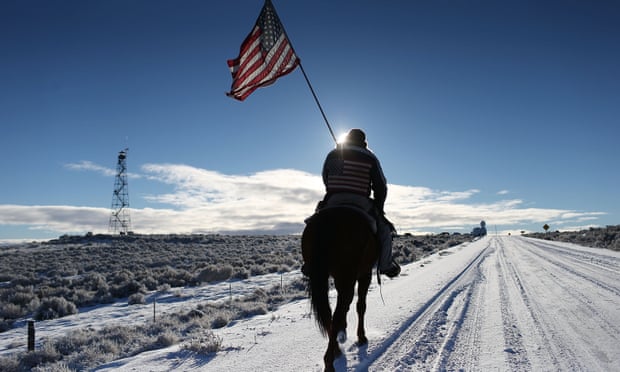
![]() |
| Because while many may see the Bundys as a joke, they see themselves as true patriots fighting in the name of God, justice, and the American Way. And a lot of people agree with them. |
So yeah, maybe the fact that the Bundys are white has something to do with why the government didn't go in guns blazing, but I don't think it is because the Feds are racists. I think it is because the whiteness of the Bundys helps convince a lot of people that they are right, and that large number of people that support them makes killing the Bundys a very VERY bad idea.
The Bundys want to start a war. They are opposed to the rule of law, science, Native land claims, protection of the environment, and any authority beyond themselves. A violent response to their provocations brings the probability of more violence closer. We should not be feeding into the type of rhetoric that feeds this kind of violent anger.
If there is any constant theme in my writing it is about the danger of divisive politics and rhetoric. This is a prime example. The Bundys are bullies and criminals, but when you ridicule them, or call for their killing, or claim that their continued existence is proof of racism, you contribute to the factionalization of our country. Our history is replete with cautionary examples of what this kind of divisiveness leads to.
Please stop calling for the killing of the Bundys, and start hoping for the peaceful restoration of the rule of law.
![]() |
| Malheur is a breathtaking place. It is one of the most important habitats in the West for migratory waterfowl. If you ever get the chance, make the trip. |
Thursday, November 19, 2015
As Human Beings, We Cannot Turn Away Syrian Refugees
In the 1940's when the family of nations turned their backs to refugees, millions of them died. In the 1970's when nations turned their backs to Cambodian refugees, millions of them died. I would like to live in a world that does not do this again.
------------------------------------------------------
I have not had time to write for this blog lately. I have more I want to say, and this topic requires much more, but this is the essence of what I want to say.
We cannot make the world a better place by allowing millions of people to die for want of a home. We cannot make the world a better place by closing our hearts and borders to refugees.
In the wake of the Paris attacks, it seems that far too many people want to just let the Aegean Sea swallow the waves of desperate humanity. Closing our eyes and hearts to the suffering of other humans will not make us safer. And denying succor to those refugees is a betrayal of fundamental humanity.
On a coldly practical level, one can certainly argue that allowing Muslims to die by the millions will be a great marketing campaign for ISIS. If one wanted to hurry along a planet razing clash of civilizations that dwarfed any previous conflict in human history, aiding in the dying of helpless Muslims would be a good way to go about it. So in the interest of the survival of our society, pure self interest should motivate you to support helping the refugees.
But we should not need to look at the political costs of abandoning humanity to understand that we cannot abandon our humanity.
There are 60 million human beings displaced right now. Our climate is in flux. War is rendering millions homeless. At no time since the end of WWII have more people been displaced. We owe it to the world's refugees to help them. Not because of what it means for us. Not because of politics. But because they are humans.
Turning our backs on the refugees is a way of murdering them. Turning our backs on millions of Syrians would be an act of negligent genocide.
The Syrian refugees, and all the other people fleeing from horrors, are people. That should be all the reason you need to know that you cannot abandon them.
------------------------------------------------------
I have not had time to write for this blog lately. I have more I want to say, and this topic requires much more, but this is the essence of what I want to say.
We cannot make the world a better place by allowing millions of people to die for want of a home. We cannot make the world a better place by closing our hearts and borders to refugees.
In the wake of the Paris attacks, it seems that far too many people want to just let the Aegean Sea swallow the waves of desperate humanity. Closing our eyes and hearts to the suffering of other humans will not make us safer. And denying succor to those refugees is a betrayal of fundamental humanity.
On a coldly practical level, one can certainly argue that allowing Muslims to die by the millions will be a great marketing campaign for ISIS. If one wanted to hurry along a planet razing clash of civilizations that dwarfed any previous conflict in human history, aiding in the dying of helpless Muslims would be a good way to go about it. So in the interest of the survival of our society, pure self interest should motivate you to support helping the refugees.
But we should not need to look at the political costs of abandoning humanity to understand that we cannot abandon our humanity.
There are 60 million human beings displaced right now. Our climate is in flux. War is rendering millions homeless. At no time since the end of WWII have more people been displaced. We owe it to the world's refugees to help them. Not because of what it means for us. Not because of politics. But because they are humans.
Turning our backs on the refugees is a way of murdering them. Turning our backs on millions of Syrians would be an act of negligent genocide.
The Syrian refugees, and all the other people fleeing from horrors, are people. That should be all the reason you need to know that you cannot abandon them.
Monday, September 7, 2015
The Toddler In The Surf
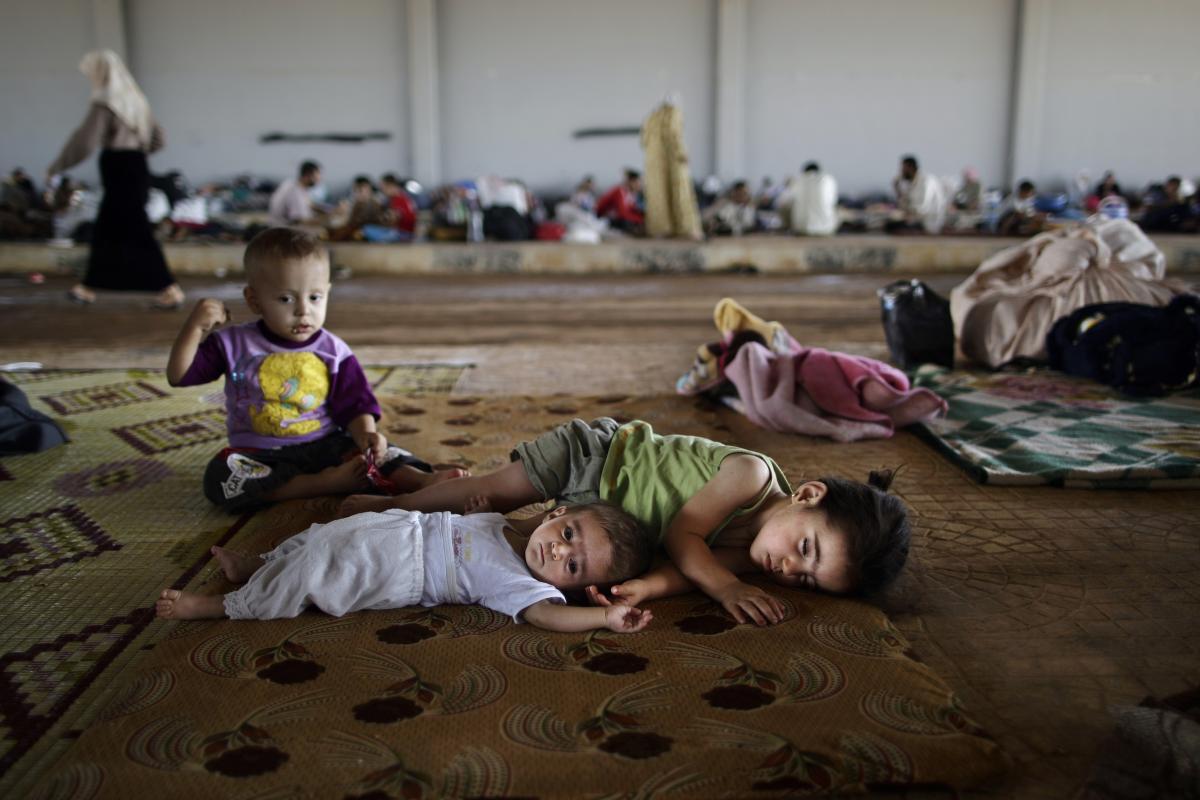
| The Zaatari Refugee camp on the border of Jordan. Just one of the camps for the more than 4 million refugees from the Syrian Civil War. Source: The Telegraph |
There is a picture on the internet. (Click through the link if you want to see the picture, but don't say I didn't warn you) It is a picture that I cannot bring myself to look squarely at, and that I cannot bring myself to put on my blog.
It is a picture of a boy, about three years old, dead on the beach in the surf. He drowned, along with his mother and brother (though his father survived), trying to reach the safety of a place not torn apart by a civil war of unimaginable cruelty.
Perhaps this picture hits me harder than most because I have a toddler myself, but I don't think that is the only reason. The photo has inspired hundreds of thousands of words of writing. The little dead boy has inspired soul searching in Western countries. The whole world doesn't have a toddler.
I think that this little dead boy strikes a chord because the world knows that the little boy didn't hurt anyone. He wasn't a rebel. He wasn't a soldier of an evil regime gassing civilians. He was not an ISIS militant raping and enslaving women and slaughtering innocents. He wasn't even a not-so-good guy that littered and cheated on his wife. He was just a little boy, trying to reach a place where he wouldn't have to worry about people trying to kill him and his family.
But he didn't make it. Like many refugees don't make it. But a lot more people have died long before they even started to seek refuge. And that is what the Syrian refugee crisis is about, people, regular people, seeking refuge from slaughter and depravity.
| Syrian Refugees entering Iraq back in 2013. Source: Times of Israel |
If you follow the news superficially it might seem like the Syrian refugee crisis is a new thing. Like it is some new humanitarian crisis that has blown up out of nowhere like a summer rainstorm. But it isn't new. It has been years in the making, and we (the West, the US, the voting public) are not innocent in this crisis. What is different about this crisis now is that it has expanded to the point where the wealthy nations can no longer ignore the human cost of their apathy and myopic meddling.
| Syrian Refugee children from back in 2013. Source: Occupy.com |
The challenge in trying to understand something as vastly catastrophic as the Syrian Civil War, or the concommitant rise of ISIS, is that there is always more context and more factors than can be held in any one mind at one time. The challenge is exacerbated by the inability of the human mind to truly grasp tragedies on a grand scale. The horrors of millions displaced and hundreds of thousands dead is so far beyond the scope of our ability to grasp that the human mind just resets back to zero. The death of one person can touch us profoundly, but when the numbers climb it becomes harder to truly feel the tragedy. So when we are confronted with a little dead boy face down in the surf, it hits harder than the photos of tens of thousands of tents.
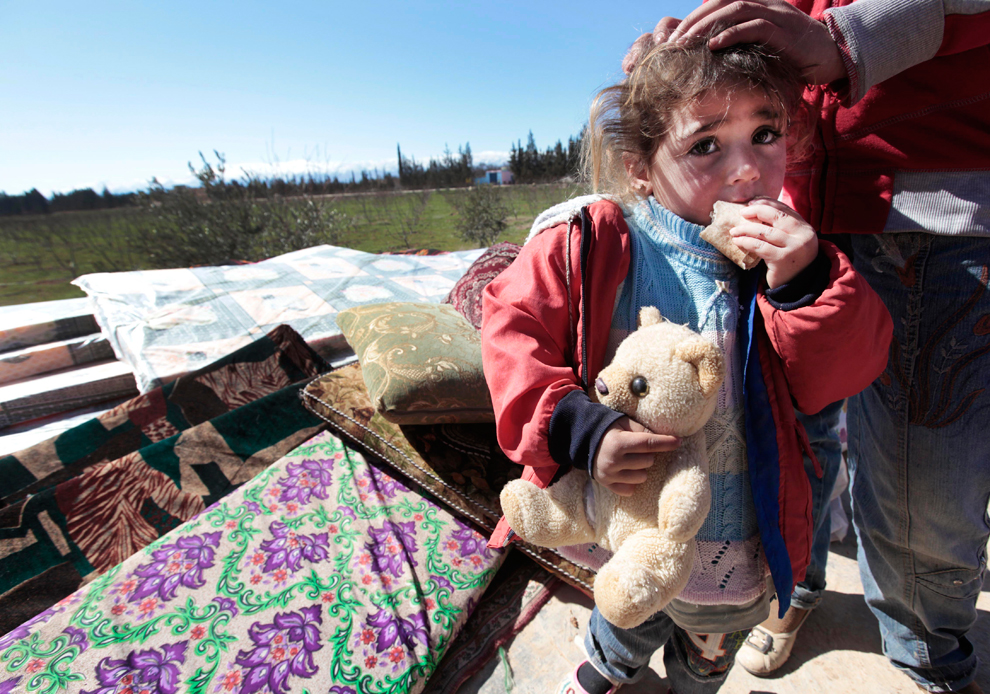
| Syrian refugee girl, from 2012. Source: Boston.com |
The Syrian Civil War may well have been precipitated by social stresses created by a severe drought, and that drought may have been a result of human-caused climate change. The post-apocalyptic flavor of bloodthirsty tyrants and maniacal murder-cults of movies like Mad Max seems to be made flesh in Syria. And fittingly, if Syria is an example of a nation brought to collapse by climate change this could be a whirlwind that much of the world will ultimately reap.
But the humanitarian crisis that faces the world right now cannot simply be chalked up to global forces of nature beyond human control. Global warming may have precipitated this mess, but failures of leadership here in the US and in the West at large have contributed to the ongoing nature of the disaster.
I could harp again on my hobby horse about the way that the failures of the US and the West to deal concretely with ISIS are creating a monster. But I've already written a blog post about how the US is half-assing its way to catastrophy (and if ISIS has its way we will half-ass our way into armageddon). But that would be unfair, because at this point ISIS has become too large, Iraq has become too weak, as has Syria, that a military solution to ISIS would require coherent and cohesive military and economic cooperation to avoid creating further regional destabilization. In short, we half-assed things long enough that we can't just go stomp on ISIS anymore.
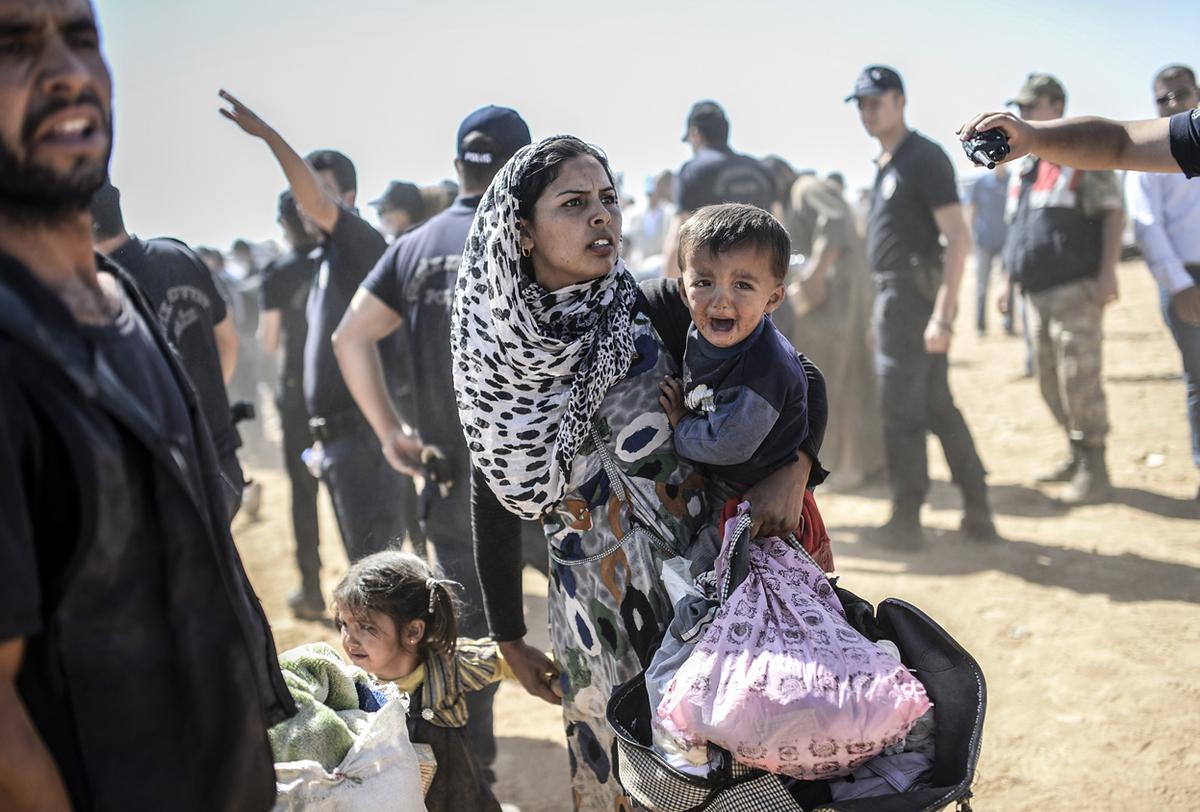
| A Syrian Kurdish women and children fleeing across the Turkish border to escape ISIS advance in 2014. Source: The Atlantic |
So instead I will harp on another one of my hobby horses, division politics. It is seriously arguable that the humanitarian crisis in Syria has reached its current magnitude thanks in large part to US part politics. The Syrian Civil War did not have to be allowed to spin out into a poly-polar mess of dozens of factions fighting for myriad goals. Of course avoiding the mess would have required doing two extremely politically poisonous things: One, at least tacitly supporting Assad; and Two, minimally not working against Russia.
Really, in order to avoid this current humanitarian crisis, the US could have simply stepped aside and let Russia more actively assist Assad with the brutal suppression of the Syrian uprising. It might have seemed heartless at the time, but it was already clear years ago that the rebels were no better, and probably worse, than Assad's regime.
You may recall the debate and bluster about "Red Lines" a few years ago when Obama was wanting to establish boundaries that would be unacceptable for Assad to cross. Obama was like Gandalf at the bridge in Moria saying "YOU SHALL NOT GAS!!!"
Of course it wasn't a movie, and Assad did use chemical weapons, but it looked like the rebels did too.
Both parties had been making a lot of noise about Syria and how bad Assad was. Some people said that we should back the rebels. Some people said that Obama was recklessly getting us involved in yet another Mideast military mistake. Some people said Obama was being too soft on Assad. Some people, who were very much in the minority at the time were saying, "umm, Assad might be bad and all, but this whole Arab Spring thing and the rebels in Syria might not be in our best interests."
But you have to remember that at the beginning, back in 2012, the Syrian Civil war didn't really seem like that big of a deal. The Arab Spring was bringing democracy to the Mideast. It was very popular in Washington to hop on the "Democracy good, Dictators bad" bandwagon. Getting into philosophical arguments about whether or not we should support "democratic" movements that seek to install democratically elected theocracies is the kind of nuanced debate that doesn't make for easily digestible soundbites. The shorthand we tend to use in this country is "Democracy good," but what we really mean is "Liberal Democracy Done Our Way good." After all, Hamas is the democratically elected leadership of Gaza. The Iraqi democracy, that we installed, decided to elect leaders that oppressed the Sunni minority. The examples go on, but it is the kind of thing that doesn't sound good in political debates. Whereas calling a political opponent anti-democracy does sound great in political debates.
So against this backdrop, a civil war breaking out in an Arab country that had seemed very stable seemed like... I dunno, democracy maybe, minor maybe, who knows, where is Syria anyway?
But then news reports started painting a picture of awfulness. It was sometime in 2012 that an Al Jazeera report first started really scarring my psyche with coverage of the Syrian Civil War. I had gotten into the habit of watching Al Jazeera reports on current events because the coverage often felt very immediate and raw. The day that an Al Jazeera report cut to footage of an infant bleeding out from a bullet wound convinced me that maybe I liked my news a little less raw. But once again it was the children of this war that broke my heart at the start and continue to haunt my thoughts today.
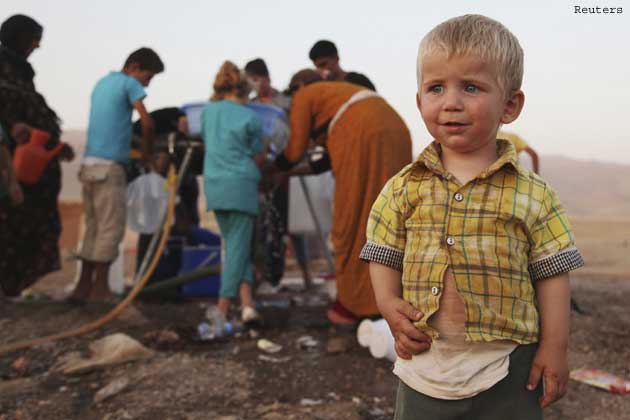
| A Syrian Refugee boy in Turkey. Reuters |
With all this awfulness happening, and "Dictators bad" in everyone's mind, eyes turned to Obama. What was he going to do about it? And here is where division politics in the US can take a tragedy on the other side of the planet and help it grow into a humanitarian catastrophe that destabilizes a region and then spills out over the world.
Obama couldn't just do nothing, or the Republicans would accuse him of failing to lead. But Obama couldn't just let Russia pursue their Agenda, especially since that would also help Iran. Backing Assad would have given the Republicans tremendous ammunition, plus most Democrats wouldn't feel comfortable backing a nasty dictator. So in order to back Assad, Obama would have had to risk attack on all sides domestically. But there was never going to be a realistic possibility of the US invading Syria and trying to set up another Iraq (remember, ISIS had not made the news yet, so Iraq was still being sold as a semi-success). Obama was caught between an emerging crisis and a political opposition that was poised to pounce on whatever action or inaction Obama took.
Obama essentially decided to avoid decisive action. In order to avoid entering into a politically costly war, Obama simply expanded the use of tremendously expensive air-power. Our politicians locked in their zero-sum game of musical chairs can all seem to agree that planes are really cool, and gee-whiz sci-fi technology like drones are fun ways to show how powerful the US is. So Obama "took action" by dropping bombs.
| Aww Yiss!!! Mutha fukin planes 'n shit!!! Time to drop some liberty on Syria! Source: The Telegraph |
Of course you can't bomb a country into having working infrastructure and the rule of law, and pretty much all of the dozens of factions (other than the Kurds) involved in the civil war are bad guys from the US perspective, so as logic would predict, a bombing campaign that couldn't actually support a side in a conflict failed to make anything better.
| Source: Russia Insider |
The US geopolitical position made standing aside a non-option, while domestic political rivalries made any meaningful action problematic. So the path of least political resistance was to drop bombs and ignore the problem as much as possible.
| Back to the kids. Syrian Refugee children in Iraq. Source: Rescue.org |
And the good news is that we actually do have a variety of things we can do, even as individuals, particularly in the US. After several hundred words crapping on the US for hamfisted meddling and apathy, I think it is only fair to remind readers that we do a lot of good as well. We are far enough away from Syria, geographically, that we don't get a lot of direct refugees (the same goes for the Old World in general); however, the US does lead the world in the resettling of refugees. Generally speaking, only about 1% of the world's refugees are eligible for permanent resettlement, but the US resettles more than half of that number. Out of the entire world, the US permanently resettles more refugees than the entire rest of the world combined.
We are a country of superlatives, usually it seems like the superlatives that get focused on are things like most money spent on military, and most shootings (that one is popular to say, but not actually true by a long shot, even among developed countries), and other negative superlatives; but we are also an exceedingly generous country, and we do integrate the most refugees into our society. And unlike many nations, the US focuses on integration, not housing refugees. In many countries refugees never get to own property or integrate into society, For instance, there are many Palestinians who are third and fourth generation refugees still living in refugee camps since the 1947 war of Israeli independence. For those refugees, almost 70 years later, they are still people without a country.
And the comparison to Palestinians is potentially quite apt, because the nature of the Syrian Civil War is such that it is very possible that millions of the Syrian Refugees may never have a home to return to. Usually, most refugees are able to return to their countries of origin after some period of time, however some refugees are permanently unable to return to their homes out of fear of death and/or persecution based on religion, political opinion, race, nationality, or membership in a particular social group. Considering that both ISIS and the Syrian government seem intent on persecuting and killing large swathes of the Syrian population, it is likely that an unprecedentedly large number of Syrian Refugees may become as permanently stateless as the Palestinian refugees have. What this means in practical terms, is that the permanent resettlement of potentially millions of Syrians may be necessary to avoid an ongoing intractable conflict like the Israeli/Palestinian conflict.
| Syrian refugee from Deir Ezzor with his children in tears of joy after arriving in an inflatable boat crammed with about 15 people. Source: Mirror |
It is too late to avoid the Syrian Civil War. We can't go back and undo the circumstances that led to this crisis. What we can do is try to keep this crisis from turning into a crisis that never ends. I wish that I could say that it would be possible to avoid this sort of calamity occurring again, but short of direct intervention by an omnibenevolent omniscient omnipotent force, I fail to see how all future humanitarian crises can be avoided. The best we can do is the best we can do with what we know and what we have now.
In the immediate term, here in the US, if you want to do something to help, but you don't want to spend money, you can make a difference by writing to your congresspeople. It might seem trite, but it really is a meaningful step you can take with a minimum of effort. Far more meaningful than any shared statuses or retweets. If you want to use a preset form, here is one all ready for you. That link is to support bills to help refugees, the site is the US Committee for Refugees and Immigrants at Refugees.org.
If you want to do more, and you can afford to give some money there are a number of worthwhile options. Here is an PRI article listing a number of organizations doing vital work on the Syrian refugee crisis. There are good options for donations. This article also contains a link to the Save the Children PSA which I will link to below, I think this video is profoundly affecting. It captures the reality of an everyday existence torn apart, and I think that is important to bear in mind when thinking about the Syrian crisis. Syria was not some turbulent backwater, it was for decades one of the most stable of Middle Eastern countries. It had one of the worst human rights records in the world, but it was stable. Stable enough for people to build lives that have been torn apart by this war.
Another option, if you are willing to truly take on some personal obligations, is you can consider sponsoring refugees. The US Department of State deals with Refugees, however the sponsoring of refugees is done through nine non-governmental organizations (NGOs)(per the State Department website), but as an indication of how opaque this process is, I cannot seem to find out what those "nine NGOs" are. There is some worthwhile information to be found, but the US system is confusing and decentralized enough that I feel it is beyond the scope of this blog post to try to explain how to sponsor people. That said, if you are in Oregon (as I am) Sponsors Organized to Assist Refugees (SOAR) through the Ecumenical Ministries of Oregon seems to be a viable option.
The refugee sponsorship option might actually be a better fit for organizations that you may be a part of, whether a religious community or social organization. If you are a member of an organization consider getting your organization involved in trying to help. The focus should not even necessarily be on sponsoring refugees at this time. Europe (and countries like Germany in particular) are currently seeing an enormous surge in refugees. Supporting groups like Refugees Welcome is a way to help soften the impact of the costs of caring for refugees in countries like Germany and Britain. And Charity Navigator offers a handy cheat-sheet for NGOs to donate to.
I wish that I could offer a workable solution to the entire Syrian Civil War, but I can't. But we can all do little, and not-so-little things to help. We can apply pressure on our politicians to seriously address the Syrian crisis. We can donate. Geography means that we here in the US can't give our time or labor to assist this crisis as easily, but we can try to assist those helping the refugees.
We can't make all the problems go away, but it is good to find ways to do something. There will undoubtedly be more awful images that will come from this war. The Syrian Civil War is ongoing. The refugees overflowing the Middle East and spilling onto the shores of the Mediterranean are largely landing in countries still reeling from financial crises. When we see refugees struggling with police it can feel bewildering, and that bewilderment can leave us feeling helpless.
When we are faced with images of toddlers face down in the surf it is a sickening feeling to be unable to do anything. We can't do as much as we might like, but we can do some things. I hope that this post helps you identify something that you can do. Because when we can help other human beings it makes the darkness of these kinds of tragedies feel a little lighter.
Saturday, July 18, 2015
An Immodest Proposal: Universal Uniformed Service
This post is a little different for me. It is not a knife review, or a digest of current events, or even anthropological; instead it is an idea of mine that I bend my friends and wife's ear about frequently. My wife has been asking me to write a post about it for a while, so here goes.
----------------------------------
I think that our country needs to institute a system of universal service for people turning 18 . My reasons for thinking this are manifold, but one thing that I want to point out right away is that I am not advocating for universal military service, but I do think it should be uniformed service (for simplicity's sake, from here on out I will abbreviate this idea as UUS for Universal Uniformed Service). This is a multifaceted idea, so I have difficulty knowing exactly where to start explaining my idea, so I will start with a description of how I would envision universal service working in order to get to why I think it should be adopted.
In my mind the ideal term of universal service would be four years. This would then sit between the completion of High School and the rest of people's lives. Realistically, I have a hard time imagining anything more than two years being within the realm of possibility for getting people to agree on. After all, two years of service starting at 18 years of age and continuing to 20 years would mean that most 20 year olds would have spent one tenth of their life in government service. From that perspective, two years is a very long time.
Each year over 4 million Americans turn 18. That would mean that if UUS were adopted, more than 8 million Americans would be in the course of their terms of service at any given time. This number far exceeds any number that could realistically be useful as military personnel. Having 8 million enlisted soldiers at any given time would be a massive drain on our economy, and would not make our armed services more effective. Considering that most of those soldiers would essentially be conscripts it would probably seriously impair the effectiveness of our armed forces.
Our current number for active duty uniformed personnel is approximately 1.4 million people, with a similar number in reserve. This is out of roughly 140 million people that would be considered "Available" for military service. Out of the 140 million available, roughly 120 million could be considered "Fit" for service. Essentially this means that one percent of the US population of service age is active duty military, and a total of two percent is active and reserve. Out of the total population half a percent is active and another half a percent is reserve, for a total of less than one percent serving. But that doesn't mean that only one percent serves, in total roughly 7.3 % of the population has served or is serving at any given time.
But 7.3% is still a small fraction of the population. This means that the burdens of service for our country are borne by less than one tenth of the population. More than 90% of the population is not involved in unformed service. This seems very problematic to me.
--------------------------------
Aside #1:
What's wrong with letting a small minority bear the burdens of service?
Firstly, and most obviously, if the vast majority of people do not serve their country then that means that the majority have not invested their own effort directly into the country. If one accepts a fascist perspective on this, that means that the majority does not value the rights and privileges of citizenship since something unearned has no value. The way I see it, when the majority does not serve, the real danger is that the majority does not truly see themselves as a part of the country. The country, the government, the nation, becomes an alienated abstraction. It is hard for a democracy to function when people do not see themselves as part of it.
Less obviously, having a small minority involved in the military means that the majority views the military as an Other. When service is voluntary this is exacerbated. This also leads to the serving minority feeling distinct from the majority. It is not healthy for a society to view it's military as a distinct class of people.
The most obvious potential negative of having what is essentially a separate military class is that military dictatorship becomes a greater possibility, but I personally think this is less of a threat to our republic at this time than another consequence of our current system.
When military service is borne by a small voluntary minority it is much easier for a country to go to war. Our all volunteer military is dangerously close to being a professional military, rather than an army of citizen soldiers. This means that politicians and the public find it easy to start thinking of soldiers as if they were mercenaries. It is then much easier to go to war. After all, it's not my kids getting shot for opaque reasons in some godforsaken corner of a country whose name I can't spell, it's those people getting shot. It's their job after all.
This is the real danger, to my mind, of our current system. Our all volunteer military means that there is close to zero negative consequences for our politicians when they want to use American money and American lives to go kill people for poorly articulated reasons. When we had a draft and the government decided to start pumping American teenagers into Vietnam, the push back from the US populace was massive and hugely destabilizing. As we near 14 years of war in Afghanistan the US populace's response is simply ignore the fact that we are at war.
Universal service makes it harder to send teenagers to die and/or kill other teenagers.
-----------------------------
But back to how to make universal service work.
The trouble with the idea of simply reinstating the draft is that, frankly, our all volunteer military is just more effective than the old model armies were. it doesn't seem like a good idea to make our military less effective.
Also, as I mentioned, if we instituted universal military service, we would end up with more than four times as many soldiers than we currently have when we already have the second largest standing military in the world. We already spend more on our military than anyone, and our military is extremely large. So how can we institute universal service in a way that actually serves our country?
The one word answer is: Infrastructure.
------------------------------
In my vision, the primary mission of a UUS would be Infrastructure. Our country doesn't need a larger army, but our infrastructure is crumbling. In many cases critical pieces of the US infrastructure are still left over from the WPA projects from the Great Depression. Much of the remainder of our infrastructure is left over from the Cold War. Our bridges and roads are crumbling. Utilities are antiquated. And there is next to zero political will to seriously fix our infrastructure problems.
The Great Recession could have been an opportunity to engage in a new round of infrastructure renewal, but rather than spending tax dollars on rebuilding the foundations that our economy is built on, the money was spent on bailouts and stimulus packages. Workers were not trained in trades. New infrastructure was not built. New jobs were not created. Bankers were saved from their own malfeasance and economic stratification was exacerbated.
And our infrastructure is still crumbling.
A UUS with Infrastructure as a primary mission would mean that we would literally have armies of young people literally building a better country.
And infrastructure doesn't just mean roads and bridges. Part of the infrastructure development could be building renewable energy systems like solar plants and wind power. Data networks, water pipelines, sewer systems, integrated waste disposal systems that combine sewage and yard waste to more efficiently produce methane to make our waste treatment energy neutral and a source of fertilizer. There are many ways that an ongoing commitment to infrastructure renewal and improvement can make our country stronger and provide more opportunities and a higher standard of living to people.
One of the obstacles to building new national infrastructure is cost. A significant portion of that cost is in labor. One of the advantages of having a uniformed service doing much of the labor is lower labor costs. I envision a system where the Engineering Corps is paid similarly to soldiers. This would mean much lower labor costs. The average enlisted soldier, with less than two years in, makes a little less than $1,500 per month (not counting benefits). The average union laborer makes a little less than $1,000 a week. If we were to have 3 million people building infrastructure at an E1 (Enlisted 1) pay rate that would mean $4.5 billion in pay per month; vs. $12 billion in labor costs for the same amount of work at the federally mandated Davis Bacon Prevailing Wage. So the savings would be almost 2/3 on labor pay.
Of course, if our country could actually commit to spending money on infrastructure the way it spends on the military industrial complex $7.5 billion dollars would be nothing. Heck, we spent that much on just a single no-bid contract to Dick Cheney's business partners during the second Iraq War. When it comes to the money lost through war profiteering by politically connected companies in the military-industrial complex $7.5 billion in wage savings is a rounding error.
--------------------------
Aside #2
As should be very obvious from the last couple paragraphs, there are already two major politically powerful groups that would almost certainly be opposed to this type of plan: Unions and the Military-Industrial Complex (MIC). This would pretty much mean that the idea that I am laying out is one that has zero chance of ever getting the support of any politician. The Democrats aren't going to want to alienate the Unions, and the Republican (and many of the Democrats) aren't going to want to alienate the MIC.
From a Union perspective this idea I am proposing is essentially taking millions of Union jobs away from trades professionals and giving them to minimally trained young adults. Taking Federal Infrastructure work away from unions would be a hard pill to swallow. I might argue that this system will give millions of young adults real-world experience and training in vital trades, and could in fact strengthen Unions in the private sector, but government work is an important part of the bread and butter of labor unions.
Nonetheless, I feel that between Unions and the MIC, the Unions are less likely to be such an insurmountable obstacle.
When it comes to war-profiteering firms like Halliburton that fund political campaigns and then provide employment to the politicians they supported after they are out of office, it is hard to imagine any possibility of this sort of idea gaining any traction. If we had a Universal Uniformed Service it would remove the need for things like private security companies to provide security for soldiers, or private corporations to do construction in foreign countries for the military. All of a sudden, instead of having unlimited billions to give to politically connected corporations the US government would have to start using uniformed personnel to do work that should be done by uniformed personnel. It would be a return to the kinds of systems that were in use back in WWII with the Construction Battalions (Seabees). (Bear in mind, the Seabees still exist, but for some reason our government prefers to funnel money to companies like Halliburton)
Since 9/11 we have spent $1.6 TRILLION (that is one thousand six-hundred billions of dollars) on the war on terror. I will just share this quote on the breakdown of that money:
A conservative estimate on the amount of that money that has been wasted out of the $206 billion paid to contractors in Afghanistan and Iraq (as of 2011) was $31 to 60 billion. Like I said before, when it comes to the incomprehensible scale of the colossal corruption of the US war machine, saving $7.5 billion in labor costs is a rounding error.
And it is this massive collusion of political and corporate interests that I feel poses the greatest obstacle to universal service. Politicians rely on these corporations (and unions to a lesser degree) for the funding necessary to run for office, and then those corporations provide positions and pay for the politicians after they leave office. Politicians don't just need the corporations to get their jobs in the first place, they are also a means to wealth after holding office. In return for the money spent on the politicians, the politicians give the corporations life by feeding them the wealth taken from taxpayers. The corporations make the politicians careers possible, and the politicians make the existence of the corporations possible. Everybody wins, except for the taxpaying public. A system of universal service would pose a grave threat to many of the most profitable aspects this system that our government and economy is currently predicated upon.
----------------------------
But back to my idea.
As I alluded to in Aside #2, even though my vision is that the primary mission of a UUS would be infrastructure, I am not envisioning infrastructure as the sole role. 8 million people is a lot of people. Earlier I threw out the number of 3 million people employed to work on infrastructure, that still leaves 5 million people. I would expect that at least a million of those people would be employed in the military, so now we are left with 4 million people. There are a lot of things that we could do with those people.
The US government currently officially employs 2.6 million people, but that doesn't count Uniformed or Legislative employees, so the actual total is closer to 4.2 million people (2% of the labor pool). But even that number hides the true number of people employed by the government. In 2005 the federal government employed roughly 7.9 million contractors. Now we are starting to see where those 8 million young people would really be useful. When you factor in the millions employed by state and municipal governments, the total number of people whose pay derives from taxpayers comes to around 17% of the US labor pool (40 million people), but most of those people are not directly employed by the government, most of them are contractors, and it is the low level contractor work that would largely be replaced by a UUS.
Conservatives may enjoy lambasting the government as inefficient, but federal budget bloat is not caused by government employees, it is caused by the shadowy way that taxpayer money can be endlessly funneled to private corporations in the name of efficiency. A UUS would gut the heart of this mechanism while posing a fraction of the labor cost.
The remainder of the 4 million people in the UUS could be employed in a wide variety of positions. Some could be employed in healthcare as an expanded Medical Corps, the Peace Corps could be expanded and we could have armies of young Americans working around the world to better the lives of billions. Rather than having private security providing security for government and military installations we could have a Security Corps. And one of the keys to making my idea useful, and the key to making it possible for the system to be truly universal, would be a Clerical Corps. At all levels of our government and military, many of the jobs being performed are clerical jobs. While many of those positions do require highly educated individuals, many of them do not.
In order for the UUS to be universal, it would need to be something that every citizen could do. If every position required an able body and a fully able mind then many would not be eligible to serve. This would mean that disabled Americans would not be able to serve, and would not be equal to those who were able to serve and share in the benefits of service. For universal service to be fair and meaningful, everyone who is willing to serve has to be able to serve. That means (to crib directly from Heinlein) if all you can do is sharpen pencils, then the government would need to create a pencil sharpening position for you, and provided you sharpened pencils adequately for your term of service you would earn the benefits of having served. If the UUS offered a truly diversified set of options for modes of service then it could in fact be a system of service that was open to all Americans.
In my mind, I imagine the start of the term of service being like the current start, Basic Training. I would envision everyone going through Basic Training, including firearms training . But obviously if the system is universal then not everyone will be able to make it through military Basic. I would envision that there would be a variety of Basic Training tracks, with Mode of Service options being presented at the end of Basic Training.
--------------------------
Aside #3
Firearm training: In my ideal scenario, the Basic Training for everyone would involve firearm training.
Considering the ubiquity of firearms in this country, I find the lack of basic firearm safety training for most people to be criminally negligent. Guns are readily available to anyone over the age of 18, but most Americans never get taught how to use one safely. Not everyone needs to like guns, not everyone needs to use guns regularly, but everyone who lives in a country where there are more guns than people should have a basic understanding of what guns are.
When you consider how available guns are in this country, and how little most people know about guns, it is surprising that our gun problems aren't much worse than they are. Obviously many people think that getting rid of gun rights is the solution to gun violence, but I tend to land on the side of trying to find solutions to problems that do not involve stripping people of freedoms. But this is too big of a topic to be contained in an aside.
Also, in addition to basic firearm safety and operation, I think that every American should be trained in First Aid. Teaching everyone about guns may or may not improve anything, but teaching everyone First Aid will undoubtedly save many lives.
---------------------------
Now that I have vaguely sketched out the bones of how I would imagine universal service working we can get to why universal service would be a good idea.
I have already touched on ways that universal service could be beneficial to the US. Universal service would create a more, well, universal feeling of investment and participation in our country. Universal service should make it more difficult for our government to engage in wars of choice, and minimally would bring more aspects of our military adventures under the auspices of our government, thereby making it easier for people to find out what it is we are really doing. Universal service would provide work experience and trade training to millions of young people every year. Universal service would provide lower cost alternatives to current contractor models. Universal service would undermine the corrupt systems that warp our government.
It sounds like a panacea! And we're not even done examining the potential benefits! But I want to take a step back and be clear that there is not magic bullet to fix all of our problems. Even if everything I have written about came true exactly as I have described, it would not fix every problem in our society. Our society and world are unimaginably complex, and there are always unintended consequences. Universal service would not eliminate corruption. Universal service would not end social ills. It would not eliminate all crime, nor provide equality for all disabled people. At best, universal service could be a tool used to fight the problems we face, but it would only be one tool. But I think that is more than reason enough to try it.
Continuing in the more intangible and hypothetical vein of reasons to institute universal service, a benefit would be providing a shared rite of passage into true adulthood for young Americans. Right now the closest thing we have is high-school graduation. After graduation the privileged get to go directly on to college which functions as an adolescence extending super high-school viewed as a necessary step to achieving a financially solvent future. Some people go on to trade schools. A small percentage go off to perform national service. And the vast majority are dumped out into a world that they are unprepared for without tradable skills or systems of support. Two years outside of the home, away from school, away from parents, with others of the same age, learning skills, and with a kind of structured and supported step on the way to adulthood would provide young adults with a clearer transition from childhood (I can easily imagine how many would see this very differently, but that is how I view it).
More concretely, universal service would provide possible solutions to many of the political issues that we currently struggle with. Many Americans require assistance to go to college. Many require assistance to afford healthcare. And most young people start out their adulthood without a nest egg to build from. Universal service could entitle all people who complete their terms to the GI Bill. Everyone would get access to educational funds. Everyone would get access to VA medical care. And upon completion of the term of service, everyone would have had the opportunity to build up a cash reserve to start their adult lives with. This would simplify arguments about how to make higher education more accessible, plus the incoming freshmen would have had a few years of adult life under their belt before starting school.
If everyone was eligible for VA medical, politicians would not be able to get away with calling people who need assistance with their medical care parasites. Additionally, politicians would not be able to continue to get away with under-funding the VA the way they currently do. And let's be clear here, the US government under-funds the VA to such an great extent that it is costing us the lives of thousands of veterans every year. Our system currently says that those who have served are entitled to medical care. Many people think that universal healthcare should be provided, and in any case many people have difficulty affording healthcare. Universal service would make universal access to basic healthcare a reality, and when everyone has access to the VA, then everyone has a stake in making it really work.
One of the benefits of this approach is that it also works around the problems of whether or not there would still be private care. There would be no need to get rid of private care. It would be a two tier system in essence, but I am fine with that. A universally available basic health care system also makes it easier for individuals to engage in entrepreneurship since access to healthcare would not be reliant on employers. However, this is another topic too big for an aside.
And making the benefits that we bestow on those who have served something that is universally available is the key to making this idea truly useful and workable. Universally earned entitlements make it much harder for conservatives to demonize poverty. This system also provides concrete incentives for everyone to serve, because there is one final piece to my vision that I think is vital. I think that people must be able to be conscientious objectors, or to refuse to serve for religious reasons. In order for universal service to really be of value it has to be something that people can refuse. Service would provide benefits, and service would be possible for those who do not wish to serve in the military, but it would not be forced on people.
-----------------------------
Maybe it would work, maybe it wouldn't. Maybe I'm a cockeyed optimist. Maybe I'm an unwitting crypto-fascist. I can't say for sure, but I think that universal service is a workable tool that we could use to build a better society with better economic mobility and a stronger base.
This is one of my more grandiose political ideas. What do you think? Let me know.
----------------------------------
![]() |
| A WPA Bridge |
I think that our country needs to institute a system of universal service for people turning 18 . My reasons for thinking this are manifold, but one thing that I want to point out right away is that I am not advocating for universal military service, but I do think it should be uniformed service (for simplicity's sake, from here on out I will abbreviate this idea as UUS for Universal Uniformed Service). This is a multifaceted idea, so I have difficulty knowing exactly where to start explaining my idea, so I will start with a description of how I would envision universal service working in order to get to why I think it should be adopted.
In my mind the ideal term of universal service would be four years. This would then sit between the completion of High School and the rest of people's lives. Realistically, I have a hard time imagining anything more than two years being within the realm of possibility for getting people to agree on. After all, two years of service starting at 18 years of age and continuing to 20 years would mean that most 20 year olds would have spent one tenth of their life in government service. From that perspective, two years is a very long time.
Each year over 4 million Americans turn 18. That would mean that if UUS were adopted, more than 8 million Americans would be in the course of their terms of service at any given time. This number far exceeds any number that could realistically be useful as military personnel. Having 8 million enlisted soldiers at any given time would be a massive drain on our economy, and would not make our armed services more effective. Considering that most of those soldiers would essentially be conscripts it would probably seriously impair the effectiveness of our armed forces.
Our current number for active duty uniformed personnel is approximately 1.4 million people, with a similar number in reserve. This is out of roughly 140 million people that would be considered "Available" for military service. Out of the 140 million available, roughly 120 million could be considered "Fit" for service. Essentially this means that one percent of the US population of service age is active duty military, and a total of two percent is active and reserve. Out of the total population half a percent is active and another half a percent is reserve, for a total of less than one percent serving. But that doesn't mean that only one percent serves, in total roughly 7.3 % of the population has served or is serving at any given time.
But 7.3% is still a small fraction of the population. This means that the burdens of service for our country are borne by less than one tenth of the population. More than 90% of the population is not involved in unformed service. This seems very problematic to me.
--------------------------------
Aside #1:
What's wrong with letting a small minority bear the burdens of service?
Firstly, and most obviously, if the vast majority of people do not serve their country then that means that the majority have not invested their own effort directly into the country. If one accepts a fascist perspective on this, that means that the majority does not value the rights and privileges of citizenship since something unearned has no value. The way I see it, when the majority does not serve, the real danger is that the majority does not truly see themselves as a part of the country. The country, the government, the nation, becomes an alienated abstraction. It is hard for a democracy to function when people do not see themselves as part of it.
Less obviously, having a small minority involved in the military means that the majority views the military as an Other. When service is voluntary this is exacerbated. This also leads to the serving minority feeling distinct from the majority. It is not healthy for a society to view it's military as a distinct class of people.
The most obvious potential negative of having what is essentially a separate military class is that military dictatorship becomes a greater possibility, but I personally think this is less of a threat to our republic at this time than another consequence of our current system.
When military service is borne by a small voluntary minority it is much easier for a country to go to war. Our all volunteer military is dangerously close to being a professional military, rather than an army of citizen soldiers. This means that politicians and the public find it easy to start thinking of soldiers as if they were mercenaries. It is then much easier to go to war. After all, it's not my kids getting shot for opaque reasons in some godforsaken corner of a country whose name I can't spell, it's those people getting shot. It's their job after all.
This is the real danger, to my mind, of our current system. Our all volunteer military means that there is close to zero negative consequences for our politicians when they want to use American money and American lives to go kill people for poorly articulated reasons. When we had a draft and the government decided to start pumping American teenagers into Vietnam, the push back from the US populace was massive and hugely destabilizing. As we near 14 years of war in Afghanistan the US populace's response is simply ignore the fact that we are at war.
Universal service makes it harder to send teenagers to die and/or kill other teenagers.
-----------------------------
But back to how to make universal service work.
The trouble with the idea of simply reinstating the draft is that, frankly, our all volunteer military is just more effective than the old model armies were. it doesn't seem like a good idea to make our military less effective.
Also, as I mentioned, if we instituted universal military service, we would end up with more than four times as many soldiers than we currently have when we already have the second largest standing military in the world. We already spend more on our military than anyone, and our military is extremely large. So how can we institute universal service in a way that actually serves our country?
The one word answer is: Infrastructure.
------------------------------
In my vision, the primary mission of a UUS would be Infrastructure. Our country doesn't need a larger army, but our infrastructure is crumbling. In many cases critical pieces of the US infrastructure are still left over from the WPA projects from the Great Depression. Much of the remainder of our infrastructure is left over from the Cold War. Our bridges and roads are crumbling. Utilities are antiquated. And there is next to zero political will to seriously fix our infrastructure problems.
The Great Recession could have been an opportunity to engage in a new round of infrastructure renewal, but rather than spending tax dollars on rebuilding the foundations that our economy is built on, the money was spent on bailouts and stimulus packages. Workers were not trained in trades. New infrastructure was not built. New jobs were not created. Bankers were saved from their own malfeasance and economic stratification was exacerbated.
And our infrastructure is still crumbling.
A UUS with Infrastructure as a primary mission would mean that we would literally have armies of young people literally building a better country.
And infrastructure doesn't just mean roads and bridges. Part of the infrastructure development could be building renewable energy systems like solar plants and wind power. Data networks, water pipelines, sewer systems, integrated waste disposal systems that combine sewage and yard waste to more efficiently produce methane to make our waste treatment energy neutral and a source of fertilizer. There are many ways that an ongoing commitment to infrastructure renewal and improvement can make our country stronger and provide more opportunities and a higher standard of living to people.
One of the obstacles to building new national infrastructure is cost. A significant portion of that cost is in labor. One of the advantages of having a uniformed service doing much of the labor is lower labor costs. I envision a system where the Engineering Corps is paid similarly to soldiers. This would mean much lower labor costs. The average enlisted soldier, with less than two years in, makes a little less than $1,500 per month (not counting benefits). The average union laborer makes a little less than $1,000 a week. If we were to have 3 million people building infrastructure at an E1 (Enlisted 1) pay rate that would mean $4.5 billion in pay per month; vs. $12 billion in labor costs for the same amount of work at the federally mandated Davis Bacon Prevailing Wage. So the savings would be almost 2/3 on labor pay.
Of course, if our country could actually commit to spending money on infrastructure the way it spends on the military industrial complex $7.5 billion dollars would be nothing. Heck, we spent that much on just a single no-bid contract to Dick Cheney's business partners during the second Iraq War. When it comes to the money lost through war profiteering by politically connected companies in the military-industrial complex $7.5 billion in wage savings is a rounding error.
--------------------------
Aside #2
As should be very obvious from the last couple paragraphs, there are already two major politically powerful groups that would almost certainly be opposed to this type of plan: Unions and the Military-Industrial Complex (MIC). This would pretty much mean that the idea that I am laying out is one that has zero chance of ever getting the support of any politician. The Democrats aren't going to want to alienate the Unions, and the Republican (and many of the Democrats) aren't going to want to alienate the MIC.
From a Union perspective this idea I am proposing is essentially taking millions of Union jobs away from trades professionals and giving them to minimally trained young adults. Taking Federal Infrastructure work away from unions would be a hard pill to swallow. I might argue that this system will give millions of young adults real-world experience and training in vital trades, and could in fact strengthen Unions in the private sector, but government work is an important part of the bread and butter of labor unions.
Nonetheless, I feel that between Unions and the MIC, the Unions are less likely to be such an insurmountable obstacle.
When it comes to war-profiteering firms like Halliburton that fund political campaigns and then provide employment to the politicians they supported after they are out of office, it is hard to imagine any possibility of this sort of idea gaining any traction. If we had a Universal Uniformed Service it would remove the need for things like private security companies to provide security for soldiers, or private corporations to do construction in foreign countries for the military. All of a sudden, instead of having unlimited billions to give to politically connected corporations the US government would have to start using uniformed personnel to do work that should be done by uniformed personnel. It would be a return to the kinds of systems that were in use back in WWII with the Construction Battalions (Seabees). (Bear in mind, the Seabees still exist, but for some reason our government prefers to funnel money to companies like Halliburton)
Since 9/11 we have spent $1.6 TRILLION (that is one thousand six-hundred billions of dollars) on the war on terror. I will just share this quote on the breakdown of that money:
Breaking down that figure into its parts provides an even better sense of scale. Of that $1.6 trillion, the Department of State received a 6% chunk for foreign aid programs and diplomatic operations and just 1% was spent on medical care for veterans. The largest share — or about 92% — was allocated to the Department of Defense, which distributed funds to the government’s civilian contractors who manufactured the necessary jets, drones, and missiles; helped run prisons like Abu Ghraib; and, provided security and support to outnumbered U.S. troops on the ground.Many people think that they are supporting the troops when they unquestioningly support the War on Terror, but the numbers show that the troops are an afterthought at best when it comes to the expenditure of our nation's treasure. The one percent that serves gets one percent of the money, the rest goes to that other One Percent.
Read more: http://www.cheatsheet.com/politics/this-is-what-1-6-trillion-bought-in-the-u-s-global-war-on-terror.html/?a=viewall#ixzz3gH8ZLN7g
A conservative estimate on the amount of that money that has been wasted out of the $206 billion paid to contractors in Afghanistan and Iraq (as of 2011) was $31 to 60 billion. Like I said before, when it comes to the incomprehensible scale of the colossal corruption of the US war machine, saving $7.5 billion in labor costs is a rounding error.
And it is this massive collusion of political and corporate interests that I feel poses the greatest obstacle to universal service. Politicians rely on these corporations (and unions to a lesser degree) for the funding necessary to run for office, and then those corporations provide positions and pay for the politicians after they leave office. Politicians don't just need the corporations to get their jobs in the first place, they are also a means to wealth after holding office. In return for the money spent on the politicians, the politicians give the corporations life by feeding them the wealth taken from taxpayers. The corporations make the politicians careers possible, and the politicians make the existence of the corporations possible. Everybody wins, except for the taxpaying public. A system of universal service would pose a grave threat to many of the most profitable aspects this system that our government and economy is currently predicated upon.
----------------------------
But back to my idea.
As I alluded to in Aside #2, even though my vision is that the primary mission of a UUS would be infrastructure, I am not envisioning infrastructure as the sole role. 8 million people is a lot of people. Earlier I threw out the number of 3 million people employed to work on infrastructure, that still leaves 5 million people. I would expect that at least a million of those people would be employed in the military, so now we are left with 4 million people. There are a lot of things that we could do with those people.
The US government currently officially employs 2.6 million people, but that doesn't count Uniformed or Legislative employees, so the actual total is closer to 4.2 million people (2% of the labor pool). But even that number hides the true number of people employed by the government. In 2005 the federal government employed roughly 7.9 million contractors. Now we are starting to see where those 8 million young people would really be useful. When you factor in the millions employed by state and municipal governments, the total number of people whose pay derives from taxpayers comes to around 17% of the US labor pool (40 million people), but most of those people are not directly employed by the government, most of them are contractors, and it is the low level contractor work that would largely be replaced by a UUS.
Conservatives may enjoy lambasting the government as inefficient, but federal budget bloat is not caused by government employees, it is caused by the shadowy way that taxpayer money can be endlessly funneled to private corporations in the name of efficiency. A UUS would gut the heart of this mechanism while posing a fraction of the labor cost.
The remainder of the 4 million people in the UUS could be employed in a wide variety of positions. Some could be employed in healthcare as an expanded Medical Corps, the Peace Corps could be expanded and we could have armies of young Americans working around the world to better the lives of billions. Rather than having private security providing security for government and military installations we could have a Security Corps. And one of the keys to making my idea useful, and the key to making it possible for the system to be truly universal, would be a Clerical Corps. At all levels of our government and military, many of the jobs being performed are clerical jobs. While many of those positions do require highly educated individuals, many of them do not.
In order for the UUS to be universal, it would need to be something that every citizen could do. If every position required an able body and a fully able mind then many would not be eligible to serve. This would mean that disabled Americans would not be able to serve, and would not be equal to those who were able to serve and share in the benefits of service. For universal service to be fair and meaningful, everyone who is willing to serve has to be able to serve. That means (to crib directly from Heinlein) if all you can do is sharpen pencils, then the government would need to create a pencil sharpening position for you, and provided you sharpened pencils adequately for your term of service you would earn the benefits of having served. If the UUS offered a truly diversified set of options for modes of service then it could in fact be a system of service that was open to all Americans.
In my mind, I imagine the start of the term of service being like the current start, Basic Training. I would envision everyone going through Basic Training, including firearms training . But obviously if the system is universal then not everyone will be able to make it through military Basic. I would envision that there would be a variety of Basic Training tracks, with Mode of Service options being presented at the end of Basic Training.
--------------------------
Aside #3
Firearm training: In my ideal scenario, the Basic Training for everyone would involve firearm training.
Considering the ubiquity of firearms in this country, I find the lack of basic firearm safety training for most people to be criminally negligent. Guns are readily available to anyone over the age of 18, but most Americans never get taught how to use one safely. Not everyone needs to like guns, not everyone needs to use guns regularly, but everyone who lives in a country where there are more guns than people should have a basic understanding of what guns are.
When you consider how available guns are in this country, and how little most people know about guns, it is surprising that our gun problems aren't much worse than they are. Obviously many people think that getting rid of gun rights is the solution to gun violence, but I tend to land on the side of trying to find solutions to problems that do not involve stripping people of freedoms. But this is too big of a topic to be contained in an aside.
Also, in addition to basic firearm safety and operation, I think that every American should be trained in First Aid. Teaching everyone about guns may or may not improve anything, but teaching everyone First Aid will undoubtedly save many lives.
---------------------------
Now that I have vaguely sketched out the bones of how I would imagine universal service working we can get to why universal service would be a good idea.
I have already touched on ways that universal service could be beneficial to the US. Universal service would create a more, well, universal feeling of investment and participation in our country. Universal service should make it more difficult for our government to engage in wars of choice, and minimally would bring more aspects of our military adventures under the auspices of our government, thereby making it easier for people to find out what it is we are really doing. Universal service would provide work experience and trade training to millions of young people every year. Universal service would provide lower cost alternatives to current contractor models. Universal service would undermine the corrupt systems that warp our government.
It sounds like a panacea! And we're not even done examining the potential benefits! But I want to take a step back and be clear that there is not magic bullet to fix all of our problems. Even if everything I have written about came true exactly as I have described, it would not fix every problem in our society. Our society and world are unimaginably complex, and there are always unintended consequences. Universal service would not eliminate corruption. Universal service would not end social ills. It would not eliminate all crime, nor provide equality for all disabled people. At best, universal service could be a tool used to fight the problems we face, but it would only be one tool. But I think that is more than reason enough to try it.
Continuing in the more intangible and hypothetical vein of reasons to institute universal service, a benefit would be providing a shared rite of passage into true adulthood for young Americans. Right now the closest thing we have is high-school graduation. After graduation the privileged get to go directly on to college which functions as an adolescence extending super high-school viewed as a necessary step to achieving a financially solvent future. Some people go on to trade schools. A small percentage go off to perform national service. And the vast majority are dumped out into a world that they are unprepared for without tradable skills or systems of support. Two years outside of the home, away from school, away from parents, with others of the same age, learning skills, and with a kind of structured and supported step on the way to adulthood would provide young adults with a clearer transition from childhood (I can easily imagine how many would see this very differently, but that is how I view it).
More concretely, universal service would provide possible solutions to many of the political issues that we currently struggle with. Many Americans require assistance to go to college. Many require assistance to afford healthcare. And most young people start out their adulthood without a nest egg to build from. Universal service could entitle all people who complete their terms to the GI Bill. Everyone would get access to educational funds. Everyone would get access to VA medical care. And upon completion of the term of service, everyone would have had the opportunity to build up a cash reserve to start their adult lives with. This would simplify arguments about how to make higher education more accessible, plus the incoming freshmen would have had a few years of adult life under their belt before starting school.
If everyone was eligible for VA medical, politicians would not be able to get away with calling people who need assistance with their medical care parasites. Additionally, politicians would not be able to continue to get away with under-funding the VA the way they currently do. And let's be clear here, the US government under-funds the VA to such an great extent that it is costing us the lives of thousands of veterans every year. Our system currently says that those who have served are entitled to medical care. Many people think that universal healthcare should be provided, and in any case many people have difficulty affording healthcare. Universal service would make universal access to basic healthcare a reality, and when everyone has access to the VA, then everyone has a stake in making it really work.
One of the benefits of this approach is that it also works around the problems of whether or not there would still be private care. There would be no need to get rid of private care. It would be a two tier system in essence, but I am fine with that. A universally available basic health care system also makes it easier for individuals to engage in entrepreneurship since access to healthcare would not be reliant on employers. However, this is another topic too big for an aside.
And making the benefits that we bestow on those who have served something that is universally available is the key to making this idea truly useful and workable. Universally earned entitlements make it much harder for conservatives to demonize poverty. This system also provides concrete incentives for everyone to serve, because there is one final piece to my vision that I think is vital. I think that people must be able to be conscientious objectors, or to refuse to serve for religious reasons. In order for universal service to really be of value it has to be something that people can refuse. Service would provide benefits, and service would be possible for those who do not wish to serve in the military, but it would not be forced on people.
-----------------------------
Maybe it would work, maybe it wouldn't. Maybe I'm a cockeyed optimist. Maybe I'm an unwitting crypto-fascist. I can't say for sure, but I think that universal service is a workable tool that we could use to build a better society with better economic mobility and a stronger base.
This is one of my more grandiose political ideas. What do you think? Let me know.
Subscribe to:
Posts (Atom)