In the 1940's when the family of nations turned their backs to refugees, millions of them died. In the 1970's when nations turned their backs to Cambodian refugees, millions of them died. I would like to live in a world that does not do this again. ------------------------------------------------------
Taken Without Permission from Facebook - Ralia, 7, and Rahaf, 13, in Beirut, Lebanon Ralia, 7, and Rahaf, 13, live on the streets of Beirut. They are from Damascus, where a grenade killed their mother and brother. Along with their father they have been sleeping rough for a year. They huddle close together on their cardboard boxes. Rahaf says she is scared of “bad boys,” at which Ralia starts crying. Copyright - Magnus Wennman / Aftonbladet / REX Shutterstock
I have not had time to write for this blog lately. I have more I want to say, and this topic requires much more, but this is the essence of what I want to say. We cannot make the world a better place by allowing millions of people to die for want of a home. We cannot make the world a better place by closing our hearts and borders to refugees. In the wake of the Paris attacks, it seems that far too many people want to just let the Aegean Sea swallow the waves of desperate humanity. Closing our eyes and hearts to the suffering of other humans will not make us safer. And denying succor to those refugees is a betrayal of fundamental humanity. On a coldly practical level, one can certainly argue that allowing Muslims to die by the millions will be a great marketing campaign for ISIS. If one wanted to hurry along a planet razing clash of civilizations that dwarfed any previous conflict in human history, aiding in the dying of helpless Muslims would be a good way to go about it. So in the interest of the survival of our society, pure self interest should motivate you to support helping the refugees. But we should not need to look at the political costs of abandoning humanity to understand that we cannot abandon our humanity. There are 60 million human beings displaced right now. Our climate is in flux. War is rendering millions homeless. At no time since the end of WWII have more people been displaced. We owe it to the world's refugees to help them. Not because of what it means for us. Not because of politics. But because they are humans. Turning our backs on the refugees is a way of murdering them. Turning our backs on millions of Syrians would be an act of negligent genocide. The Syrian refugees, and all the other people fleeing from horrors, are people. That should be all the reason you need to know that you cannot abandon them.
The Zaatari Refugee camp on the border of Jordan. Just one of the camps for the more than 4 million refugees from the Syrian Civil War. Source: The Telegraph
There is a picture on the internet. (Click through the link if you want to see the picture, but don't say I didn't warn you) It is a picture that I cannot bring myself to look squarely at, and that I cannot bring myself to put on my blog.
It is a picture of a boy, about three years old, dead on the beach in the surf. He drowned, along with his mother and brother (though his father survived), trying to reach the safety of a place not torn apart by a civil war of unimaginable cruelty.
Perhaps this picture hits me harder than most because I have a toddler myself, but I don't think that is the only reason. The photo has inspired hundreds of thousands of words of writing. The little dead boy has inspired soul searching in Western countries. The whole world doesn't have a toddler.
I think that this little dead boy strikes a chord because the world knows that the little boy didn't hurt anyone. He wasn't a rebel. He wasn't a soldier of an evil regime gassing civilians. He was not an ISIS militant raping and enslaving women and slaughtering innocents. He wasn't even a not-so-good guy that littered and cheated on his wife. He was just a little boy, trying to reach a place where he wouldn't have to worry about people trying to kill him and his family.
But he didn't make it. Like many refugees don't make it. But a lot more people have died long before they even started to seek refuge. And that is what the Syrian refugee crisis is about, people, regular people, seeking refuge from slaughter and depravity.
Syrian Refugees entering Iraq back in 2013. Source: Times of Israel
If you follow the news superficially it might seem like the Syrian refugee crisis is a new thing. Like it is some new humanitarian crisis that has blown up out of nowhere like a summer rainstorm. But it isn't new. It has been years in the making, and we (the West, the US, the voting public) are not innocent in this crisis. What is different about this crisis now is that it has expanded to the point where the wealthy nations can no longer ignore the human cost of their apathy and myopic meddling.
Syrian Refugee children from back in 2013. Source: Occupy.com
The challenge in trying to understand something as vastly catastrophic as the Syrian Civil War, or the concommitant rise of ISIS, is that there is always more context and more factors than can be held in any one mind at one time. The challenge is exacerbated by the inability of the human mind to truly grasp tragedies on a grand scale. The horrors of millions displaced and hundreds of thousands dead is so far beyond the scope of our ability to grasp that the human mind just resets back to zero. The death of one person can touch us profoundly, but when the numbers climb it becomes harder to truly feel the tragedy. So when we are confronted with a little dead boy face down in the surf, it hits harder than the photos of tens of thousands of tents.
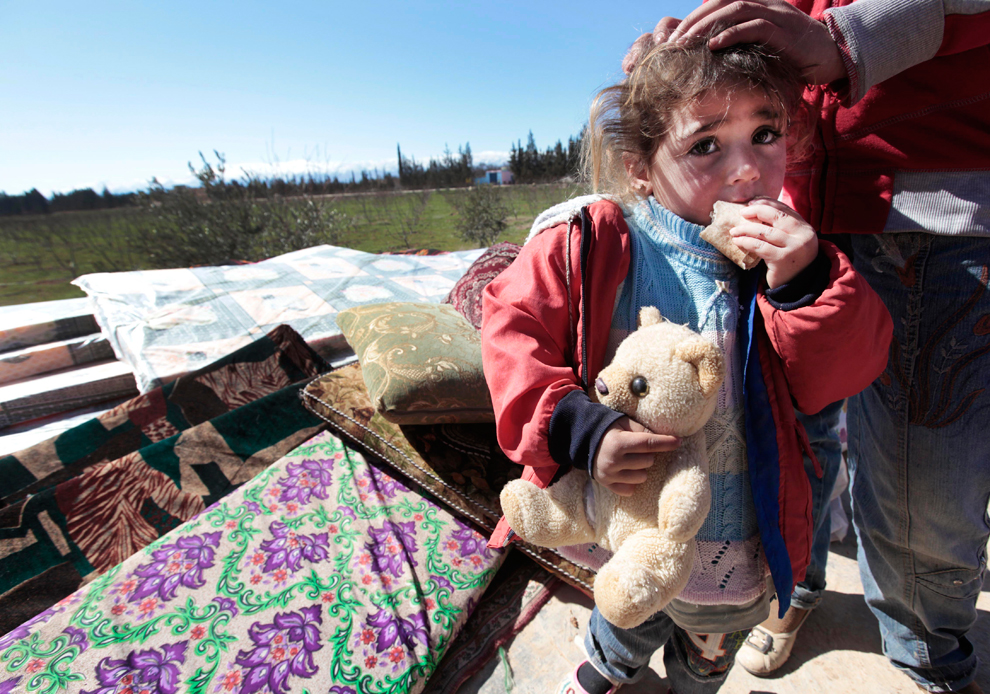
Syrian refugee girl, from 2012. Source: Boston.com
The Syrian Civil War may well have been precipitated by social stresses created by a severe drought, and that drought may have been a result of human-caused climate change. The post-apocalyptic flavor of bloodthirsty tyrants and maniacal murder-cults of movies like Mad Max seems to be made flesh in Syria. And fittingly, if Syria is an example of a nation brought to collapse by climate change this could be a whirlwind that much of the world will ultimately reap.
But the humanitarian crisis that faces the world right now cannot simply be chalked up to global forces of nature beyond human control. Global warming may have precipitated this mess, but failures of leadership here in the US and in the West at large have contributed to the ongoing nature of the disaster.
I could harp again on my hobby horse about the way that the failures of the US and the West to deal concretely with ISIS are creating a monster. But I've already written a blog post about how the US is half-assing its way to catastrophy (and if ISIS has its way we will half-ass our way into armageddon). But that would be unfair, because at this point ISIS has become too large, Iraq has become too weak, as has Syria, that a military solution to ISIS would require coherent and cohesive military and economic cooperation to avoid creating further regional destabilization. In short, we half-assed things long enough that we can't just go stomp on ISIS anymore.
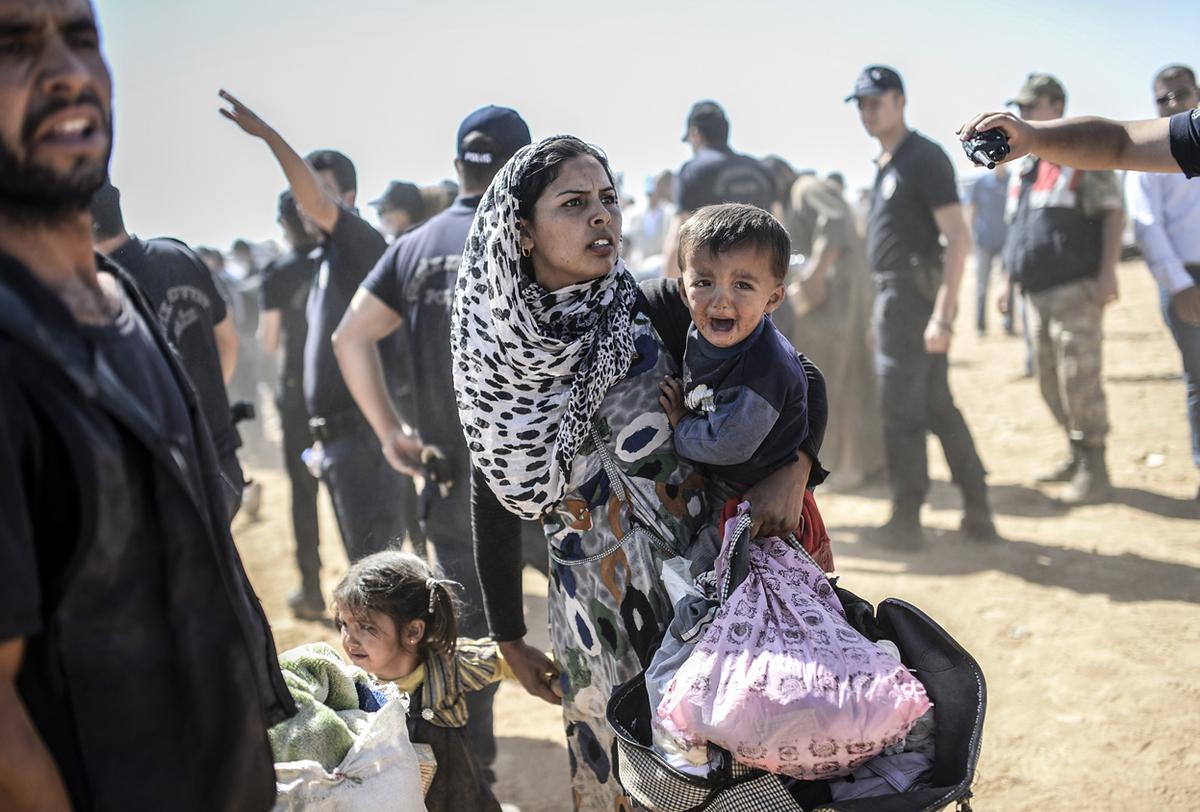
A Syrian Kurdish women and children fleeing across the Turkish border to escape ISIS advance in 2014. Source: The Atlantic
So instead I will harp on another one of my hobby horses, division politics. It is seriously arguable that the humanitarian crisis in Syria has reached its current magnitude thanks in large part to US part politics. The Syrian Civil War did not have to be allowed to spin out into a poly-polar mess of dozens of factions fighting for myriad goals. Of course avoiding the mess would have required doing two extremely politically poisonous things: One, at least tacitly supporting Assad; and Two, minimally not working against Russia.
Really, in order to avoid this current humanitarian crisis, the US could have simply stepped aside and let Russia more actively assist Assad with the brutal suppression of the Syrian uprising. It might have seemed heartless at the time, but it was already clear years ago that the rebels were no better, and probably worse, than Assad's regime.
You may recall the debate and bluster about "Red Lines" a few years ago when Obama was wanting to establish boundaries that would be unacceptable for Assad to cross. Obama was like Gandalf at the bridge in Moria saying "YOU SHALL NOT GAS!!!"
Of course it wasn't a movie, and Assad did use chemical weapons, but it looked like the rebels did too.
Both parties had been making a lot of noise about Syria and how bad Assad was. Some people said that we should back the rebels. Some people said that Obama was recklessly getting us involved in yet another Mideast military mistake. Some people said Obama was being too soft on Assad. Some people, who were very much in the minority at the time were saying, "umm, Assad might be bad and all, but this whole Arab Spring thing and the rebels in Syria might not be in our best interests."
But you have to remember that at the beginning, back in 2012, the Syrian Civil war didn't really seem like that big of a deal. The Arab Spring was bringing democracy to the Mideast. It was very popular in Washington to hop on the "Democracy good, Dictators bad" bandwagon. Getting into philosophical arguments about whether or not we should support "democratic" movements that seek to install democratically elected theocracies is the kind of nuanced debate that doesn't make for easily digestible soundbites. The shorthand we tend to use in this country is "Democracy good," but what we really mean is "Liberal Democracy Done Our Way good." After all, Hamas is the democratically elected leadership of Gaza. The Iraqi democracy, that we installed, decided to elect leaders that oppressed the Sunni minority. The examples go on, but it is the kind of thing that doesn't sound good in political debates. Whereas calling a political opponent anti-democracy does sound great in political debates.
So against this backdrop, a civil war breaking out in an Arab country that had seemed very stable seemed like... I dunno, democracy maybe, minor maybe, who knows, where is Syria anyway?
But then news reports started painting a picture of awfulness. It was sometime in 2012 that an Al Jazeera report first started really scarring my psyche with coverage of the Syrian Civil War. I had gotten into the habit of watching Al Jazeera reports on current events because the coverage often felt very immediate and raw. The day that an Al Jazeera report cut to footage of an infant bleeding out from a bullet wound convinced me that maybe I liked my news a little less raw. But once again it was the children of this war that broke my heart at the start and continue to haunt my thoughts today.
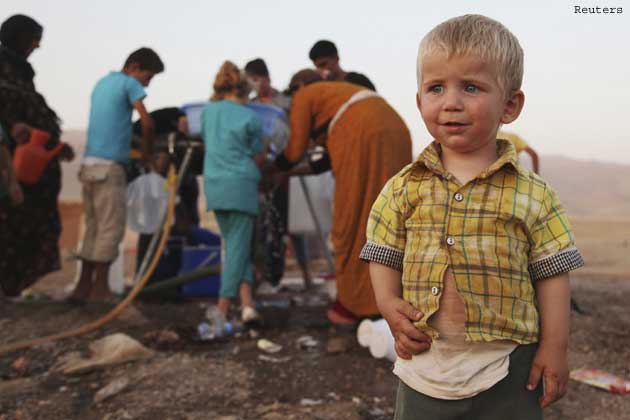
A Syrian Refugee boy in Turkey. Reuters
With all this awfulness happening, and "Dictators bad" in everyone's mind, eyes turned to Obama. What was he going to do about it? And here is where division politics in the US can take a tragedy on the other side of the planet and help it grow into a humanitarian catastrophe that destabilizes a region and then spills out over the world.
Obama couldn't just do nothing, or the Republicans would accuse him of failing to lead. But Obama couldn't just let Russia pursue their Agenda, especially since that would also help Iran. Backing Assad would have given the Republicans tremendous ammunition, plus most Democrats wouldn't feel comfortable backing a nasty dictator. So in order to back Assad, Obama would have had to risk attack on all sides domestically. But there was never going to be a realistic possibility of the US invading Syria and trying to set up another Iraq (remember, ISIS had not made the news yet, so Iraq was still being sold as a semi-success). Obama was caught between an emerging crisis and a political opposition that was poised to pounce on whatever action or inaction Obama took.
Obama essentially decided to avoid decisive action. In order to avoid entering into a politically costly war, Obama simply expanded the use of tremendously expensive air-power. Our politicians locked in their zero-sum game of musical chairs can all seem to agree that planes are really cool, and gee-whiz sci-fi technology like drones are fun ways to show how powerful the US is. So Obama "took action" by dropping bombs.
Aww Yiss!!! Mutha fukin planes 'n shit!!! Time to drop some liberty on Syria! Source: The Telegraph
Of course you can't bomb a country into having working infrastructure and the rule of law, and pretty much all of the dozens of factions (other than the Kurds) involved in the civil war are bad guys from the US perspective, so as logic would predict, a bombing campaign that couldn't actually support a side in a conflict failed to make anything better.
The US geopolitical position made standing aside a non-option, while domestic political rivalries made any meaningful action problematic. So the path of least political resistance was to drop bombs and ignore the problem as much as possible.
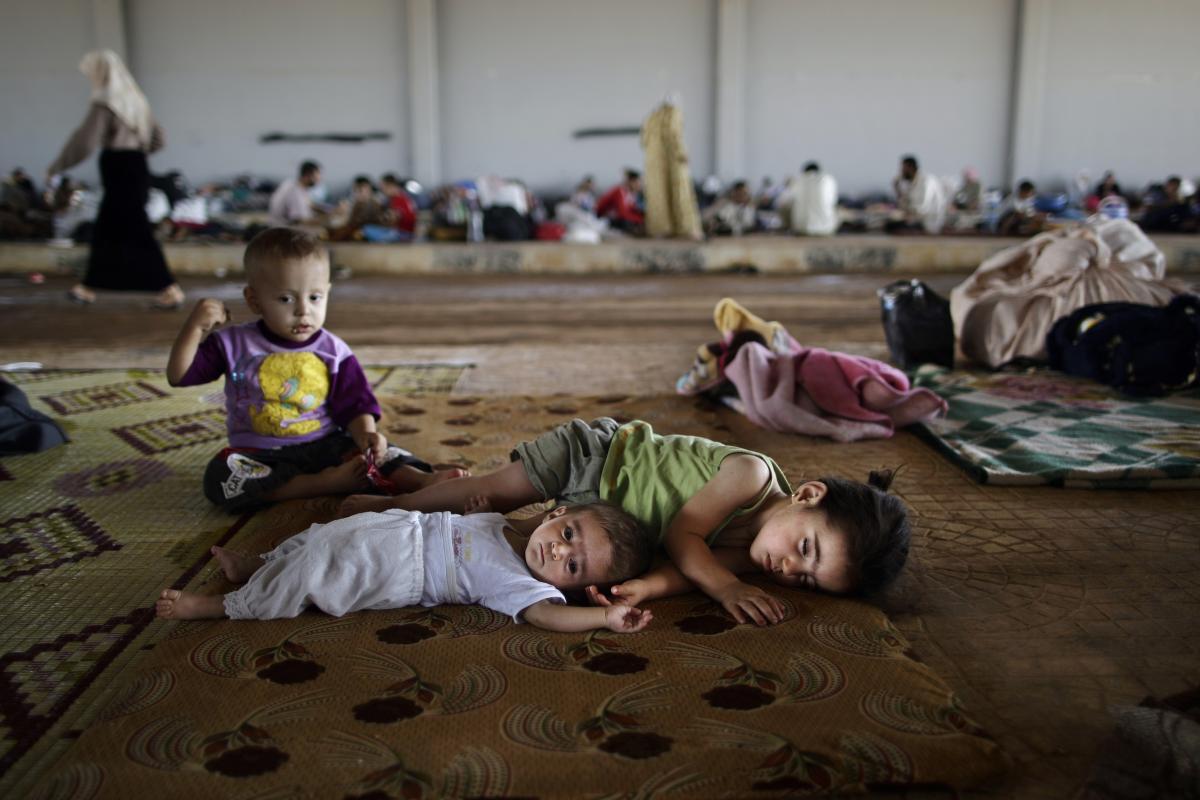
Back to the kids. Syrian Refugee children in Iraq. Source: Rescue.org
All of this writing and finger pointing and political hobby-horsing of mine finally brings us back to the real issue, the human cost of the Syrian Civil War. I don't want to simply say "tsk tsk, Obama messed up, and the Republicans helped." I don't think that assigning blame is as important as acknowledging that we all have a share in this problem, and that we all have a responsibility to do what we can about it.
And the good news is that we actually do have a variety of things we can do, even as individuals, particularly in the US. After several hundred words crapping on the US for hamfisted meddling and apathy, I think it is only fair to remind readers that we do a lot of good as well. We are far enough away from Syria, geographically, that we don't get a lot of direct refugees (the same goes for the Old World in general); however, the US does lead the world in the resettling of refugees. Generally speaking, only about 1% of the world's refugees are eligible for permanent resettlement, but the US resettles more than half of that number. Out of the entire world, the US permanently resettles more refugees than the entire rest of the world combined.
We are a country of superlatives, usually it seems like the superlatives that get focused on are things like most money spent on military, and most shootings (that one is popular to say, but not actually true by a long shot, even among developed countries), and other negative superlatives; but we are also an exceedingly generous country, and we do integrate the most refugees into our society. And unlike many nations, the US focuses on integration, not housing refugees. In many countries refugees never get to own property or integrate into society, For instance, there are many Palestinians who are third and fourth generation refugees still living in refugee camps since the 1947 war of Israeli independence. For those refugees, almost 70 years later, they are still people without a country.
And the comparison to Palestinians is potentially quite apt, because the nature of the Syrian Civil War is such that it is very possible that millions of the Syrian Refugees may never have a home to return to. Usually, most refugees are able to return to their countries of origin after some period of time, however some refugees are permanently unable to return to their homes out of fear of death and/or persecution based on religion, political opinion, race, nationality, or membership in a particular social group. Considering that both ISIS and the Syrian government seem intent on persecuting and killing large swathes of the Syrian population, it is likely that an unprecedentedly large number of Syrian Refugees may become as permanently stateless as the Palestinian refugees have. What this means in practical terms, is that the permanent resettlement of potentially millions of Syrians may be necessary to avoid an ongoing intractable conflict like the Israeli/Palestinian conflict.
Syrian refugee from Deir Ezzor with his children in tears of joy after arriving in an inflatable boat crammed with about 15 people. Source: Mirror
It is too late to avoid the Syrian Civil War. We can't go back and undo the circumstances that led to this crisis. What we can do is try to keep this crisis from turning into a crisis that never ends. I wish that I could say that it would be possible to avoid this sort of calamity occurring again, but short of direct intervention by an omnibenevolent omniscient omnipotent force, I fail to see how all future humanitarian crises can be avoided. The best we can do is the best we can do with what we know and what we have now.
In the immediate term, here in the US, if you want to do something to help, but you don't want to spend money, you can make a difference by writing to your congresspeople. It might seem trite, but it really is a meaningful step you can take with a minimum of effort. Far more meaningful than any shared statuses or retweets. If you want to use a preset form, here is one all ready for you. That link is to support bills to help refugees, the site is the US Committee for Refugees and Immigrants at Refugees.org.
If you want to do more, and you can afford to give some money there are a number of worthwhile options. Here is an PRI article listing a number of organizations doing vital work on the Syrian refugee crisis. There are good options for donations. This article also contains a link to the Save the Children PSA which I will link to below, I think this video is profoundly affecting. It captures the reality of an everyday existence torn apart, and I think that is important to bear in mind when thinking about the Syrian crisis. Syria was not some turbulent backwater, it was for decades one of the most stable of Middle Eastern countries. It had one of the worst human rights records in the world, but it was stable. Stable enough for people to build lives that have been torn apart by this war.
Another option, if you are willing to truly take on some personal obligations, is you can consider sponsoring refugees. The US Department of State deals with Refugees, however the sponsoring of refugees is done through nine non-governmental organizations (NGOs)(per the State Department website), but as an indication of how opaque this process is, I cannot seem to find out what those "nine NGOs" are. There is some worthwhile information to be found, but the US system is confusing and decentralized enough that I feel it is beyond the scope of this blog post to try to explain how to sponsor people. That said, if you are in Oregon (as I am) Sponsors Organized to Assist Refugees (SOAR) through the Ecumenical Ministries of Oregon seems to be a viable option.
The refugee sponsorship option might actually be a better fit for organizations that you may be a part of, whether a religious community or social organization. If you are a member of an organization consider getting your organization involved in trying to help. The focus should not even necessarily be on sponsoring refugees at this time. Europe (and countries like Germany in particular) are currently seeing an enormous surge in refugees. Supporting groups like Refugees Welcome is a way to help soften the impact of the costs of caring for refugees in countries like Germany and Britain. And Charity Navigator offers a handy cheat-sheet for NGOs to donate to.
I wish that I could offer a workable solution to the entire Syrian Civil War, but I can't. But we can all do little, and not-so-little things to help. We can apply pressure on our politicians to seriously address the Syrian crisis. We can donate. Geography means that we here in the US can't give our time or labor to assist this crisis as easily, but we can try to assist those helping the refugees.
We can't make all the problems go away, but it is good to find ways to do something. There will undoubtedly be more awful images that will come from this war. The Syrian Civil War is ongoing. The refugees overflowing the Middle East and spilling onto the shores of the Mediterranean are largely landing in countries still reeling from financial crises. When we see refugees struggling with police it can feel bewildering, and that bewilderment can leave us feeling helpless.
When we are faced with images of toddlers face down in the surf it is a sickening feeling to be unable to do anything. We can't do as much as we might like, but we can do some things. I hope that this post helps you identify something that you can do. Because when we can help other human beings it makes the darkness of these kinds of tragedies feel a little lighter.
An Israeli Soldier on the Golan Heights, photo from Associated Press. If you are wondering what is up with the clown hat, it's a helmet cover. They create a less obviously head shaped profile than an uncovered helmet. Handy when you are working in an area where people are looking for heads to shoot I guess.
The historical context and ethnic/religious dynamics of Middle East Conflict are something that I talk about frequently in my posts. Unfortunately this is not a topic that can ever be fully explained in a single blog post. When you find a YouTube video, or an article that makes the Middle East clear and easy to understand you should probably assume that the person who made it is pushing an agenda, and is at best being less than fully honest. And that guideline goes for me too, when you read my posts you should realize that I am trying to present what I see as the relevant context to the points that I am trying to make.
One of the books that I have on the Middle East is History of the Arab-Israeli Conflict by Bickerton and Klausner (the first few editions were called "A Concise History..." but they dropped the "concise" bit as the book kept getting longer), and that book which is essentially just a collection of brief descriptions of the things that have happened in the history of a country that is less than 70 years old (and printings of original documents) is hundreds of dense pages long. And that book does not offer interpretation or real narrative, and covers only one part of the Middle East (if you would like a easier read that provides valuable insight into the Arab-Israeli conflict I would recommend The Lemon Tree by Sandy Tolan. It is not an exhaustive history book, but it is a well researched non-fiction book that is very readable and has a compelling narrative).
I say this simply to illustrate why even the issues of a single territory, roughly the size of Vancouver Island, is too complicated to fully explore in a single post. When you find a neat Youtube video that make the Middle-East simple, clear, and presents and unambiguous good actor, you need to realize that the information is very biased. You should also realize that extreme bias does not necessarily mean lying. The confusing thing about the Middle East is that different sides of a given conflict will present seemingly contradictory accounts of events, but often both sides are simultaneously right... and simultaneously wrong.
And sometimes people on the same side can radically disagree on what is going on. Take the current issues for Israel and the US regarding al Qaeda and Iran. The US is focused on fighting al Qaeda, and has erroneously decided that ISIS is the same as al Qaeda and should be fought with a mixture of insufficient half measures and talks with Iran. Israel is focused on avoiding the eradication of the state of Israel and the slaughter of Jews (which is a stated goal of Iran's leadership, and reaffirmations of that goal are ongoing. Iran's supreme leader actually tweets about wiping out the Jews). Israel's approach focuses on total opposition to Iran and antagonizing Western allies (like the US) by pandering to Israeli religious hard-liners.
So even though the US and Israel are allies, they disagree on who the main enemy is. A fantastic illustration of this is that Israel actually has relatively friendly relations with the al Qaeda group that has seized the Golan Heights. Israel does not pretend that al Qaeda is no threat to Israel, but al Qaeda is far preferable to Israel than the Iranian backed militias. As far as Israel is concerned, al Qaeda is the lesser evil. For the US, al Qaeda is the Big Bad. Al Qaeda has been attacking the US for decades, and the US has poured TRILLIONS of dollars into the War On Terror over the past decade and a half. The US has been so serious about fighting al Qaeda that we eviscerated our own Constitution and civil liberties with the Patriot Act. We have invaded two sovereign nations under the auspices of battling al Qaeda. People have been tortured by our government, held indefinitely, subjected to secret trials, governments have been toppled, thousands have died, back-scatter radiation is used to take naked pictures of travelers in airports, grandmas in wheelchairs get groped by TSA agents, and international goodwill toward the US has been squandered, all in the name of battling al Qaeda.
And now our closest ally in the Middle East is getting cozy with al Qaeda, and the US is getting cozy with Iran.
How could this happen?
In terms of the here and now, much of the blame should be placed on Benjamin "Bibi" Netanyahu and Obama. As far as I can tell both Obama and Netanyahu have decided that their mutual antipathy is more important than good governance. Obama and Bibi dislike each other. They dislike each other so much that they both actively work against each other. Bibi even came to the US at the request of Republican lawmakers in order to undermine our President over the Iran issue. (Note: the fact that I think that Bibi is probably right about the danger of negotiation with Iran over nukes does not mean that Bibi's trip to Washington was not an egregious act.) It sometimes feels like Obama and Bibi have decided that, civilian deaths be damned, they are going to stick it to each other even if it means blowing up the entire Middle East.
But it is not that simple.
The US is concerned about al Qaeda, and ISIS, and the Taliban. All terroristic Salafist groups. As of right now, the US is actually lucky that because of the way ISIS has set itself up, al Qaeda and the Taliban cannot cooperate with ISIS without joining ISIS. This is a complicated issue, but the upshot is that we are currently fortunate that other Salafist extremist groups are fighting ISIS. With the advances that ISIS is making that may not remain true for very long.
The US went to war in the Middle East to combat terrorism, and in the process, toppled the government of the regional counterbalance to Iran, and created a power vacuum where even more pernicious expressions of Islamic fundamentalism (of both Sunni and Shia varieties) could flourish.
When the Arab Spring began the US cheered on the pro-democracy movements. Then kind of cringed as some of those movements turned into anarchy and civil war. Long story short, Syria became an endless parade of mind boggling horrors. I don't even like to describe some of the things I have seen video of or read about from the Syrian Civil War. But worst of all from a US perspective there wasn't even a good guy to back in Syria. The Obama administration knew that backing Assad from the outset would be the move most likely to favor the US, and on that one issue even Russia agreed. But backing Assad would mean backing a bad, bad man. Even if cold realities of realpolitik favored backing Assad, Obama has consistently tried to plot as moral of a course as he could.
Obama could not bring himself to back the bad guy (of course every step of the way Obama is beset by a damned if you do, damned if you don't onslaught by the Republicans), and the stage was set for ISIS to emerge. Then ISIS spilled across the border into the power vacuum of Iraq.
Obama has always been a politician in search of compromise. When he ran for president back when the recession was just starting, he campaigned on promises to look for common ground. He was even going to look for common ground on issues like abortion.
I bring up abortion because it is a perfect microcosm of the problems that can arise when you assume that everyone is going to be willing to settle for mutually unsatisfactory compromises.
Meaningful negotiation and compromise relies on mutual good will, and good faith. The Republicans and Democrats in the US are not interested in good will and good faith with each other. While I place a greater share of the blame for the poisonous climate of political victory over good governance on the heads of Republicans, Democrats have not covered themselves in glory either. For both parties, party victory is more important than the good of the country. That means that wedge issues are what is campaigned on, rather than campaigning on how to best achieve agreed upon goals. Why would one campaign on realistically discussing how to eliminate the deficit, when one can simply call an opponent a baby-killer/woman-hater.
And that brings us to the other element that is needed for meaningful negotiation, a shared reality. There can be no negotiation on issues like abortion, because the disagreement is based on fundamental differences in worldview. If you believe that an unborn fetus is a person with all the rights of a person, then abortion is wrong. If you believe that the potential for life does not outweigh the rights of a person to decide what to do with their own body, then you are probably pro-choice. The issue is not one where there is any real middle ground, because the issue is one where the underlying assumptions about reality determine one's position on the issue.
Obama seeks dialogue and compromise, domestically and abroad, but the abortion issue presents a microcosm analogy for why there is so much trouble with that approach. US politics are too poisonous to allow for debate on actual issues that can be resolved. Political debates and campaigns are fought on the basis of us vs. them, and political dialogue is focused on intractable issues, like abortion.
So Obama could start a conversation with "let's talk about student debt." And the most politically profitable Republican response would be "you're a baby-killer."
Since voters seem to respond to this sort of political dialogue, both sides engage in these tactics. And there is no national third or fourth option, and both parties are committed to maintaining these political wedges. So continuing rounds of "debate" over issues like guns and abortion are had.
So despite getting raked over the coals domestically for trying to find middle ground, Obama still tries to treat others as sane, reasonable, honest actors at home and abroad. And when it comes to the Middle East he is faced with one of the masters of divisive wedge issue politics in Benjamin Netanyahu on one side, and an Iranian leadership that is happy to tell Obama that they are willing to be good boys.
So between Bibi treating Obama as the enemy, and Iran at least pretending to be an option for historically meaningful statesmanship, Obama seems to have chosen Iran.
I think this is a mistake, but an understandable one. Bibi is busy undermining Obama, engaging in racist scare politics in Israel, and even going so far as to reject the possibility of Palestinian statehood, which seriously undermines the moral argument for the US backing Israel. Clearly they don't like each other, and the fact that they keep playing an international version of bumper cars seems to indicate that they are more interested in screwing each other over than trying to coordinate strategies.
Al Qaeda is an Islamic fundamentalist terrorist organization that seeks to destroy the US, and Western power. For millions of people around the world, Osama bin Laden was seen as a kind of Robin Hood type character. He was the plucky underdog taking the fight to Western imperialist powers. For us in the West, he was a murdering criminal who slaughtered civilians. Once again, the worldview that people bring to the topic determines where their sympathies lie.
After 9/11 the US sought to destroy al Qaeda's ability to carry out attacks against us. Now bin Laden is dead. Al Qaeda has fragmented into various smaller terror franchises. The power structures of the old al Qaeda have been dismantled. We went in like the sorcerer's apprentice, and tried to smash what we had created (the sorcerer's apprentice enchanted a broom, the US funded, equipped, and trained the Mujahadeen in Afghanistan as a cat's paw to use against the USSR) and like the sorcerer's apprentice, we are left with hundreds of autonomous offshoots plaguing us at every step.
But we still need to protect ourselves, even if our efforts thus far have been less than totally successful.
ISIS is one of those offshoots, but ISIS is not al Qaeda. ISIS is a competitor to al Qaeda and the Taliban. ISIS is an emergent theocratic state. It is terroristic, and it sponsors terrorism, but it is not simply a terrorist organization. It is like a brand new state sponsor of terrorism that is busy building a territory through slaughter and medieval rules. ISIS is essentially a political organization style straight out of the 7th century. Their methods seem ghastly to us in the West, because they are playing by a totally different rule book. The West plays by the rules established in the Treaty of Westphalia and subsequent treaties. ISIS plays by the rules of the Prophet (as they see them).
But that is not what really makes ISIS different from al Qaeda. What really makes ISIS different is their goal. ISIS seeks to bring about the end of days. ISIS is literally trying to end the world. I think it is hard for many in the West to wrap their minds around a worldview that sees the Apocalypse as a desirable goal. It is also challenging to accept that this goal and frightening worldview could be attracting growing numbers of followers. But ISIS's message is attractive to many people, even people from the West (I really need to try to write a short blog post on this topic).
Thus far, the US response to ISIS has been to treat it like it was al Qaeda 2. And Obama has tried to act against ISIS, without doing anything politically risky like actually fighting ISIS, while also trying to avoid offending Muslims by saying things like "ISIS is not Muslim." But the need to face this threat, and the desire to defuse other problems in the Middle East has seemed to blind Obama to other threats, like Iran.
Obama has sought, throughout his Presidency, to engage in diplomacy. He has reached out to leaders of other countries in an effort to solve differences peacefully. His attempt to negotiate with Iran is of a piece with his style of leadership. Obama is looking for peaceful solutions. Trying to resolve conflicts without further bloodshed.
This is laudable.
However, in the case of Iran it is also very questionable.
Iran wants nukes. Iran claims that it only seeks nuclear capabilities for peaceful purposes, but they are not seeking to trade for uranium, they want nuclear enrichment capabilities of their own. In a chaotic and tense Middle East where there is much animosity toward Iran from Arab states (remember, Iran is not Arab, it is Persian. It is also Shia, not Sunni), as well as Israel and the US, this is a dangerous threat to the balance of power in the region.
Obama just wants to fix the Iraq mess, and avoid the world blowing up. Israel is more focused on survival, and wants to avoid a more powerful Iran.
So even if Obama and Bibi could put aside their personal differences, the fundamental differences in the way they view events that are unfolding in Syria and the broader Middle East means that the US and Israel are not in sync strategically. At least in immediate goals.
It's a confusing mess.
-------------------------------------------
This entry has already gone on too long. I started out trying to make things clearer, but I feel like I just made things more confusing. Hopefully some of you will find useful information here. I welcome feedback, even the negative kind.
Iraqi Army and Shia Militants during the Tikrit Offensive last week (source, Al Jazeera)
Iraq is gone. Where once there was Eastern Syria and Western Iraq there is now the Islamic State (ISIS). For all practical purposes Kurdistan is a de facto state in the areas formerly known as Northern Syria and Northern Iraq. And now with Iranian military and Iranian backed Shia militias doing the fighting while the US sits this campaign out, I think you can just start thinking of Eastern Iraq as Western Iran.
Last September, when I wrote about the disaster in the making that the US approach to ISIS was creating, I was not entirely accurate in my short term predictions. I did predict that ISIS would be particularly dangerous to Jordan, and I did predict that they would not destroy themselves right away, and that they were rewriting the maps of the Middle-East, and that they would spread to other parts of the Middle East. But even though I wrote about the Sunni-Shia divide, I somehow failed to see that this could also lead to a vastly expanded sphere of direct Iranian influence. Like anyone else, I get blinded by emergent threats to global stability, and forget about countries that we have been at odds with for decades.
Now ISIS has been pushed back from Tikrit, in an offensive that the US didn't have much to do with. The offensive was led by Iranian troops and Iranian backed Shia Militias. You may recall that these are the guys that we spent so much time, money, and lives fighting a few years back. The Iraqi military was unable to even slow ISIS, and the US leadership decided that decisive action would be too politically difficult, so a power vacuum was left for Iran to step into. For the Shia in Iraq, the US approach has meant that the only thing standing between them and the mass murder of their men and systematic rape and enslavement of their women was Iran and Shia militias. For the Sunni in areas now controlled by ISIS they face the threat of reprisal massacres by Shia Militias. So for the Sunni residents of the Sunni Triangle, ISIS is the only thing standing between them and slaughter. Bad times all around.
I have a hard time imagining Iraq ever going back to what it was before the US invasion.
I know that there are a lot of people who think that Iran and ISIS are the same, or likely to team up against the US, but that is wrong. It may be possible for the US to convince itself (for a while) that things aren't going so bad for our strategy, because peace between Iran and ISIS is, if anything, probably less likely than peace between the US and either ISIS or Iran. The Atlantic ran an excellent article recently that I feel should be required reading for anyone that wants to talk about ISIS. There are a number of valuable insights to be gleaned from the article, but one of the key things to take away is the difference between the way ISIS treats Christians and Jews versus the way ISIS treats Shia Muslims and other Islamic sects.
ISIS adheres to a doctrine of Sharia law based on (their interpretation of) the practices of the Prophet Muhammad during the initial expansion of Islam. When I wrote about how Islam is not incompatible with Western culture I talked about Sharia Law and the ways that the Islamic Caliphates preserved the foundations of Western Culture from a destructive early Christianity, but the Sharia and Islam that I talked about was not the same as what ISIS seeks to bring to the world.
(I want to be very clear that I am not saying that ISIS is un-Islamic. I'll leave the deciding who is or is not Islamic to ISIS. I think that Obama was foolish to try to make that claim. ISIS is not representative of mainstream Islam, and they reject all the values that created a flowering of Islamic art, culture, and power, but that doesn't mean that they are not Islamic)
ISIS pursues a very specific version of Sharia with the stated goal of bringing about the end of the world (literally, they want to usher in the apocalypse and bring about the end of the world). In order to achieve their goals they base their application of Sharia on the strictest possible interpretation of the Quran and only the portions of the Hadith attributable to the Prophet. The rest of the intervening centuries of elaboration on Sharia is discarded and only their interpretation of Sharia remains.
What this means is that Christians in ISIS occupied territory are able to live in (relative) peace provided they acknowledge the supremacy of ISIS and pay a tax. For Shia, and groups like the Yazidi (whom ISIS considers witchcraft practicing apostates), ISIS considers them to be apostates, and by their interpretation of the Quran (or at least the Hadith) is pretty clear that death is the only option for dealing with apostates. That means that for the majority of the population of Iraq, especially in Eastern Iraq, an ISIS victory means ethnic cleansing and mass murder.
Under Saddam, the Kurds and Shia were opressed by a relatively secular Saddam and the Sunni Arab minority. After the US invaded and tried to install Western style democracy, the Kurds and the Sunni Arabs were oppressed by the Shia Majority. ISIS represents an opportunity for protection and power for the Sunni living under their control. A unitary Iraq represents death and strife.
Now just to be clear, I don't think that Eastern Iraq is actually going to be annexed by Iran. The two countries fought the deadliest war since WWII, and there is a lot of bad blood, but I do think that Iraq is no longer going to be a regional balance to Iran. Whatever is left of Iraq when the dust settles is more likely to be a tail wagged by Iran's big dog.
This backdrop should also be remembered when pondering the negotiations between the US and Iran over their nuclear ambitions. Iran's nuclear ambitions already threatened the balance of power in the Middle East, now they are able to expand their areas of influence on the ground as well as through international negotiations.
I cannot pretend that I know what path is best for dealing with Iran. I know much less about those issues than I probably should.
What I do feel pretty confident about is that Iraq is now an unrecognized casualty of the US led response to ISIS.
I was originally envisioning this as a much larger article, but I think that it might be best to leave this entry short, and split some of the other ideas I am working on into other pieces. One that I want to put together is looking at why ISIS appeals to so many people from all over the world. But my next entry on this topic is going to be about why we need to stop calling ISIS a terrorist organization. ISIS is not a terrorist organization it is an insane theocracy centered on a millenniarian death cult and a state sponsor of terrorism, but it is an actual de-facto state at this point.
The School of Athens (Escola de Atenas) - Raphael - This image represents thinkers key to the Renaissance.
The short answer is: No.
But if we are being honest then we have to admit that there is a problem. Saying that Muslim extremists comprise only a minority of Muslims is factually accurate. Suggesting that the minority of extremists does not mean that there is a problem with Islam for the West is wrong.
---------------------------------
There is a commonly used chestnut that "Hitler was democratically elected." In reality, the Nazis only got ~1/3 of the vote. The Nazis were a minority in Germany leading up to WWII. That didn't mean the world didn't have a Germany problem.
Marxist rebels were a minority in Russia before the October Revolution, that didn't mean the Tsar didn't have a Marxism problem.
Less than 50% of the white population of the original 13 colonies that formed the US supported independence, but Britain certainly had a revolutionary problem.
Just because an agitating group is a minority within a larger group does not insulate the larger group from blame. If the larger group does not actively work against the minority agitators then it only takes a minority to effect change. This doesn't just apply to negative things. In the US, the majority didn't approve of interracial marriage until the late 1990's, but the minority fighting for equal rights was able to make interracial marriage legal in all states in the US in 1967 when approval of interracial marriage was less than 20%. It was a minority agitating for change, but the anti-miscegenation crowd had an equality problem.
So let us acknowledge that extremists being a minority is a functionally meaningless issue. Historically it doesn't matter if an opinion is held my a minority or a majority, it matters what the majority does about it. Let us contrast interracial marriage with gay marriage. The majority in the US has favored gay marriage for several years now, but gay marriage is still not fully legal in the US. It took 30 years of legality for interracial marriage to achieve the levels of approval that gay marriage has, but up until the last few years the majority has acted decisively against gay marriage, and even now the majority is not acting decisively in favor of gay marriage.
---------------------------------
I make this argument so that we can start to approach to the larger question of why the West has an Islam problem. There is a perception among many that Islam and Western secular society are fundamentally incompatible, but this is not true. You may wonder how I can state as fact that Islam and Western society/thought are not incompatible right after arguing that there is a conflict between Islam and the West. To begin with, modern secular Western culture owes its existence to Islam.
That's right, without Islam there is no Western society as we know it.
------------------------------------
Following the fall of the Roman Empire, Western Europe descended into the dark ages. Illiteracy and religious fundamentalism were the rules of the time. Western culture stagnated. Barbarism and tribal conflict ruled the West. Pagan philosophy and thought, like the writings of the ancient Greeks and the Romans were quashed and destroyed. Religious diversity was brutally suppressed.
Women's legal rights were largely non-existent. European women were covered head to toe with only their faces showing for almost a thousand years. Even the hair was covered. The stereotypical nun's habit with its wimple is a familiar vestige of this long era of the severe oppression of women.
When Genghis Khan conquered his way west across Asia he reached Poland. He won a costly battle, but found nothing worth taking. He turned his armies around and left Europe to itself. Europe was too materially impoverished to even be worth conquering.
Even the art of this period was far cruder than the art of the Greeks and Romans.
Then our history books tell us that there was a miraculous reawakening in Europe. The Renaissance. Art, culture, trade, and thought flourished. Classical philosophers like Aristotle, Socrates, and Plato were rediscovered. Engineering and science exploded. But where did the knowledge necessary for this reawakening come from?
The Muslim world.
During the long dark period of absolute religious fundamentalism the flame of Western thought and culture had been kept alive by Islam. Greek and Roman writings were preserved and translated. During the dark ages Muslim cities had lighted streets. A hospital founded in Cairo in the late 9th century AD had a library with thousands of book, a pharmacy, licensed physicians, and male and female attendants treating men and women. A Baghdad hospital of a similar vintage had fountains designed to cool the air inside the hospital. While Britain was fighting Vikings, Baghdad had air conditioning.
Even our numbering system, so vital to modern science, was introduced to the West from the Muslim world. The Italian Fibonacci introduced Arabic numerals to Europe in 1202.
A close up on Averroes from Escola de Atenas. Averroes is a latinization of Ibn Rushd, a Muslim Philosopher
-----------------------------------
One thousand years ago two cultures clashed. One culture was impoverished and largely illiterate. That culture provided few or no legal rights to women, who were covered head to toe in clothing. They regularly engaged in murderous atrocities against religious minorities. They were dominated by a religion that taught them to hate and battle infidels. That was Europe.
European culture clashed against another that they viewed as ungodly and decadent. This other culture granted legal rights and protections to women and religious minorities to a degree not seen before. They were rich, literate, scientific, and Muslim. The clash was called the Crusades.
The Christians slaughtered men women and children. They committed many atrocities. But the majority of Christians never killed Muslims in the Middle East. Most European Christians never even met a Muslim. Nonetheless Islam still had a Christianity problem.
It seems ironic doesn't it that positions seem reversed today.
--------------------------------------
The rise of Islam was in many ways as large a moment in the development of human rights and rule of law as the Code of Hammurabi. As strange as it might seem to many of us today, Sharia law was extraordinarily progressive for its time. Sharia was particularly progressive in the area of women's rights. It wasn't until the 20th century that women in Western countries received rights equivalent to the rights provided in Islamic law. It seems truly bizarre (at least to my mind) to think of Islam as being pro-women, but by the standards of the time in the Middle-East Sharia was practically women's lib.
In the area of religious tolerance early Sharia was also pretty progressive. While the classical definition of Dhimmi was reserved for Christians and Jews, as the areas of Muslim control grew the idea came to include non-monotheists like Hindus and Buddhists. A Dhimmi was a second class citizen, but they were still a citizen with protected rights.
It is truly strange to me that the Muslim Revivalist movements of the 20th century seem to focus on an Islam stricter than the Islam that pertained during the time of Mohammad or the following centuries. When I read about early Islam it seems very different than the vision espoused by ISIS (Salafism) or the Muslim Brotherhood. It makes me wish that there was a popular Muslim movement to recapture the progressive spirit of early Islam, rather than a regressive repressive version of Islamic law.
--------------------------------
The conflict between modern Western society and Islam is not a matter of fundamental incompatibility. I feel like anyone who has met a significant number of Muslims should be able to see that. I've known too many Muslims to believe that Islam is any more fundamentally incompatible with our culture than any other religion as a whole. In many ways our modern secular society was cradled by a tolerant early Islam, more than by an intolerant early Christianity.
But that doesn't necessarily mean that the current conflicts between Western society and Islamic fundamentalism are not religious in nature. Just like the Crusades were religiously motivated, the current strain of jihadist violence is religiously motivated. In both cases I think that the religious component is only a part of the overall picture.
I have met people who claim that the Crusades were purely motivated by economics. I think that idea is too reductive. You can't reduce something as complicated as a struggle between two cultural groups to a single cause. These kinds of clashes are not just about economics, nor are they just about water, or even just about religion. Islam by itself does not result in terrorism any more than Christianity by itself results in terrorism.
-------------------------------------
But even though Christian fundamentalist terrorists have struck at Western nations for centuries, the West does not usually feel like it has a Christianity problem these days. If you are asking what Christian terrorists there have been, you can look at religiously affiliated nationalist movements like the IRA in Ireland; or the Lord's Resistance Army in Uganda; or religiously motivated groups that bomb abortion clinics; or the Christian Fundamentalist terrorist extraordinaire, John Brown, whose acts helped to precipitate the US Civil War and free the slaves.
And really I think the difference is that Christianity and Western society are pretty synonymous in most people's minds. For English speakers the conversion of Britain to Christianity predates the development of the English language, so Christianity is privileged in many ways that are so fundamental to the language that they can be hard to spot. Islam is seen as the other, and increasingly Muslim leaders in the Middle East have been casting themselves as opposition to Western Imperialism.
And it is that idea of opposition to Western Imperialism that gets to the heart of why the West has an Islam problem. Because here we get back to the issues of the minority versus the majority.
--------------------------------------
A truism I appreciate is that it doesn't matter what's in your heart, it only matters what you do. We are all familiar with the idea that the road to hell is paved with good intentions. In life your actions matter more than your inner thoughts. If Hitler had quietly hated Jews and just tried to take over the world he would not be seen as nearly the monster that he is. But that was not the case. Perhaps most Germans during WWII disliked the idea of killing off Jews, but their actions didn't prevent the Holocaust. Inaction can be just as bad as action, and it doesn't matter whether or not people see themselves as good or decent if their actions do not seek to stop injustice.
I don't mean to compare Islam to Nazism, Nazis are just an easy target. And because everyone is familiar with them and pretty much everybody hates them, they make an easy allegory.
The comparison I want to draw here is about people saying that they do not support something while they do nothing to oppose it. When there is not widespread condemnation among Muslim groups of the goals and tactics of extremists it does not matter whether or not extremists are a minority. A silent majority empowers a vocal and active minority.
---------------------------------------
Islam and the West are not incompatible at their cores. They are not even unrelated. But if we close our eyes to the problems growing between Islam and the West then we all contribute to the rise of fundamentalism and terrorism. We in the West need to look honestly at what conditions in the Middle East are contributing to conflict, and what actions of ours exacerbate the problems. We can't do that if we are trying to be politically correct and deny that there is a problem.
And in the Muslim world people can't just say that extremists are a minority. I know that speaking and acting out against the extremists can be very dangerous for individuals. We are all familiar at this point with the price Malala Yousafzai paid for daring to try to get an education, and she survived. Many other individuals who have tried to stand up to Muslim extremists have died. And as long as the majority stays silent and quiescent that will not change.
The extremists are the minority, even where they are in power. That doesn't matter. Actions matter, not thoughts. The extremists act while the majority stands by. That is how it always is pretty much everywhere. The majority is harder to organize than a minority. It is easier to find agreement in a minority. And an organized minority is stronger than a disorganized majority.
In a leadership and organizational vacuum, whoever is organized and prepared to lead can thrive. In Gaza, Hamas thrives. In Syria and Iraq, ISIS is thriving. ISIS is not thriving because people there don't want to live in peace, or don't love their children, or don't want nice things. ISIS and similar organizations like the Taliban, thrive because the majority that just wants to lead their lives in peace are disorganized and unled. Islam is not to blame for the power vacuums that currently obtain in much of the Middle East, but it does provide an easy rallying point for organizations that want to fill that vacuum.
Air strikes weren't successful in Vietnam. They weren't successful between the Gulf War and 9/11. And they aren't going to be successful now. Likewise casting any criticism of Islam as racist is not going to fix the problems.
If we want to stop ISIS and other groups of that ilk from gaining power we need to be able to talk about why they are able to rise to power. We can't get there if we treat Islam as anathema to our society. We also can't get there if we are stuck on politically correct evasions. Looking honestly at the consequences of our actions and refusing to accept blame shifting can do a lot more than trying to be superficially sensitive or dropping bombs.
ISIS Released footage of their treatment of captured Iraqis
The US is nickle and diming its way into a military catastrophe. Buoyed on a wave of non-substantive tough talk and Pollyanna analysis the US has embarked on a half-assed military misadventure that is calculated to last until it can be punted on to the next administration to blow up in all of our faces. Obama has decided to double down on the strategy of propping up proxies which has served us so well over the last four decades. That strategy has produced such stunning successes as the Afghan civil war, the rise of the Taliban, the development and funding of al Qaeda, and most recently has produced the Islamic State. America's strategy going forward is to do more of what created this mess in the first place. The difference this time is that Islamic State is not like the Taliban or al Qaeda. Islamic State is a far greater threat to global stability than any of its predecessors, and the current strategy could empower them in ways that ignoring them never could.
To my way of seeing things, the biggest problem with Obama's approach to this conflict is viewing it as an extension of the US led War on Terror. Obama is on record as considering Islamic State to be nothing more than terrorists, plain and simple. I think that this is colossally wrong-headed and the source of what I consider to be the failings in most of the analysis of the current situation. I believe that the Islamic State should be viewed more as an anti-colonialist indigenous movement to understand what is going on. As I see it the roots of Islamic State's success can be found in the aftermath of WWI.
European Colonialism and the Pan Arab Movement
I think that most people are familiar with the ways that the onerous conditions placed on Germany after WWI led to WWII and the rise of Nazism. What fewer people seem aware of is the way that France and England's handling of the Middle East after the fall of the Ottomans have contributed to many of the current problems in the Middle East.
As WWI drew to a close the allied victors decided how they were going to chop up the Ottoman Empire. The Middle East was divided up primarily between France and England. This is also the same era that much of the current national borders in Africa were invented by European powers. There seems to be little rhyme or reason to the shape of the areas of influence and the various territorial mandates that were established by France and England. The divisions certainly were not made with an eye to the populations of the various areas, or even recent historical divisions.
It seems to me as though France and England just got together over a map and argued over how to divide things. Ecological regions, ethnic divisions, and recent political divisions were ignored. The Kurds were split among several different territorial areas. Arabs and Bedouins, Shia and Sunni. All the various major and minor ethnic and religious divisions were simply ignored for a more visually harmonious map.
(An interesting side note is the British Mandate of Palestine. Palestine had not been a distinct political area since the fall of the Crusader Kingdom. When the Ottoman Territories were divided up Britain claimed the area where the Crusader Kingdom had been and gave it the name the Mandate of Palestine. The section to the West of the Jordan River was termed Palestine, and the Eastern Section was termed Transjordan. Today we know the British Mandate of Palestine as Israel/Palestine and the Kingdom of Jordan. This partition is from whence the identity of the Arab Palestinians and the modern geographical idea of Palestine derives.)
I think some maps might be in order. So to start with I offer the tremendously confusing ethnic map of the Middle East:
This map is just a mind boggling mess. And it doesn't even include religious divisions, which are very important to understanding the current conflict. But it should make it clear that France and England didn't try to put the international boundaries in positions that would make sense ethnically. In fact, it almost seems more like gerrymandering designed to cut across the territories of various ethnic groups. For the Kurds this put them in the position of being a regional minority four countries. It is noteworthy that the most complicated ethnic picture in Iraq is found in the predominantly Kurdish areas where there is a truly multicultural hodgepodge. This broader view map fails to adequately capture the complexity, believe it or not.
Next I offer the Shia Sunni divide map:
Once again the map is confusing and utterly fails to conform to national boundaries, but at least there is only two groups to think about. I would like to point out that if you compare the two maps you may note the large Sunni area in western Iran that coincides with the Kurdish area.
Two major points I want to make about these maps: One; There is a very large area of the middle east that is dominated by ethnic Arabs, but that ethnicity is divided into a very large number of countries. Two; The Shia Sunni divide creates isolated pockets of Shia in the ethnically Arab areas.
If one was prone to putting credence into conspiracy theories one might suspect that the British and the French had deliberately created a map designed to create a dynamic paralysis. The territorial divisions ensure sectarian divides and ethnic divides within countries. Further, splitting the major ethnic groups (Kurds and Arabs for the purposes of this article) into multiple countries discourages the development of a central power. Almost as though the victorious powers in WWI had sought to prevent any new loci of power developing in the vacuum left by the Ottoman Empire. Of course that idea presupposes a great deal of cunning and forethought when insensitivity could do the job just as well.
Now for a few more maps starting with a closeup on Syria and Lebanon:
Haha jk lol
Just kidding, I'm not even going to try to unpack that one. Here's a massively simplified version:
This article is dealing with broad strokes, and this is good enough. We can see the major divisions. Assad is Alawite, ISIS is a Sunni Pan-Arab group, and the Kurds are up in their corner.
Next We turn to Iraq:
This is also a bit busy, but it provides the image of a Multi-ethnic Kurdish north, with a multi-ethnic finger drawing down to Baghdad. I'll provide a simplified version of this map:
These two maps work well together. The lower map conveniently shows the population breakdown in a pie chart, and it clearly shows the major overlap zones. The upper map helps explain the population breakdown by showing the large sparsely populated areas in white, whereas the lower map shows a huge area being dominated by Sunni Arabs. Even though Sunni Arabs dominate the largest area of the map, within Iraq Sunnis are a minority. Globally among Muslims Shia are the minority, but within Iraq (like Iran) Shia are the majority.
So now we have a picture of the fractured ethnically and religiously confusing mess that currently obtains in the Middle-East, particularly in the areas of Iraq and Syria. The mess is made more confusing by the Sunni-Shia divide and the way that divide interacts with ethnicity. The Kurds are mostly Sunni, and ISIS is also Sunni. But ISIS is fighting the Kurds and the Shia. ISIS is claiming to be fighting for a new Muslim Caliphate. If this were really just about Sunni Islam then one would expect ISIS to be trying to ally with the Kurds, Or if this was just about Arab ethnicity then one would expect ISIS to at the very least not be massacring Shias. But as we know ISIS is slaughtering Shias and their Kurdish coreligionists. So what's going on?
Now we return to WWI and the Pan-Arab movement. In WWI the Allies found an ally in Prince Feisal (Feisal I). Feisal helped mobilize the Arabs against the Turks. Feisal was a Hashemite. The Hashemites had traditionally been rulers of Mecca... You know what, this is a whole different article. The history of the Hashemites is wildly confusing to me. The Sunni-Shia divide began with dispute over the succession of the original Caliphate with the Shia supporting the Hashemites, but the Hashemite kings are Sunni now. Plus the Kingdom of Saud now controls Mecca. There is too much to cover, and it confuses the hell out of me. To sum up, Feisal I was an Arab leader and a pro-Arab nationalism figure who was also instrumental in defeating the Ottomans.
Feisal I
Following WWI Feisal was proclaimed king of Syria. The French fought Feisal and kicked him out of Syria. The British needed a leader for the country of Iraq that they had set up, so they tapped Feisal. Feisal came in and set up the Sunni domination of Iraq. Some time later the Hashemites were done away with in Iraq and the Ba'athists came to power. Saddam was a Ba'athist leader. The Ba'athists continued the Sunni domination of Iraq.
Throughout this period the Saudis supported a radical conservative strain of Sunni Islam typically referred to as Salafism of Wahhabism. This strain of Sunni Islam is behind the Mujahadeen who were the Islamist fighters in the Afghan civil war that the US propped up to combat the USSR. Al Qaeda and the Taliban grew out of this movement. ISIS also grew out of this movement.
Confusingly the parallel Muslim Revivalist movement typified by the Muslim Brotherhood and its offshoot Hamas are not connected to Salafism. Don't ask me to explain. But even though these are movements that are similarly Pan-Islamic in aims they are not the same. The Muslim Brotherhood is more pro-woman and tolerant of religious minorities than Salafism. Keep that in mind when talk turns to "moderate" Islamist groups in Syria. Hamas is moderate compared to ISIS.
For the last century there have been multiple threads growing and moving in the Middle East. A pan-Arab movement, a pan-Islam movement, and Muslim revival movements. Against those movements there have been the realities of nations and existing power structures. The West has sought to manipulate those power structures to keep allies in power while discouraging any major shakeups that could have jeopardized the balance of power. For much of the 20th Century the USA and the USSR competed through Middle East proxies.
Why is Islamic State Different?
So what does all of this mean? Why is it important that one understands European Colonialism in a Middle east context? What does Feisal I have to do with ISIS? Who cares whether the Muslim Brotherhood is theologically related to ISIS?
Let us start with Feisal. Feisal symbolizes a rise of modern pan-Arabism. A movement to unite Arabs. His movement obviously didn't succeed. But the current conflict is centered in the places where he sought to start his movement. His movement was stymied by Western influence.
The Salafists and the Muslim Brotherhood have both been pushing an agenda of strict Islamism in government. Iran has been pushing its own Shia Islamist movement. Throughout the Middle East, regardless of country, sect, or region there has been a growing wave of Islamic fundamentalism. The Muslim Brotherhood, though influential has had to spread its message without support from any national governments. In contrast, the Salafist movement has enjoyed the patronage of the Saudis, who the US has backed.
While the West and the governments of the Middle East have all sought to restrict the growth of the Muslim Brotherhood, Salafism has been given relative free reign. The US armed and supported Salafist militants as proxies against the Russians. This wasn't really seen as a big problem until those seeds we sowed in Afghanistan were reaped in the form of airplanes flying into buildings 13 years ago.
ISIS, not nice people
And now we have ISIS. ISIS grew out of the same movement, and like the earlier groups moved into areas of relative power vacuum and chaos. ISIS might have grown out of al Qaeda, but unlike al Qaeda it is not content to make terrorist strikes. ISIS wants to be a country. ISIS is conquering territory. ISIS is imposing its rule. And ISIS is sticking its thumb in the eye of the West.
In Iraq ISIS has a fertile ground for making territorial gains. For decades the Sunni Arabs in Iraq imposed their will. This built resentment among the Shia and the Kurds. When the US decided to invade Iraq and prop up a quasi-democracy, the power structure was upended. The Kurds mostly just wanted to do their own thing, but the majority Shia who had been oppressed for decades decided that they wanted to do some oppressing of their own. The shoe was on the other foot. The oppressors were now the oppressed. And nothing the US did seemed to convince the Shia led government that bringing the heel down on the Sunni was a bad idea.
ISIS had gained experience in the Syrian civil war. While the outside world dithered over whether to support the clearly awful Assad or the potentially even worse Islamist Militants, ISIS grew. Then ISIS exploded across the border and swiftly dominated the Sunni Triangle. ISIS rule means that Sunni Arabs in Iraq will not be dominated by the Shia. ISIS offers a return to power, brutal and unjust as that power might be.
And yet we are still just grazing the surface of what makes ISIS different. ISIS is standing at a confluence of historical currents. ISIS represents a homegrown threat to European Colonial power structures. ISIS is a pan-Arabic, pan-Islamic movement that it right now rewriting the map. A de-facto fracturing of Syria and Iraq along ethnic and sectarian lines is occurring. ISIS is attracting militants from the US, the UK, France, and defectors from al Qaeda. Their ranks are growing. ISIS is overrunning the Iraqi army. For a century Middle-East peoples have been seeking self-determination free of the constraints of foreign powers. Now ISIS is succeeding.
So What Should We Do?
Let us be clear here. Islamic State is awful and terrifying. They are committing mass atrocities. They are literally executing children. There are unconfirmed reports of them using chemical weapons. Rape, child-rape, and forced marriages are parts of their arsenal. That anyone could support this movement defies decency and sanity.
Yes, this is what ISIS is doing
What will happen if we do nothing? It is hard to believe that the powers that be in the Middle East would not act against ISIS. This movement grew out of the movement Saudi Arabia fostered. If the movement has too much success it would threaten the House of Saud. The movement is a threat to Jordan. The movement is a threat to everyone. If we do nothing, then the powers in the Middle East would be forced to act in their own interests. They could fail. ISIS could emerge victorious, a new Islamic Caliphate spanning the Muslim World could emerge, a new global locus of power. But I think that ISIS would fail. Horrors would be perpetrated. The fallout would be unpredictable. But ISIS would fail.
What would happen if we came down like the hammer of God with the full force of the US military brought to bear against ISIS in an act of pure naked aggression? ISIS would be crushed in a matter of days. Unfortunately the power vacuum and chaos that allowed ISIS to rise would remain. The cultural currents that foster groups like ISIS would remain. Short of bald faced imperialistic annexation of Syria and Iraq I fail to see a military solution to this problem.
What might happen if we continue on our current course? Well we are already seeing that our air-strikes are not dislodging ISIS. Our use of air-power is very expensive. It is also politically expedient for our US leaders. Raining fire and brimstone on ragheads from a safe position of invulnerable power gets relatively little push back from the US public. For our politicians, US Air Power is a safe way to impose our will on the world. US soldiers aren't at risk, and it's only money. The military industrial complex grows stronger, and the American people are insulated from the ethical atrocities that our government commits in our name. But while air-strikes burn through the US treasury and our moral position as a nation they don't really seem to be accomplishing much. Remember, between the first Iraq war and the invasion in 2003 we were frequently engaging in air-strikes against Iraq. 12 years of air-strikes accomplished very little, and certainly did not result in any useful progress for our interests. There is no real reason to believe that we are going to see a major change in the efficacy of air-strikes.
What our current strategy will do is allow our politicians to act like they are doing something. The use of US forces on the ground as advisers will probably work just as well as it is working in Afghanistan. In any case the current strategy will probably keep things simmering until the next presidential election then it will be someone else's problem.
Meanwhile ISIS will be able to show that it is strong enough to stand up to the US. ISIS will be able to show the world that there is a Muslim Arab force that can take on the world. ISIS will be empowered by US and allied actions. Meanwhile Middle East powers will be put in the position of helping foreign powers step on the necks of Muslims, or resisting the West and further empowering ISIS.
The current strategy could result in a destabilization of the Middle East power structure. What would happen if ISIS did end up gaining power over a major percentage of Middle East oil reserves? A new Islamic Caliphate could legitimately pose an existential threat to the US. That would force a major clash. A "Clash of Civilizations." I am honestly concerned that our current strategy against ISIS could trigger WWIII.
Hopefully I am just paranoid. I really hope that I am blowing things wildly out of proportion and all the analysis that I've read that assumes that ISIS will just fizzle is actually correct. I do not want to be right. But I strongly believe that our current strategy is extraordinarily dangerous.
I would support decisive action or no action, but half-assing it is the wrong move.