Showing posts with label Knives (general). Show all posts

Monday, July 24, 2017

Knife Review: Fiddleback Forge Bushfinger (Production Model)

Introduction:

The Fiddleback Forge Production Bushfinger with black micarta handle.
Okay, so first things first, this review is a year and a half overdue.  I have been very busy during grad school, and I have really let my knife reviewing slide.  Also, I liked this knife, but couldn't give it a glowing review, and that left me feeling conflicted and not wanting to face writing this review.  I'm going to try to get more active with this blog this summer, and this knife review is important to that effort.

----------------------------------------------------

The knife I am reviewing today is the Fiddleback Forge Production Bushfinger.  The Fiddleback Forge "Production" line is what are known as midtech knives.  Fiddleback Forge is a handmade knife company, but that means that a lot of their handmade forged knives can be hard to get a hold of, so they came out with the production models that are made using more production friendly methods and materials (but still high end) like particle steels and micarta for the handles.  Midtech is the middle ground between custom knives and regular production knives.  It is a pretty amorphous term for an ambiguous category that mostly implies that the knives are fancier and more limited than normal production knives, but not as fancy and expensive as full custom knives.  In the case of the Fiddleback Forge Bushfinger it means the production version is about $225 vs. $350-plus-if-you-can-even-manage-to-snag-one for the handmade forged versions (You can look here for some images of the handmade Bushfingers).  So the production versions are relatively affordable, easy-to-get versions of popular models.

This particular knife was a prize that I won.  I entered into a drawing for sharing pictures and stories of practicing bushcraft skills with children, and I got lucky and received this lovely Bushfinger.  My desire to say nice things about the Bushfinger for use during bushcraft was a big part of why I delayed writing this review, because even though I really like the knife, I don't like it for bushcraft.  This knife has made it into regular use, but actually in the kitchen, not in the field.

The TL;DR review summary: 

This is a great little general purpose knife, but not great for working with wood.  In my opinion, you are better off with a $15 Mora knife for bushcraft, but the Fiddleback is far superior for most actual camping tasks like food preparation.

Let's Start With the Specs:

From the Fiddleback Forge website:

Blade length - 4 inches
Handle length - 5 inches
Blade metal - 1/8" thick S35VN (or maybe 5/32", different sites say different things, and I don't have my calipers handy)
Handle material - Canvas Micarta (black canvas micarta on the reviewed knife)
Tang - Sekeletonized full
Grind - Flat
(Note: no Rockwell hardness is specified on the website

The blade on this knife was given a stonewashed finish, which is one of my favorite finish types.  A stonewash finish is created by... tumbling the knife with pebbles.  It is what it sounds like.  In my experience stonewash finishes feel pretty low friction, and they are more resistant to corrosion than bead blasted finishes.  Additionally the stonewash hides scratches pretty well, which helps keep the blade looking nice.  The stonewash on this particular knife has worn off somewhat unevenly.  It has seen quite a bit of use, but I have been a little surprised compared to other stonewashed knives I have owned and used.  But the wear is hard to capture in a photo.
Closeup of the wear on the finish after a year and a half of use...  that somehow doesn't really show what I am talking about.


The steel of the blade itself is the very fancy supersteel CPM S35VN.  This is a very tough, hard wearing, corrosion resistant, stainless steel that is able to take and hold a very keen edge.  It is a particle steel, which as I have written before is made with science magic.  The fantastic performance has something to do with carbides... I think.  I'm no metallurgist (I've actually learned a lot about metalurgy over the last couple years, but it is a fantastically complicated topic and I am no expert, so this blurb still holds true).
It is a handsome knife.

This is a handy sized, but not large fixed blade.  The Bushfinger avoids one of my pet peeves common to smaller fixed blade knives by having a full sized handle.  I have big hands, so little handles are a problem for me.
Generous handle, don't be fooled by my bearpaws.

Like I said, I have big hands, so unless you also have big hands the knife probably won't look quite so small in your hand.  The handle is a full five inches, so it has plenty of handle, and that handle is very comfortably designed.  The comfyness of the handle is one of the nicest features of the knife for me.

The blade size and shape is well designed for general use.  The swell of the base of the blade keeps your fingers from sliding up during use.  The point is nicely sharp, and the shape provides a long shallow belly that is handy for slicing things like meat and vegetables as well as cutting cordage and boxes.

A Note on the Sheath:

The RLO sheath is good looking and offers excellent retention without being to clingy.
The guy who gave me this knife had a custom sheath made for it, a leather covered kydex RLO sheath (RLO is Rick Lowe Custom Leather) with a Tek Lok belt clip.  It is a cool setup, but I think I would actually prefer the leather beltloop sheath with the ferro rod holder that comes standard from Fiddleback Forge.  I like my knives to sit lower, and I like to wear them on my belt.  The sheath is a part of why this particular knife hasn't made it onto many hikes for me.  But it would be great for attaching to webbing or a backpack.  It is a cool sheath, just not my style.
Knife next to sheath.

Review:

Steel:

CPM S35VN is an excellent steel.  It certainly meets the standard of being a supersteel.  It is a high quality particle steel, made in the USA.  It is well known, and has excellent characteristics for knife making.  And while $225 is not chump change, it is not a high price for a good quality US made knife with a supersteel blade.  I think that for the price this is an excellent steel.

Blade Finish:

Stonewash is probably my favorite blade finish.  It usually is excellent for a user knife.  It hides scratches, it looks nice, it is not too reflective, and it has a lower friction coefficient than most coatings.  But as previously mentioned, I have not been thrilled with the uneven way the finish has worn off.  Perhaps it is just a result of use, but I think it was caused by an uneven finish.

Blade:

This knife was not new when it came to me.  It was in excellent condition, but I can't evaluate the quality of the factory edge.  When the knife came to me it was duller than I like, so I sharpened it and gave the edge a slightly more acute terminal bevel.  The reprofiled edge handled wood work a little better, but still didn't make this a knife I really like for bushcraft.

The shape of this blade is good for general purpose, but for me it has not been good for working with wood.  I have tried carving and whittling with this knife, and really didn't find it a good option.  It is possible to make shavings for tinder with the knife, but it is not that easy.  If you are like me then you like to have obsessively pretty shavings and feathersticks.  Despite the name of the knife, I found it unpleasant to try to make feathersticks with.  For tinder making the knife was functional, and not much more (You can compare the wood shaving picture below to this one from the Ambush Alpha):
I just can't seem to get really good pretty shavings with this knife.

But even though I found the knife a disappointment for woodwork, it is a pleasure to use and hold, and a generally useful design.  I found it so nice that it ended up going into my kitchen knife block to use as a petty-knife.  It isn't often that I come across a knife that is robust enough for camping use and also refined enough for daily use in the kitchen.  The bladestock is thick for a kitchen knife, but not too much so, and the blade height and angling makes the knife easy to use on a counter or cutting board.

So all in all, I like the blade, just not for wood.

Handle:

Outstanding.  Very comfortable handle.  Great ergonomics.  Well done CNC sculpting of the micarta.  Good size.  Hand filling but not too big for people with normal sized hands.

Fit and Finish:

As I said, this knife came to me used, but in good condition.  As such, I cannot make claims as to initial edge quality.  Other than that, this is a lovely knife.  The uneven wear of the stonewash didn't become apparent until after a few months of use, and since I typically only use a knife for a month before I review it, that wouldn't have been an issue in a more timely review.

Otherwise, this knife was excellently made.  The sculpting of the micarta takes the grain of the material into account, which makes for lovely patterns in the handle.  The logo on the spine is attractive.  The knife is certainly a good looking knife, and well made.

Use Review:

As I have mentioned a couple times, I both really liked this knife, and was disappointed in it.  I liked it so much that it became a daily user, but in the kitchen, not the field.  It is a little short and robust for a petty knife, but it is just such a nice knife that it makes me want to use it.  It has served me well over the last year and a half getting almost daily use in the kitchen.

But I can't quite get over how much I didn't like the knife for bushcraft.  I have read other reviewers that seem to like the knife just fine for woodwork.  I have seen other people post pictures of fine feathersticks they made with a Bushfinger, but the knife just doesn't work quite right for me with wood.

It would be perfectly fine as a knife for camping and hiking.  It is a good size and weight.  Handy and generally useful design.  And the handle and blade design make it feel very secure in the hand without forcing your hand into any particular positions.  The design is stout enough to stand up to any uses that I would typically put a knife through (though if I were looking for a sharpened prybar to pound through logs I would probably get something else).

Summary:

 This is a good knife.  A pretty knife.  A useful and handy knife.  But despite the name, I would not recommend it for bushcraft.  But like I said earlier, there are great low cost options like Moras for bushcraft.  What really sets apart a knife like the Fiddleback is materials, style, and execution; and all three of those are excellent with all of the Fiddleback knives.  The handle really is great.  So this isn't an unequivocal review, but if this knife appeals to you I suspect you will like it.


This angle actually shows the wear on the finish better.

Fiddleback Forge Production Bushfinger


Friday, August 19, 2016

Knife Review: Spartan Harsey Folder (SHF)

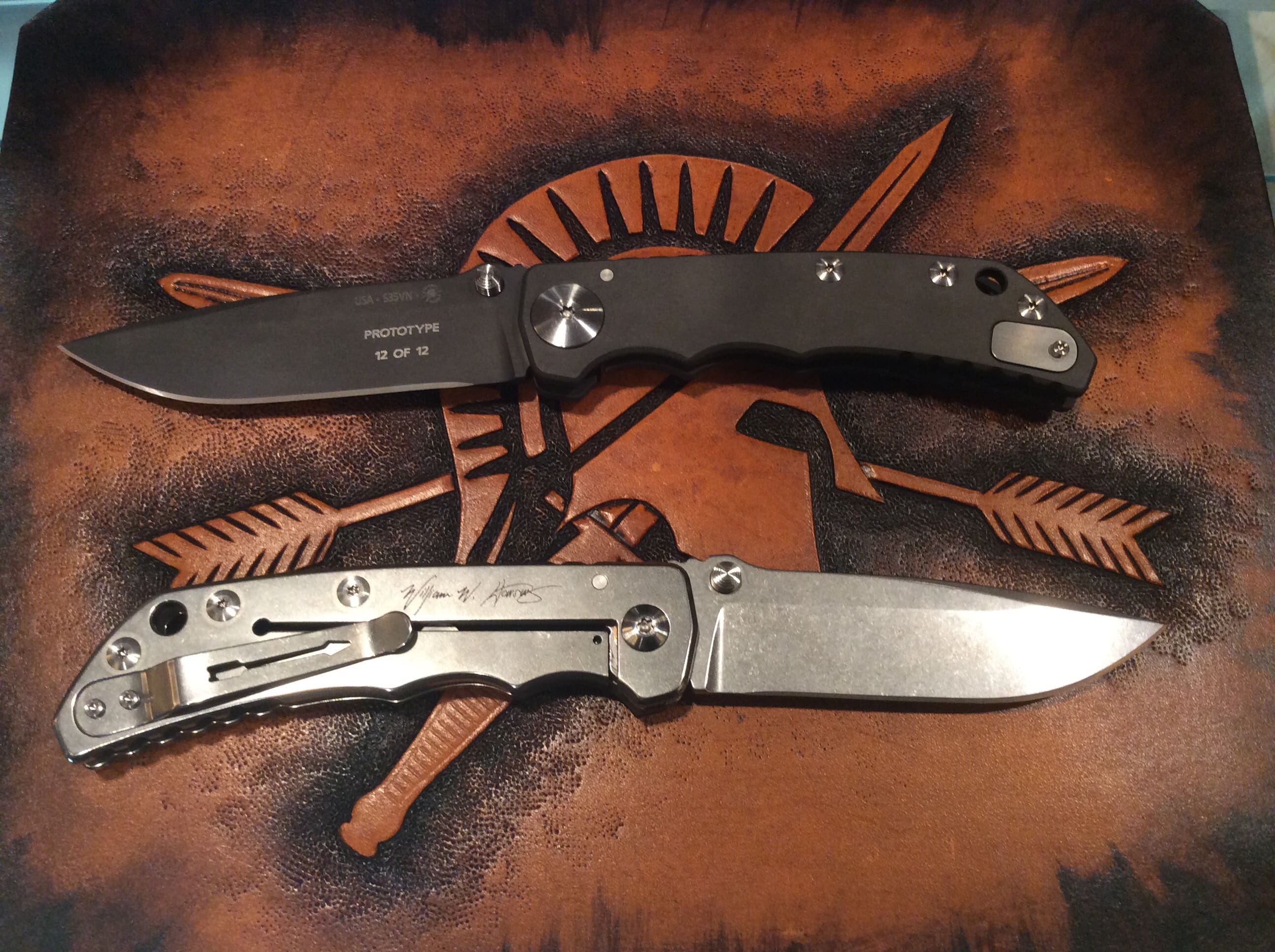
The Spartan Harsey Folder.  This particular one that I reviewed is a custom version that I bought from Spartan Blades.  The standard versions are either all stonewashed or all black.

Introduction:


It's finally here!  My Spartan Harsey Folder, the aptly acronymed SHF.  This is the knife whose future existence I teased in my review of the Lone Wolf T2.  At the time of that review the SHF was still in development.  Now that I finally have mine in hand and have had a month to test it out, I have to say it was worth the wait.  Given the fact that the SHF won 2016 American Made Knife of the Year at Blade Show, I'd say that other people feel the same way.

The SHF is a knife with a lineage.  Renowned knife designer Bill Harsey has designed a number of iterations of knives similar to the SHF over the years, but he really hit a home run with the Lone Wolf T series.  Unfortunately Lone Wolf went out of business, and so the T2 design went defunct.  Bill really wanted to make sure that when he brought the design back that it was an improvement, and the best knife it could be.  After some successful collaborations with Spartan Blades they developed the SHF, which is an all metal, framelock version of the knife.
My little collection of Harsey designed knives.  You could say I am a fan.  From left to right: The Spartan Harsey Difensa, the Gerber Applegate-Fairbairn Combat Folder, the Gerber Applegate-Fairbairn Covert Folder, the Spartan Harsey SHF, the Lone Wolf T2, The Tacops Falcon (designed by Bill Harsey and Chris Reeve), and the Fantoni HB-02
The T2 and the SHF side by side
The result is something more than a remake.  It is a new knife.  Stouter and more, well, spartan, but also refined.  The T2 was an amazing value at the time (the pricing on the resale market for the Lone Wolf T2's is comparable to the SHF these days), it was a great quality knife for the price.  The SHF on the other hand is simply an outstanding knife.  It's price is comparable to other high quality American made knives in its bracket, but there are no compromises made to keep the price down.  So it costs more, but the SHF doesn't have fiberglass reinforced nylon (FRN) handle scales like the base model T2 either.  The SHF shares the fantastic ergonomics of the T2, but there are a lot of little differences.  And this review is about the details.


The TL;DR review summary: 
This knife is a special knife.  It is pretty big, it is not super light.  It is solid and impressive.  It is exquisitely balanced, and a very good slicer, especially for a modern tactical style knife.  The thumbstud deployment takes some getting used to, and the lockup seems a little too early for my tastes.  But on balance, I think this is an outstanding knife.


The Version Reviewed is a Custom:

The SHF usually comes in one of two versions, the all stonewashed version, or the all black physical vapor deposition (PVD) diamond-like carbon (DLC) coated version.  I have a personal distaste for handles that look like the blades (and honestly, a prejudice against metal handles in general), so I didn't really want the all stonewashed version.  On the other hand, I don't like black coated blades either.  I just personally don't like them, and I don't like my knives to be too intimidating to people, and black coated blades seem a little too "tactical" to me.  So I decided to be a little picky.  This knife costs between $450 (stonewashed) and $500 (DLC Coated), so for that kind of money I want to make sure that I get exactly what I want.

Spartan Blades' first production run of the SHF went out as pre-orders to retailers, so there wasn't a chance for me to get a customized one in that first run.  The second production run was when Spartan Blades was able to get their system ready for more rapid production, and since I had been in touch with Spartan on an ongoing basis they let me know when they had more knives coming up for sale.  I asked if it would be possible to get a knife made with the black handle and the stonewashed blade.  Kimberly at customer service told me that they were getting ready to do some customs, and that she would let me know when they were ready to start making them.  I was very surprised that it was just a week later when she let me know that my custom knife was ready.  My patience paid off in the opportunity to have a knife made for me to my specifications, and I am quite happy with it.

This is the most expensive knife I have ever bought, and it is the first custom knife I have had made for me, so it is a first for me in those ways.


Let's Start With the Specs:


  • Blade Length:        4"
  • Overall Length:      8 13/16"
  • Finish:                    Black PVD (Handle), Stonewash (Blade)
  • Blade Thickness:   0.154"
  • Thickness:              0.5"
  • Blade Steel:           CPM S35VN
  • Blade Hardness:    58-60 RHC
  • Frame:                    6AL-4V Titanium
  • Weight:                   5.888 Oz
The SHF is a substantial folding knife.  Coming in with a four inch blade and an overall length of almost nine inches when open.  That said, this knife does not seem overly large.  It is a good sized knife for general use in my opinion.  Some people might prefer a smaller knife (or live in a jurisdiction that bans knives of this size), but for my money this size knife is just right.  Plus the handle size is a great fit for my hand.
The SHF in my hand.  Note, I have pretty big hands which is why I usually avoid having my hands in the picture, but it shows the handle fit for me.
The blade on this knife was given a stonewashed finish, which is one of my favorite finish types.  A stonewash finish is created by... tumbling the knife with pebbles.  It is what it sounds like.  In my experience stonewash finishes feel pretty low friction, and they are more resistant to corrosion than bead blasted finishes.  Additionally the stonewash hides scratches pretty well, which helps keep the blade looking nice.  The stonewash finish also keeps the blade from being too reflective if that is a concern.
I feel like this image captures the stonewash finish nicely.  The bright high-desert sun also captures the subtle prismatic effect of the DLC coating in bright lights.  While no one would call DLC sparkly, it is subtly prismatic for a very subdued iridescent shimmer.  It is really only noticeable in full bright sunlight, but it is one of my favorite minor details.

The steel of the blade itself is the very fancy supersteel CPM S35VN.  This is a very tough, hard wearing, corrosion resistant, stainless steel that is able to take and hold a very keen edge.  It is a particle steel, which as I have written before is made with science magic.  The fantastic performance has something to do with carbides... I think.  I'm no metallurgist.
The blade stock of the SHF seems to be a little thicker than the T2.  I didn't break out my calipers, but I'm pretty sure.

The handle is titanium, which translates to an extremely solid feeling knife.  I was initially surprised that the knife still felt surprisingly (to me) heavy in the hand.  I expected the titanium handle to allow for a very light knife, like with the Fantoni HB 02.  However, the thick slabs of Titanium (while strong) are not milled out at all, and leave the knife with a substantial weight.  I wondered about that heft initially, until I checked the balance:
That balance is right at the index finger groove.
The knife balances right at the index finger groove.  This is the same point of balance one finds on Harsey's knives like the Difensa.  Having the balance a little back of the blade, right at the fulcrum of the index finger provides a lively feel in the hand.  Bill Harsey has made his reputation designing tactical and fighting knives, and this knife reflects that, and manages to capture the same balance point in a folding knife.


A Note on the Clip:

The T2 on top, with it's tip-down clip, and the SHF below with its titanium tip-up clip.
One of the big changes between the T2 and the SHF was changing the pocket clip from an obligatory right-handed tip-down clip to a left/right reversible tip-up pocket clip.  I personally prefer a tip-down clip since I usually carry my knife in my back pocket.  Plus the T2 clip was one of my favorite things about the old design, and it fit my hand more unobtrusively than any other pocket clip I've used, despite the beefiness if the clip.  That said, I actually wanted the SHF for use in the field, and I typically wear pants with back pocket flaps in the field, which makes the front pocket carry of the SHF actually a bonus.  Also, the titanium clip is strong and fairly unobtrusive in the hand.  Plus, the arrow cutout is pretty cool in my opinion.

Review:


Steel:


I feel that CPM S35VN is an excellent steel, and a good fit for a knife in this price range.  I'd say that the steel is an unequivocal positive.  I know that some steel snobs might prefer a more esoteric steel (like S90V or M390), but for balance of metal characteristics I think S35VN is hard to beat in a tactical/EDC knife.  Additionally, Spartan Blades has a proven track record with their heat treatment of S35VN.  They know how to get the most out of the steel, and the performance has been excellent.

Blade Finish:


As I stated earlier, the stonewash finish is one of my favorite finishes for a knife.  It's attractive, hides scratches, and it provides a lower friction coefficient than a DLC/ZRN coated blade, especially when wet.  I like the easier slicing a lot, especially in a blade that has some thickness.

Blade:


I really think the blade on this knife is excellent.  I was initially a little sad that Spartan was not offering a full-flat-grind option on the blade (like my T2 Ranger), but I was willing to accept the modified spear-point sabre-grind blade for an all purpose knife.  It has been my experience that sabre-grind blades tend to not slice as well due to the more obtuse angles and increased thickness.  I was pleasantly surprised to find that the slicing performance of the SHF has been quite impressive.  Even though the SHF is thicker at the terminal bevel than the T2 Ranger was, the terminal bevel grinds and blade geometry work to create a blade that is the equal of the Ranger for the cutting tasks I have put it to.

(The SHF actually is even better at apple slicing than the Ranger, which is handy since my two-year-old demands that I slice up her apples one slice at a time daily)

A final nice feature of the blade is the jimping.  The jimping strikes a neat balance between echoing the jimping of the T2, and also recalling the jimping on Spartan Blades' fighting knives.  The jimping is effective, but not obnoxious, and manages to strike a good balance both in performance and aesthetics.  It is the little things that really make a knife for me.
A look at the jimping


Handle:


The handle, while nice, is one place where I really missed the T2.  The wood handles and radiused edges of the T2 made for a handle that really melted into the hand.  The all-metal handle and chamfered edges of the SHF make for a knife that has a much more positively grippy feel in the hand.  You feel the SHF much more than the T2.  The chamfered metal looks and feels more modern and agressive.  I liked the old fashioned feel and look of the wooden handle.

In actual use I found that the SHF performed nicely, and the handle did not result in hot-spots on my hands.  The handle jimping is attractive and effective.  And the knife is very comfortable to use, and the same excellent ergonomics are there.  But I miss the soft rounded comfort of the T2.  Of course you can't buy a new Lone Wolf T2 anymore, because the company is gone, so the comparison is unfair.  Even more unfair since the wooden handled version was uncommon even when they were getting made.  The SHF handle compares just fine with other production Harsey designs currently on the market, like Fantoni's HB series.

It is worth noting as well that all of the screws and standoffs on the SHF are also made out of titanium.  That detail is a part of the reason for the cost of the knife, but it is a neat detail.


Locking Mechanism:


The locking mechanism on the SHF is an integral frame lock with an internally mounted Hinderer Lockbar Stabilizer (a patented feature licensed for this knife).  Since the handle is also the frame of the knife, a part of the handle functions as a spring and moves in to lock the blade in place.  The mechanism is similar to a liner lock, but with a liner lock there are handle scales over the metal frame.  The advantage of the integral frame lock is that when you hold the knife handle it actually holds the lock in place, which provides additional reliability.  The frame lock is very popular, particularly on high end knives.  I personally prefer liner locks, but that is because I am biased against metal handles, and I dislike having different materials on different sides of the handle.  But this is a detail where my tastes run counter to most folks who buy higher end knives, so I am pretty much out of luck.

(Note on lock terminology: with frame and liner locks, early or late refer to how far the lock travels over the blade tang when the lock engages.  Over time, like years, the metal wears down where the lock engages, and this means that over time the lockup gets later.  An early lockup means that even as the metal wears down there will be plenty of additional surface to ensure secure lockup.  However, if the lockup is too early then the lock can fail to fully engage, which can be dangerous.  Three Sisters Forge has a patented adjustable cam [stop pin] that allows for lockup timing to be adjusted, but they are the only ones I know of with this feature, so in my experience you are mostly stuck with the lockup you get from the factory.)

The locking mechanism on the SHF is probably my biggest issue overall with the knife.  The lockup is very early.  There is no issue if the blade is flipped open using the thumbstud, or simply opened with a little authority, but when the knife is opened gently with two hands the lock fails to engage.  Over time I am sure this will change, and it is not an issue for me in normal use, but when I let people borrow the knife they tend not to be "knife people" and try to be too gentle with the knife, which creates an unsafe situation.


Deployment:


The deployment of the SHF required some learning on my part.  The strong detent and shape of the thumbstuds meant that the knife actually did not work with quite the same hand movements I was used to.  Additionally, the extremely smooth opening (comparable, in my experience, only to a Sebenza) meant that when I did get the knife opening, the blade flew out way faster than I was used to/expecting.  I expected the knife to open exactly the same as my T2:

However, the SHF is not the T2, and nowhere was this more evident than with the deployment:

As you can see, when the thumbstuds are used right, the blade pops right out.  With practice this became easy to do, and quite satisfying, but it did involve a learning curve.  I was used to a controlled opening arc, and the SHF essentially just needs to get launched.  At the end of the SHF video I demonstrate the pinch method that I have found works easiest for me if I want to do a controlled arc.
Note the grooves leading to the thumbstuds.
The best tip that I can offer for opening the SHF is to use the thumbstud access grooves as a guide.  The grooves guide your thumb-tip to the correct angle and position to open the knife with ease, but the mechanics are a little different than I was used to.


Fit and Finish:


The fit and finish of this knife is absolutely outstanding.  My only complaint is the too-early lockup, but otherwise I detected no irregularities, misalignments, assymetries, or flaws.  The knife was literally flawless as far as I can tell.  This is the first knife I have owned that I felt exceeded the build quality of the Fantoni HB 02 (of course the HB 02 costs about half the price, but Fantoni makes fabulous knives).
A comparison photo with the Fantoni HB 02
The factory edge on the knife was very sharp, and is still the only edge put on the knife thus far.  I have had no need to resharpen the knife.  I have been very pleased with the edge on this knife.  The edge seems a great balance of stable geometry and... sliciness (for lack of a better word).  It cuts like a dream.

One last touch that I really liked was having Bill Harsey's signature on the blade.  It is a little touch that makes me very happy.
The William W. Harsey signature.

Use Review:


In use this knife has performed excellently.  It works very well for most every task I have used it for.  As a modern style folder, it simply can't compete with a little old-fashioned slipjoint knife for apple slicing, but even in the apple slicing department it outperforms other similarly sized knives.  The excellent ergonomics make the SHF a very handy all-purpose knife.  It handles most kitchen tasks very well.  Most any cooking task that calls for a petty knife can be handled ably.  And it also slices up cardboard cleanly and chops through blackberry vines nicely.

One particular use where the SHF really outperformed my expectations was in whittling.  I have not really found modern folders to be very handy for whittling for the most part, but the SHF actually makes a pretty decent whittler.  I whittle when bored, and so I am happy that the SHF actually tackles that task ably.

Summary:


The SHF really is a different knife from the old T2.  The shared lineage, similar appearance, and design of the SHF invites comparison, but the two knives feel quite different in use.  The T2 is still my absolute favorite knife of all time, but I really feel like the SHF is actually a nicer knife in almost every way.  The quality of the SHF is certainly top-notch.

The SHF is a spendy knife.  The price is comparable to other high-end mid-tech production knives (Hinderer, Strider, Chris Reeve, etc.), but that price is still awfully high for your average knife buyer.  That said, for myself, I am very happy with this purchase.  I fully expect to get decades of use out of this knife, and I find it a pleasure to carry and use.

The SHF in nature

I just love the green of that high desert lichen

A nice view of the blade with the signature

Knife in nature

Knife in nature


And one last knife in nature

Sunday, January 24, 2016

Knife News: Spartan Blades SHF (Spartan Harsey Folder)

Updated 08-21-2016:  I actually wrote a review of the SHF, so if you would actually like to read what I think about the knife now that I own one, you can read it here.

Updated 07-07-2016:  I didn't really think many people were going to read this preview, but since hundreds of people have read it I thought maybe I should update so things.

If you read my knife reviews you may recall a section at the tail end of my review of the Lone Wolf Harsey T2:
When I posted my original First Impressions Review, Bill Harsey left a comment on my Facebook page informing me that he had finished up prototyping work on a new similar knife.  He said that the new one would have a titanium frame and handle (I'm not personally a big fan of metal handles, but I am willing to reserve judgement).  So this is very exciting news to me.

Unfortunately, I have no idea when this new version might come out, or who would be producing it, or what price it might be sold at.  And there is not even really a guarantee that the knife ever will enter production.  And hopefully Bill won't be mad at me for writing about his Facebook comment here.

But, if a new version of the T2 comes to fruition, I will do everything I can to review it in a timely fashion.  I'm not a particularly well known reviewer, and I don't have much of a following, so it's not like the makers would have a strong motivation to send me a tester.  And the knife will not be cheap, and heading into grad school, money is not something I am swimming in.  So even if the knife came out tomorrow, it might be a while before I could review it.  But if a new one comes out, I will let you all know.

So to sum up, the Lone Wolf T2 is my favorite knife.  I think it is just about perfect, but it is hard to buy, and the prices that they sell for these days can make it hard to justify actually using.  But stay tuned, there may be a resurrection of this knife, and that could truly be an amazing knife. 
 Well the resurrection of the T2 is here in the form of the Spartan Blades SHF (Spartan Harsey Folder).
The new SHF, coming out in a stonewashed finish and black DLC (DiamondLike Coating) finish.
The exciting news is that the knife is finally being released.  The bad news is that it will be some time before I can actually get my grubby mitts on one.

Update:  I have just ordered my SHF, so I will be reviewing it soon.

The SHF is being sold for the prices of $460 for the stonewashed version and $495 for the DLC version.  Those prices, while well within the normal range for US made knives of comparable materials, mean that it is going to take me quite a while to save up the funds to spend on a knife that is essentially a new version of a knife I already have.  But I am going to buy it, it's just going to take a while.  I'm guessing probably at least six months (I don't make big bucks as a grad student, I have some non-discretionary spending coming up, and there are several conferences I need to attend in the next couple months, so six months may be overly optimistic), but I look forward to reviewing the knife when I get it.

Of course having to wait a while is not entirely bad news, but let's talk a bit about the knife first...

Materials:

Like most of the Spartan Blades catalog, the blade of the SHF is made of CPM S35VN.  I have written about this steel a few times, my summary is that it is a science-magic steel.  It's neat stuff, and Spartan Blades knows how to work with it.

The biggest change between the SHF and the T2 is that the SHF is a frame lock.  That means that part of the handle frame actually springs inward to lock the blade in place.  And then the frame is further held in place by your hand as long as you are holding the handle.

The the handle and all the non-blade hardware of the SHF is titanium, which is probably the most exciting part of this new design for me.  The screws, standoffs, blade pivot, and clip are all made out of titanium.  This should be one extraordinarily strong and solidly constructed folding knife.  I am particularly excited about the titanium pivot.  All of the points where failure might occur are going to be made of extremely strong and lightweight material (not that using a folding knife as a knife would lead to failure in a less strongly built knife, but some people like to to silly things with their knives).

Makers:

Spartan Blades is a US company based out of North Carolina.  The company was founded (and is owned) by two retired special forces soldiers, Curtis Iovito and Mark Carey.  In addition to being veteran owned, and employing other veterans, Spartan Blades uses US origin materials for their products.  Not only are the knives made in the US, the materials that make the knives are made in the US.  The sheaths for the knives are made by vendors that are also veteran owned companies that us US origin materials.  And Spartan Blades works with other US veteran owned companies.

The message here is that Spartan Blades is a company that takes "Made in America" seriously at all levels, and has a commitment to service and others who have served.  Being so resolutely US sourced does tend to mean that costs for materials and labor will be higher than if the knives were made and sourced overseas, but I would argue that the additional cost can be well worth paying.

In a country (and world) dominated by the forces of market economics, the dollars we spend are our most concrete forms of real power.  When you spend money on goods you vote with your wallet.  I am not speaking metaphorically, you really are shaping the world you live in with your spending habits.  This is not to say that it is always wrong to buy foreign made goods by any means, but it is to say that price should not always be the only consideration.  Spartan Blades is a company I like to support.

It helps, of course, that Spartan Blades makes excellent quality goods.  I have been quite thrilled with my Spartan Harsey Difensa since I purchased it.  It has actually seen a lot more use than I had initially expected.  It is just a well designed and built piece of equipment.  (And the soldier that I bought Model II for has also been quite happy with it.)

But Back To The SHF:

While I wish I could just buy a SHF right now, it might actually work out better for me to have to wait.  I am excited for the SHF, but there are things that I am not crazy about with these initial models.

The stonewashed finish

I am not crazy about metal handles.  One of my favorite things about my T2 is the wooden handles.  I like the way they feel, and to my mind they feel warmer in the hand than metal handles.  However, I know that Bill Harsey has carried a titanium handled knife for many years, and he seems to like it.  While it is a logical fallacy to simply rely on an appeal to authority, some people really are experts.  I'd count Bill as an expert.  I am willing to give a metal handled knife a chance, particularly since one of the reasons I want the SHF is for when I am working in the field.  I tend to end up working in the high desert fairly frequently, and the gritty sand can do a number on even artificial handles like derlin. The titanium should be able to stand up to that well, plus if I do need the knife repaired I can send it in to Spartan  (unlike the T2, Lone Wolf Knives doesn't exist anymore so if I mess up my knife there is no where to send it).

I like the DLC on the handle, but I really don't like black Blades on my knives. I know a lot of people really like that look, but I am hoping for the option for a stone washed blade in a black handle later this year.  Another option that I hope becomes an option this year is the Flat Dark Earth color ZRN finish. It has a nice golden tone I prefer to black.

Update:  Spartan was finally able to make space for some custom orders for the SHF, and that is why I finally bought mine today.  I will be getting a SHF with the black handle and stonewashed blade.  I have no idea when the FDE blade might be an option.

The other thing that I hope will happen sooner, rather than later, is a full flat grind option like the one on my T2.  I had some questions about the SHF, and I emailed Curtis Iovito, who was kind enough to get back to me promptly. One of the questions I asked was whether or not there would be different blade styles. He told me that there was a possibility of different styles, but there was no current plans to start working on new designs.  It will probably be longer than I want to wait before any new blade geometries come out, but I can hope.

Tip up clip.  You can go left or right, but it is tip up all the way.

One thing that I was sad to see on the SHF was the obligatory tip up clip. I really like the design of the tip down clip on the T2 (though it was one of the aspects of the T2 that I have read the most complaints about online, there are a lot of people that prefer tip up). Despite the large size of the clip on the T2, I have found it to be very unobtrusive in the hand, I worry that the SHF clip will be less comfortable. We will just have to see.

Update:  I got to handle the SHF folders at the Oregon Knife Collectors Association Show this spring, and I found the clip to be totally unobtrusive in the hand.  I seriously did not notice it when I held the knife.  I have also realized that most of the pants that I wear in the field have flaps on the back pockets, so the front pocket carry is going to be actually a plus for me.

Colored hardware

The last thing that I am looking forward to is the different colored hardware that has been shown in the prototype photos that Spartan Blades has put out. The gold and blue colored screws, standoffs, and thumbstuds look like a neat way to add some visual spark to the SHF.

But enough of my rambling on about a knife I haven't actually had a chance to hold.  I've given Spartan Blades enough free advertising for today. I just wanted to share my excitement at the news that the new SHF is finally coming out.


Tuesday, December 29, 2015

Knife Review: Mora: Morakniv HighQ Allround Knife

Introduction:
Morakniv HighQ Allround knife with sheath

When I started doing these knife reviews, a part of my motivation was to provide suggestions for affordable good quality knives.  In that vein, I am finally getting around to reviewing a Mora knife.  If you were to spend far too many hours reading about various types of knives for camping and bushcraft on various knife forums (as some of us do), there would be certain knife brands that you would hear mentioned repeatedly as top performers.  The Mora knives are absolutely one that I read people raving about, but what I didn't realize at first was that they are also extremely affordable.  When it comes to affordability in a general purpose knife, I don't think you can really beat a Mora.

Most of the knives I have been reviewing tend to be fairly expensive.  Some of them are very expensive, but not this one.  You can pick up a Morakniv HighQ Allround for less than $15.  This is a quality knife that you can pick up at a disposable knife price.  But in reality, you probably won't pick up this exact knife since the model that I am reviewing was recently discontinued, but there are newer models that are very similar.  If you would like a handy primer on the different styles of Mora knives there is a handy one here, from Ramblin' Jim.  As Jim says, at these prices you can just pick up a few and try them out.  Amazon has bundles of different Mora models for sale.


The TL;DR review summary: 


If you really aren't interested in reading the whole review, then let me just say that I started out just wanting to see if the Mora could handle some of the tasks that I had done with other bushcraft knives.  It was such a pleasure to use I ended up carving a spoon.

This is the first spoon I have ever carved, and I did it entirely with the Mora I am reviewing here (well, I also used sandpaper, but it was the only knife I used)


Let's Start With the Specs:


(Knife Specifications from Knife Center)


  • Blade Length: 3.75" (95 mm)
  • Blade Steel: High Carbon Steel, 59-60HRC
  • Blade Thickness: 2 mm
  • Overall Length: 8.2" (208 mm)
  • Handle Material: Rubber
  • Weight: 3.7 oz. (105 g)
  • Made in Sweden

I'm not going to go into the specs too much here, especially since this exact knife is discontinued, but the followup models are very similar.  

What I think is probably most noteworthy is the steel.  This particular knife that I reviewed is not stainless, it is high carbon.  I accidentally left it outside for a few weeks after I had taken the photos I used for the review, and it definitely rusted.  The rust was just superficial, and it cleaned off, but it left stains.  And this type of steel does stain.  After using the knife for a while the steel will turn grey, even if you take care of it, that is just the way it goes.  The discoloration is called a patina, and lots of people actually really like the patina.  There are many discussions online devoted to different types of forced patinas, and how to get different colors.  I personally prefer stainless myself, but carbon steel is often better performing than less expensive stainless steels.  

Mora also has a good reputation for their heat treatment of their stainless steels, and the use Sandvik steels for their stainless.  But that is not what I am reviewing, because Mora has a particularly good reputation for the heat treatment on their carbon steel blades, and my experience is that the reputation is well earned.  Carbon steels might discolor easier, and they require cleaning and oiling to maintain optimally, but a good high carbon steel can have as good or superior edge holding and toughness than a stainless super-steel at a much lower price.  If you want excellent performance for a low cost, and you are willing to take care of your tools, then a high-carbon steel can be an excellent choice. 


A Note on the Sheath:


I really liked the sheath for this knife.  It is not fancy looking, but it is not a fancy knife.  The sheath is easy to clip on to your belt, but it stays on securely.  The knife fits snugly into place in the sheath with no wiggle or rattle.  It stays secure without needing an additional snap or loop to hold the knife in place.  As an extra bonus, and showing the origin of the knife as a construction/work knife, the sheath is designed to stack with other Mora sheathes, so if you needed two different knives you could have them stacked.


Review:


Steel:


As I stated earlier, the steel is high carbon.  Morakniv does not provide a more precise description than that.  Whatever the exact steel recipe is, when combined with their heat treatment is makes for an outstanding performing blade steel.  A lot of the hardness, edge holding, and resistance to chipping in a knife comes down to having a good heat treatment.  The many decades in the making reputation of knives from Mora, Sweden is in large part due to the heat treatment.

I found the knife to hold an excellent edge, even when I abused the edge.  And one of the benefits of carbon steel as opposed to stainless steel is that it is easier to sharpen.  So after I managed to wear out the initial edge to the point where it just was not performing as well, it was a breeze to put a new edge on the knife.


Blade Finish:


The blade finish is nothing to write home about.  It is a standard, somewhat polished, finish.  The knife is a work knife, it is going to get scratched, and since it is a carbon steel blade it is going to get a patina.  Some other Mora knives have coatings or special finishes, this one does not.


Blade:


So a big part of what makes this knife (and most of Mora's lineup) perform so well while maintaining sturdiness is the Scandi Ground blade.  The scandi grind is a great geometry for a utility knife.  Different types of tasks can be easier with different grinds, I for one strongly prefer full flat grinds for kitchen knives as an example.  The scandi is especially good for wood working, which is handy for a knife you intend to use for camping or bushcraft.

A big part of the reason the scandi grind works so well for cutting into materials like wood is the lack of a secondary bevel.  The primary bevel on the blade goes right to the edge, so the blade does not shoulder until the blade is at least as far in as the edge of the primary bevel.  I worry that this might be getting a little jargon-rich/technical, so I will just say that I like the grind.  If you want to know more about grinds I wrote about them in my article Knives: A Primer a while back.  I also link to an interesting video that explains blade geometry and shouldering in more depth in that article.

The blade on this knife is pretty small.  It is less than four inches long, and pretty thin.  The blade feels more than solid enough for any task I asked of it, but it is not a big tank of a blade.  It is a handy, nimble size, good for general tasks, but it is not a big chopper.

I did do a little batoning with the knife, just because I figured that it really wouldn't have been a big deal if the knife broke.  The knife held up just fine, but with such a short blade you are pretty much limited to splitting wood that is already kindling.  If you have read my other reviews then you know that I am not a fan of batoning, but it is very "in" right now.

The one big drawback to the thinness of the blade is that it ended up giving me blisters on my left hand from pressing on the back of the blade while carving.


Handle:


The handle is one of the best things about this knife.  It is not pretty, or flashy, but it is comfy.  The handle is plastic covered with a rubber layer.  It is soft, grippy, and ergonomically excellent.  This knife really feels good in the hand, even after you have been using it for quite a while.


Deployment:


This is a fixed blade, not a folder, so deployment is really just taking it out of the sheath.  The sheath is well designed, and it is quick and easy to take out the knife.


Fit and Finish:


Fine for a $12 knife.  This really isn't a fancy knife.  All I cared about was the sharpness of the knife, and that everything solid.  The bevel were even on the knife.  It came very sharp.  I have absolutely no complaints.


Use Review:


I took a fair number of photos, so I will let the pictures do most of the use review talking.  The one thing I will say, which I feel perfectly sums up how I felt about this knife in use, is that I had originally planned to give this knife away after I was done with the review, but I ended up liking it so much that I decided to keep it.  I like whittling, and it is a great whittler.  It also makes a great extra backup knife.  When I am out in the field, people often need to borrow a knife.  The Mora is a good one to be able to loan out.


The Mora is not really a kitchen knife (though Mora does make kitchen knives) but it does fine.  It's really at it's best handling paring or boning tasks, it's not a real food prep knife.


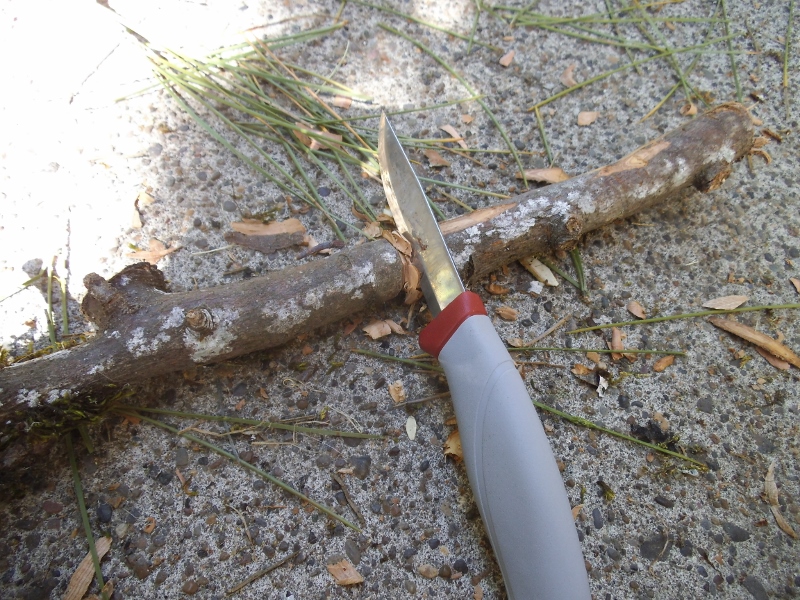
I loved this knife for wood working.  I used it here to drill out a hole for a fire board.


It bit right into the wood for the notch.


Made quick work of the notch.


You can see in this picture that I ended up getting too enthusiastic with the knife.  I found that it was not totally ineffective at chopping (this knife is NOT a chopper, but it did better than I expected).  But the small size and light weight lulled me into not taking it seriously.  I ended up chopping into my fingertip.  Always remember, knives are not toys, and this one was sharp.  That cut was 100% user error.  My fault.


Cut through a branch to make a spindle for a fire drill.


This is the process of cutting through.


Just a shot of the knife surrounded shavings and evidence of using it.


Summary:

I highly recommend these knives.

If you are looking for a good quality all around knife, and you don't want to pay a lot, this is the knife for you.  Heck, even if you are willing to spend a lot of money, consider picking up a Mora, it might change your mind.  They aren't fancy, they aren't flashy, but they are extremely affordable and very good quality.  Frankly mine is a pleasure to use.

Moras are a great example of a quality tool that you can find for a great price.  And the best part is, you can use it as roughly as you want, since even if you did manage to break the knife you are only out the cost of a couple Big Macs.