So I just thought that I would write this out to get it on the record, especially since I am feeling like maybe I could be wrong.
I have managed to predict presidential elections correctly pretty well for the most part. When I was 7 I predicted Dukakis would win the Presidency, and I was wrong, but other than that I have been pretty good. Starting in 2002, I really started to feel like the social currents were so clear that it was obvious years before the election that by the time the elections came around an honest analyst would have known who was going to be elected for years ahead of time.
So I started making my predictions the October prior to the election year. Obviously the Bush prediction was simple. I thought the 2008 Obama prediction was also easy, since by October 2007 Obama already had a secret service detail (You don't get secret service protection unless there are credible threats against your life related to the office of the Presidency. I figured that if people were already actively trying to murder Obama before there had even been a single primary that momentum was overwhelmingly on his side.). Likewise, Romney clearly had the momentum in the Republican field in 2011, and even if the US was ready to elect a Mormon I have a hard time imagining it would be someone like Romney, not to mention that the electoral map was very stacked against any possibility of Republican victory.
So that was my record. I've been able to make good calls more than a year out over the last couple elections, so that was going to be the subject of a blog post back in October, but I didn't write it, because I no longer felt confident in my prediction. But I decided to go ahead and share my prediction: I predicted Hillary in 2016.
I actually originally predicted Hillary in 2016 back in 2012, but for years I saw no reason to change my prediction. The Republicans are too busy nominating either hate mongering radicals that appeal to the extremely vocal subset of extremists within the party or bland panderers that cater to just enough regressive policies to appease the people who want to roll back freedoms for people they don't like. When we got to 2015 with no serious Democratic challengers and passel of theocrats on the Republican side I felt very confident in my prediction.
But the Bernie Sanders happened. He was very out of the blue for me. My politics tend to favor more centrist candidates, so I have been pretty optimistic about Hillary--
(Parenthetical digression: If you think that Hillary is super liberal then you have probably been pretty well indoctrinated by the decades of anti-Hillary bull that has been spouted Right Wing extremists. Back in the early 90's you may recall that the strong opinions that Hillary held were treated as a threat to the fabric our nation since she was supposed to shut up and smile like a good woman. Her political aspirations were seen as evidence of Bill's emasculation. There was a popular t-shirt at the time that said "I don't trust President Clinton or Her Husband." The fanatical and endless attacks against Hillary on all levels--political, personal, sexual, wifeliness, age, emotionality, etc. ad naseum--are pretty transparently anger about her failure to submit adequately to traditional female roles. So you can think of Hillary as a liberal if you want, but as far as I am concerned you are wrong. Don't drink the Kool-Aid.)
--though I will probably vote for a third party candidate as per usual myself. But I did not expect an honestly liberal candidate to rise up on a wave of Democratic anger.
I also did not think that Republican anger could actually lead to a populist candidate rising to prominence on a platform of fascist nationalism predicated the oppression, marking, and exclusion of a religious minority.
Clearly I was wrong on both ends. Rather than the predictable show off between Jeb/Rubio and Clinton that I expected, the primaries are turning out to be real races.
On the Republican side there is the execrable Trump who has not fizzled like I expected (I'm still hopeful that he will. His popularity leaves me scared for the spiritual health of our nation.), and the even more extreme--though not as bombastic--Cruz (Who has the same citizenship status as me, and who I think does not qualify as a Natural-born citizen. McCain was born in US occupied and controlled territory as a part of a governmental service obligation on the part of his parents, that was a totally different ball of wax.).
And on the Democratic side you have the once-presumptive nominee, Hillary, and the very liberal upstart campaign of Bernie Sanders. I never thought that Sanders could get this far. At first I thought that he was just going to force Hillary leftward (and thereby open the door a little more for the Republicans), but instead he has turned into a real force in his own right. He has somehow managed to make the liberal Democratic anger feel somewhat hopeful, and I feel like it is that hopefulness that really makes him dangerous to the status quo in the primary race.
Now I don't know who is going to win. And that is kind of exciting, but it also kind of upsetting since I usually like to think I am pretty good at political prognostication.
But back to this last October. I was already feeling uncertain. But I stuck to my Hillary prediction. I just wanted to actually publicly state my prediction so that I can't go back and retroactively ascribe foresight to myself if it turns out I was wrong.
My official prediction is Hillary, but my unofficial prediction is I'm just not sure anymore.
Showing posts with label Center Gnome. Show all posts
Showing posts with label Center Gnome. Show all posts
Thursday, February 4, 2016

Sunday, January 24, 2016
Knife News: Spartan Blades SHF (Spartan Harsey Folder)
Updated 08-21-2016: I actually wrote a review of the SHF, so if you would actually like to read what I think about the knife now that I own one, you can read it here.
Updated 07-07-2016: I didn't really think many people were going to read this preview, but since hundreds of people have read it I thought maybe I should update so things.
If you read my knife reviews you may recall a section at the tail end of my review of the Lone Wolf Harsey T2:
The exciting news is that the knife is finally being released. The bad news is that it will be some time before I can actually get my grubby mitts on one.
Update: I have just ordered my SHF, so I will be reviewing it soon.
Like most of the Spartan Blades catalog, the blade of the SHF is made of CPM S35VN. I have written about this steel a few times, my summary is that it is a science-magic steel. It's neat stuff, and Spartan Blades knows how to work with it.
The biggest change between the SHF and the T2 is that the SHF is a frame lock. That means that part of the handle frame actually springs inward to lock the blade in place. And then the frame is further held in place by your hand as long as you are holding the handle.
The the handle and all the non-blade hardware of the SHF is titanium, which is probably the most exciting part of this new design for me. The screws, standoffs, blade pivot, and clip are all made out of titanium. This should be one extraordinarily strong and solidly constructed folding knife. I am particularly excited about the titanium pivot. All of the points where failure might occur are going to be made of extremely strong and lightweight material (not that using a folding knife as a knife would lead to failure in a less strongly built knife, but some people like to to silly things with their knives).
Makers:
Spartan Blades is a US company based out of North Carolina. The company was founded (and is owned) by two retired special forces soldiers, Curtis Iovito and Mark Carey. In addition to being veteran owned, and employing other veterans, Spartan Blades uses US origin materials for their products. Not only are the knives made in the US, the materials that make the knives are made in the US. The sheaths for the knives are made by vendors that are also veteran owned companies that us US origin materials. And Spartan Blades works with other US veteran owned companies.
The message here is that Spartan Blades is a company that takes "Made in America" seriously at all levels, and has a commitment to service and others who have served. Being so resolutely US sourced does tend to mean that costs for materials and labor will be higher than if the knives were made and sourced overseas, but I would argue that the additional cost can be well worth paying.
In a country (and world) dominated by the forces of market economics, the dollars we spend are our most concrete forms of real power. When you spend money on goods you vote with your wallet. I am not speaking metaphorically, you really are shaping the world you live in with your spending habits. This is not to say that it is always wrong to buy foreign made goods by any means, but it is to say that price should not always be the only consideration. Spartan Blades is a company I like to support.
It helps, of course, that Spartan Blades makes excellent quality goods. I have been quite thrilled with my Spartan Harsey Difensa since I purchased it. It has actually seen a lot more use than I had initially expected. It is just a well designed and built piece of equipment. (And the soldier that I bought Model II for has also been quite happy with it.)
But Back To The SHF:
While I wish I could just buy a SHF right now, it might actually work out better for me to have to wait. I am excited for the SHF, but there are things that I am not crazy about with these initial models.
I am not crazy about metal handles. One of my favorite things about my T2 is the wooden handles. I like the way they feel, and to my mind they feel warmer in the hand than metal handles. However, I know that Bill Harsey has carried a titanium handled knife for many years, and he seems to like it. While it is a logical fallacy to simply rely on an appeal to authority, some people really are experts. I'd count Bill as an expert. I am willing to give a metal handled knife a chance, particularly since one of the reasons I want the SHF is for when I am working in the field. I tend to end up working in the high desert fairly frequently, and the gritty sand can do a number on even artificial handles like derlin. The titanium should be able to stand up to that well, plus if I do need the knife repaired I can send it in to Spartan (unlike the T2, Lone Wolf Knives doesn't exist anymore so if I mess up my knife there is no where to send it).
I like the DLC on the handle, but I really don't like black Blades on my knives. I know a lot of people really like that look, but I am hoping for the option for a stone washed blade in a black handle later this year. Another option that I hope becomes an option this year is the Flat Dark Earth color ZRN finish. It has a nice golden tone I prefer to black.
Update: Spartan was finally able to make space for some custom orders for the SHF, and that is why I finally bought mine today. I will be getting a SHF with the black handle and stonewashed blade. I have no idea when the FDE blade might be an option.
The other thing that I hope will happen sooner, rather than later, is a full flat grind option like the one on my T2. I had some questions about the SHF, and I emailed Curtis Iovito, who was kind enough to get back to me promptly. One of the questions I asked was whether or not there would be different blade styles. He told me that there was a possibility of different styles, but there was no current plans to start working on new designs. It will probably be longer than I want to wait before any new blade geometries come out, but I can hope.
One thing that I was sad to see on the SHF was the obligatory tip up clip. I really like the design of the tip down clip on the T2 (though it was one of the aspects of the T2 that I have read the most complaints about online, there are a lot of people that prefer tip up). Despite the large size of the clip on the T2, I have found it to be very unobtrusive in the hand, I worry that the SHF clip will be less comfortable. We will just have to see.
Update: I got to handle the SHF folders at the Oregon Knife Collectors Association Show this spring, and I found the clip to be totally unobtrusive in the hand. I seriously did not notice it when I held the knife. I have also realized that most of the pants that I wear in the field have flaps on the back pockets, so the front pocket carry is going to be actually a plus for me.
The last thing that I am looking forward to is the different colored hardware that has been shown in the prototype photos that Spartan Blades has put out. The gold and blue colored screws, standoffs, and thumbstuds look like a neat way to add some visual spark to the SHF.
But enough of my rambling on about a knife I haven't actually had a chance to hold. I've given Spartan Blades enough free advertising for today. I just wanted to share my excitement at the news that the new SHF is finally coming out.
Updated 07-07-2016: I didn't really think many people were going to read this preview, but since hundreds of people have read it I thought maybe I should update so things.
If you read my knife reviews you may recall a section at the tail end of my review of the Lone Wolf Harsey T2:
When I posted my original First Impressions Review, Bill Harsey left a comment on my Facebook page informing me that he had finished up prototyping work on a new similar knife. He said that the new one would have a titanium frame and handle (I'm not personally a big fan of metal handles, but I am willing to reserve judgement). So this is very exciting news to me.Well the resurrection of the T2 is here in the form of the Spartan Blades SHF (Spartan Harsey Folder).
Unfortunately, I have no idea when this new version might come out, or who would be producing it, or what price it might be sold at. And there is not even really a guarantee that the knife ever will enter production. And hopefully Bill won't be mad at me for writing about his Facebook comment here.
But, if a new version of the T2 comes to fruition, I will do everything I can to review it in a timely fashion. I'm not a particularly well known reviewer, and I don't have much of a following, so it's not like the makers would have a strong motivation to send me a tester. And the knife will not be cheap, and heading into grad school, money is not something I am swimming in. So even if the knife came out tomorrow, it might be a while before I could review it. But if a new one comes out, I will let you all know.
So to sum up, the Lone Wolf T2 is my favorite knife. I think it is just about perfect, but it is hard to buy, and the prices that they sell for these days can make it hard to justify actually using. But stay tuned, there may be a resurrection of this knife, and that could truly be an amazing knife.
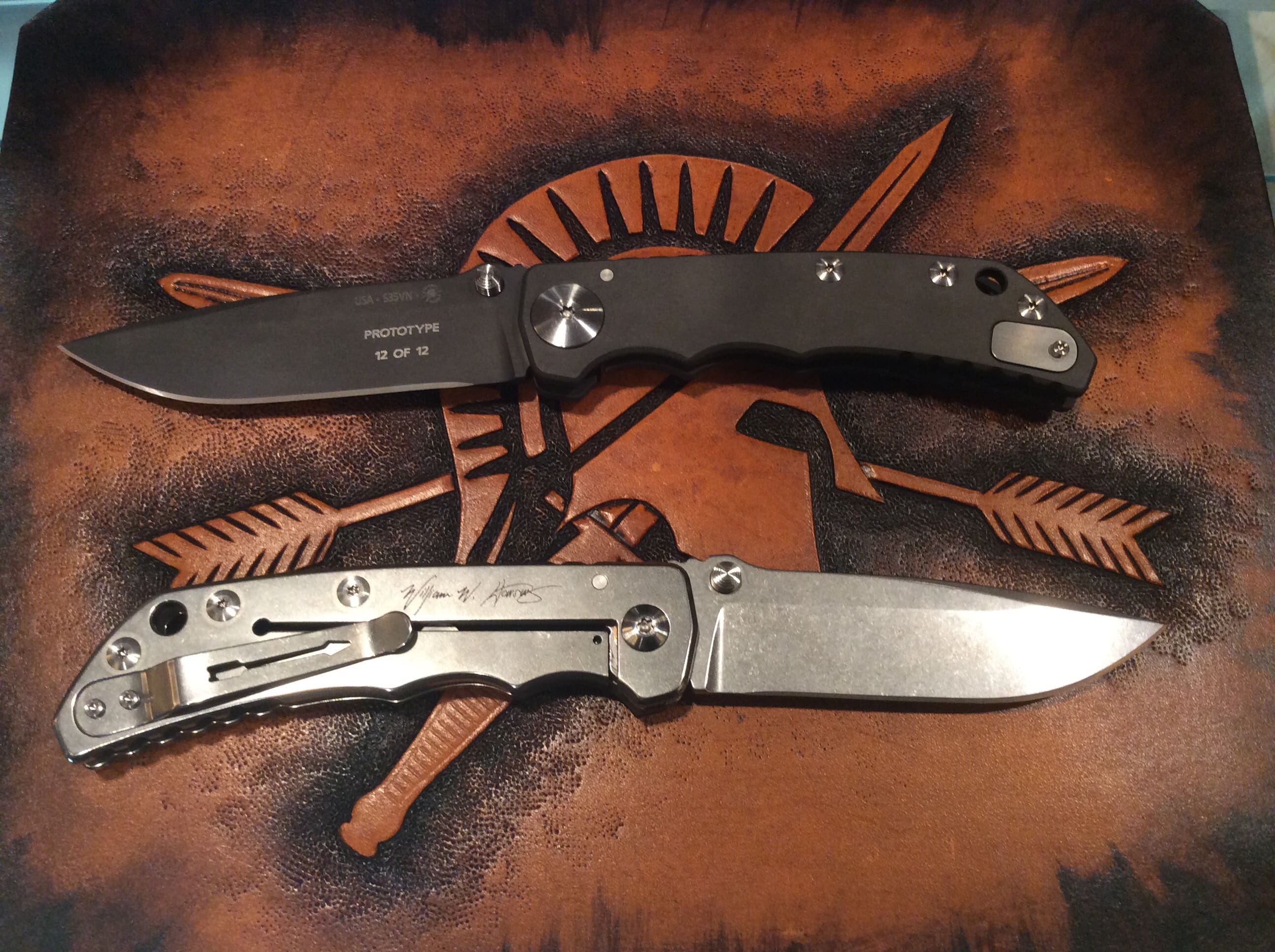 |
| The new SHF, coming out in a stonewashed finish and black DLC (DiamondLike Coating) finish. |
Update: I have just ordered my SHF, so I will be reviewing it soon.
The SHF is being sold for the prices of $460 for the stonewashed version and $495 for the DLC version. Those prices, while well within the normal range for US made knives of comparable materials, mean that it is going to take me quite a while to save up the funds to spend on a knife that is essentially a new version of a knife I already have. But I am going to buy it, it's just going to take a while. I'm guessing probably at least six months (I don't make big bucks as a grad student, I have some non-discretionary spending coming up, and there are several conferences I need to attend in the next couple months, so six months may be overly optimistic), but I look forward to reviewing the knife when I get it.
Of course having to wait a while is not entirely bad news, but let's talk a bit about the knife first...
Materials:
Like most of the Spartan Blades catalog, the blade of the SHF is made of CPM S35VN. I have written about this steel a few times, my summary is that it is a science-magic steel. It's neat stuff, and Spartan Blades knows how to work with it.
The biggest change between the SHF and the T2 is that the SHF is a frame lock. That means that part of the handle frame actually springs inward to lock the blade in place. And then the frame is further held in place by your hand as long as you are holding the handle.
The the handle and all the non-blade hardware of the SHF is titanium, which is probably the most exciting part of this new design for me. The screws, standoffs, blade pivot, and clip are all made out of titanium. This should be one extraordinarily strong and solidly constructed folding knife. I am particularly excited about the titanium pivot. All of the points where failure might occur are going to be made of extremely strong and lightweight material (not that using a folding knife as a knife would lead to failure in a less strongly built knife, but some people like to to silly things with their knives).
Makers:
Spartan Blades is a US company based out of North Carolina. The company was founded (and is owned) by two retired special forces soldiers, Curtis Iovito and Mark Carey. In addition to being veteran owned, and employing other veterans, Spartan Blades uses US origin materials for their products. Not only are the knives made in the US, the materials that make the knives are made in the US. The sheaths for the knives are made by vendors that are also veteran owned companies that us US origin materials. And Spartan Blades works with other US veteran owned companies.
The message here is that Spartan Blades is a company that takes "Made in America" seriously at all levels, and has a commitment to service and others who have served. Being so resolutely US sourced does tend to mean that costs for materials and labor will be higher than if the knives were made and sourced overseas, but I would argue that the additional cost can be well worth paying.
In a country (and world) dominated by the forces of market economics, the dollars we spend are our most concrete forms of real power. When you spend money on goods you vote with your wallet. I am not speaking metaphorically, you really are shaping the world you live in with your spending habits. This is not to say that it is always wrong to buy foreign made goods by any means, but it is to say that price should not always be the only consideration. Spartan Blades is a company I like to support.
It helps, of course, that Spartan Blades makes excellent quality goods. I have been quite thrilled with my Spartan Harsey Difensa since I purchased it. It has actually seen a lot more use than I had initially expected. It is just a well designed and built piece of equipment. (And the soldier that I bought Model II for has also been quite happy with it.)
But Back To The SHF:
While I wish I could just buy a SHF right now, it might actually work out better for me to have to wait. I am excited for the SHF, but there are things that I am not crazy about with these initial models.
 |
| The stonewashed finish |
I am not crazy about metal handles. One of my favorite things about my T2 is the wooden handles. I like the way they feel, and to my mind they feel warmer in the hand than metal handles. However, I know that Bill Harsey has carried a titanium handled knife for many years, and he seems to like it. While it is a logical fallacy to simply rely on an appeal to authority, some people really are experts. I'd count Bill as an expert. I am willing to give a metal handled knife a chance, particularly since one of the reasons I want the SHF is for when I am working in the field. I tend to end up working in the high desert fairly frequently, and the gritty sand can do a number on even artificial handles like derlin. The titanium should be able to stand up to that well, plus if I do need the knife repaired I can send it in to Spartan (unlike the T2, Lone Wolf Knives doesn't exist anymore so if I mess up my knife there is no where to send it).

I like the DLC on the handle, but I really don't like black Blades on my knives. I know a lot of people really like that look, but I am hoping for the option for a stone washed blade in a black handle later this year. Another option that I hope becomes an option this year is the Flat Dark Earth color ZRN finish. It has a nice golden tone I prefer to black.
Update: Spartan was finally able to make space for some custom orders for the SHF, and that is why I finally bought mine today. I will be getting a SHF with the black handle and stonewashed blade. I have no idea when the FDE blade might be an option.
The other thing that I hope will happen sooner, rather than later, is a full flat grind option like the one on my T2. I had some questions about the SHF, and I emailed Curtis Iovito, who was kind enough to get back to me promptly. One of the questions I asked was whether or not there would be different blade styles. He told me that there was a possibility of different styles, but there was no current plans to start working on new designs. It will probably be longer than I want to wait before any new blade geometries come out, but I can hope.
 |
| Tip up clip. You can go left or right, but it is tip up all the way. |
One thing that I was sad to see on the SHF was the obligatory tip up clip. I really like the design of the tip down clip on the T2 (though it was one of the aspects of the T2 that I have read the most complaints about online, there are a lot of people that prefer tip up). Despite the large size of the clip on the T2, I have found it to be very unobtrusive in the hand, I worry that the SHF clip will be less comfortable. We will just have to see.
Update: I got to handle the SHF folders at the Oregon Knife Collectors Association Show this spring, and I found the clip to be totally unobtrusive in the hand. I seriously did not notice it when I held the knife. I have also realized that most of the pants that I wear in the field have flaps on the back pockets, so the front pocket carry is going to be actually a plus for me.
 |
| Colored hardware |
The last thing that I am looking forward to is the different colored hardware that has been shown in the prototype photos that Spartan Blades has put out. The gold and blue colored screws, standoffs, and thumbstuds look like a neat way to add some visual spark to the SHF.
But enough of my rambling on about a knife I haven't actually had a chance to hold. I've given Spartan Blades enough free advertising for today. I just wanted to share my excitement at the news that the new SHF is finally coming out.
Friday, January 15, 2016
Not Racism, Or At Least Not Entirely: Why the Malheur Occupiers are Still Alive
I will go into more depth here, but I will summarize why the Federal forces are taking a kid gloves approach to the the militants who are currently occupying the Malheur National Wildlife Refuge, and I will do it with an image.
That image is of Baylee Almon in the arms of a firefighter who pulled her from the wreckage of the Oklahoma City Federal building after the deadliest terrorist attack on American soil, other than 9/11. That bombing attack, which killed 168 people (19 of whom were under the age of 6) and injured 680 others, was carried out in retaliation for the violent responses to anti-government militants earlier in the 1990's.
Is the reluctance of the FBI to start slaughtering occupiers due to racism? I would argue no, it is due to the very high body counts that have historically resulted from violent suppression of anti-government extremists, and the high chance of retaliatory terrorism.
The extreme-right brand of anti-government militancy is closely tied to extreme religious conservatism as well. Despite our society's fixation on Islamic terrorism, it is actually Christian terrorism that historically was responsible for more deaths in the US. One need merely look at the ongoing incidents of Anti-Abortion Violence for examples. Murder, abductions, arson, bombings, and ramming buildings with cars are all actions that continue to occur. Just a month and a half ago three people were killed in a shooting attack on a Planned Parenthood.
This is not to say that the Bundy Militants are abortion clinic bombers, but they are a part of a broader cultural segment that views the use of violence and threats to force their views on others as acceptable. Of course, one could argue that the people arguing that the government should go in and kill all the occupiers are doing the same. And I would argue that there is a great degree of truth to that, but there is a difference. One side is arguing that only non-governmental groups and individuals have the right to kill and seize through force of arms in pursuit of political goals, and the other side argues that only governmental groups and individuals have the right to kill and seize through force of arms in pursuit of political goals. Both sides are essentially arguing that people who disagree with them should be killed or at least threatened with violence, the disagreement is just on who is allowed to kill and threaten people.
Back in the early 1990's the Federal government clearly acted on the assumption that violent suppression of anti-government groups was the way to go. This led first to the Ruby Ridge standoff. A violent and deadly episode that resulted in acquittal for the people who were charged, but not before an agent, a dog, and a boy were killed. There was a wrongful death suit that followed as well.
The next year another anti-government/religious group got into a dispute with the Federal government. This time it was the Branch Davidians in Waco Texas. In this case, the Branch Davidians were suspected of stockpiling weapons... in a state where it was not a crime to stockpile weapons. The end result was 82 dead Branch Davidians (76 in the fiery end, 5 in a shootout, and one other killed by agents) and 4 dead agents. A large number of the dead in this case were also children.
The Oklahoma City Bombing was in 1995. The massive scale of that violence shook the nation.
The next year, 1996, when Federal forces again had a confrontation with anti-government/religious extremists things went a little differently. This time it was the Montana Freemen. The standoff was resolved peacefully. After 5 agent deaths and scores of anti-government types dead in two years the Federal government had decided that perhaps using a softer approach might be more effective. A long period of relative peace between anti-government types and the government ensued for almost 20 years.
Enter the Bundys.
In 2014, 20 years of law-breaking on the part of Cliven Bundy resulted in the government trying to get him to stop illegally grazing his cattle on Federally owned land. This led to a standoff between armed anti-government/Christian forces and Federal agents. Including snipers aiming their weapons at agents. The Feds backed down, and the Bundys kept breaking the law. They are still using those federal lands without a permit.
(As an aside, under the land laws that apply most everywhere in the English speaking world, if anyone other than the government owned the land Cliven Bundy is using, at this point he would have a very strong adverse possession case, particularly after facing down the government. The Bundys and their philosophical kin make frequent appeals to common law, and under common law the fact that the Feds backed down fully legitimized their flouting of federal regulations, as well as giving them possession of the land they have been unlawfully using.)
Part of the problem is that the roots of the anti-government/Christian movement go back a long way in our country's history. How long you ask? How about 1791?
In 1791, three years after the ratification of the US Constitution, WesternRanchers Farmers rose up against the federal government in opposition to what they saw as unconstitutional abuse of power in the form of taxing whiskey. This was called the Whiskey Rebellion. And from that point on the US government was pretty consistent in using lethal force to suppress acts of open rebellion.
When John Brown seized the Harpers Ferry Armory the Feds brought the hammer. This raid helped trigger the US Civil War (itself often cast by supporters of the Confederacy as a dispute over Federal Government power), and most people today side with John Brown as an abolitionist, but we should not lose sight of the fact that John Brown was a religiously motivated extremist with a history of terroristic actions and violence in support of his abolitionist cause. And while John Brown may have been on the anti-slavery side of the debate, it is worth considering what he was trying to do. He was trying to start a conflict to end slavery. He was successful. Not directly, but as a martyr.
As a martyr John Brown's cause gained strength. A martyr cannot be discredited. The ideas that a martyr stands for are bulletproof. The violent response by the government helped bring about the Civil War.
And that, I think, is part of the mindset that motivated the Bundys. They see themselves as Godly and moral men fighting for a just cause, and if they are martyred they could trigger violence that could convulse our nation.
The Bundys are the inheritors of a cultural mindset that celebrates the Christian individual, and reviles the rule of law. This mindset extends to the American Revolution, and after the failures of the Articles of Confederation, it was only three years after the United States became a country that armed conflict resulted from this mindset. Even the concept of Manifest Destiny, that led to the current territorial extent of the Lower 48 states was tied to a Christian ideology that legitimized the use of force to drive people (Indians) from their homes. And this anti-government/Christian ideology is on full display in the Republican Presidential nomination race.
(If you want yet another example, take a look at the Bath School Disaster. The deadliest school massacre in US history was not committed with a gun, it was a bomb set off by a man angry about taxes. Children often pay the price of this kind of violence.)
The Bundys may be threatening bullies and criminals, but there are a LOT of people in this country that agree with them. And when the federal government has come down hard on people who stood for movements that had a lot of support it has led to a lot of blood.
After the blood and reprisals of the early 1990's the US government adopted a set of tactics that sought to impose the rule of law, and imprisonment on anti-government militants. By imprisoning the Freemen they were rendered powerless. They were not martyrs, they were criminals. As long as this strategy kept working things didn't get as bloody as they had been,
But then in 2014, the kid gloves approach didn't result in the restoration of the rule of law. It resulted in the victory of the Bundys, at gunpoint. The Bundys threatened the US government with violence and the US government backed down.
The Bundys were empowered.
On January 2nd the Bundy opposition to the rule of law took a scary new turn. After hijacking the cause of a real injustice (the Hammonds), the Bundys seized the Malheur National Wildlife Refuge station. Now they are stealing and damaging federal property. They are tearing down fences. They are making roads across wildlife habitat and archaeological sites. They are poaching. Beyond the simple illegal occupation of the site (and of course promoting armed insurrection) there is no shortage of laws the Bundys are breaking now.
While the Bundys may claim to be peaceful, they are armed, and if we are being honest, most of the militants at the refuge probably get a lot more range time in than your average law enforcement personnel (despite what you may have seen in movies, guns are not magic, they require practice to use well, and having a badge doesn't make someone a crack shot). If we were talking about the Bundys standing up to the US Army this wouldn't matter. With a couple thousand dollars expended in transportation and material costs an artillery strike could end the occupation without any need for soldiers to put themselves at risk.
But that is not what we are talking about.
The Feds want to resolve this by restoring the rule of law. If the Feds kill all the militants at the Malheur National Wildlife Refuge they will create martyrs. Martyrs that have a lot of people who agree with them. And that kind of bloodbath has historically resulted in more bloodbaths. And more violence And terrorism (the real kind).
If the Feds can resolve this by arresting and jailing the Bundys and their compatriots, there is a real chance to defuse this dangerous escalation before it turns into the kind of blood we saw two decades ago.
So yeah, maybe the fact that the Bundys are white has something to do with why the government didn't go in guns blazing, but I don't think it is because the Feds are racists. I think it is because the whiteness of the Bundys helps convince a lot of people that they are right, and that large number of people that support them makes killing the Bundys a very VERY bad idea.
The Bundys want to start a war. They are opposed to the rule of law, science, Native land claims, protection of the environment, and any authority beyond themselves. A violent response to their provocations brings the probability of more violence closer. We should not be feeding into the type of rhetoric that feeds this kind of violent anger.
If there is any constant theme in my writing it is about the danger of divisive politics and rhetoric. This is a prime example. The Bundys are bullies and criminals, but when you ridicule them, or call for their killing, or claim that their continued existence is proof of racism, you contribute to the factionalization of our country. Our history is replete with cautionary examples of what this kind of divisiveness leads to.
Please stop calling for the killing of the Bundys, and start hoping for the peaceful restoration of the rule of law.
 |
| This little girl was Baylee Almon. She was one year and one day old when this picture was taken in 1995. She didn't get any more days. |
That image is of Baylee Almon in the arms of a firefighter who pulled her from the wreckage of the Oklahoma City Federal building after the deadliest terrorist attack on American soil, other than 9/11. That bombing attack, which killed 168 people (19 of whom were under the age of 6) and injured 680 others, was carried out in retaliation for the violent responses to anti-government militants earlier in the 1990's.
 |
| The Oklahoma City Bombing |
Is the reluctance of the FBI to start slaughtering occupiers due to racism? I would argue no, it is due to the very high body counts that have historically resulted from violent suppression of anti-government extremists, and the high chance of retaliatory terrorism.
The extreme-right brand of anti-government militancy is closely tied to extreme religious conservatism as well. Despite our society's fixation on Islamic terrorism, it is actually Christian terrorism that historically was responsible for more deaths in the US. One need merely look at the ongoing incidents of Anti-Abortion Violence for examples. Murder, abductions, arson, bombings, and ramming buildings with cars are all actions that continue to occur. Just a month and a half ago three people were killed in a shooting attack on a Planned Parenthood.
This is not to say that the Bundy Militants are abortion clinic bombers, but they are a part of a broader cultural segment that views the use of violence and threats to force their views on others as acceptable. Of course, one could argue that the people arguing that the government should go in and kill all the occupiers are doing the same. And I would argue that there is a great degree of truth to that, but there is a difference. One side is arguing that only non-governmental groups and individuals have the right to kill and seize through force of arms in pursuit of political goals, and the other side argues that only governmental groups and individuals have the right to kill and seize through force of arms in pursuit of political goals. Both sides are essentially arguing that people who disagree with them should be killed or at least threatened with violence, the disagreement is just on who is allowed to kill and threaten people.
Back in the early 1990's the Federal government clearly acted on the assumption that violent suppression of anti-government groups was the way to go. This led first to the Ruby Ridge standoff. A violent and deadly episode that resulted in acquittal for the people who were charged, but not before an agent, a dog, and a boy were killed. There was a wrongful death suit that followed as well.
 |
| The End of the Waco Seige |
The next year another anti-government/religious group got into a dispute with the Federal government. This time it was the Branch Davidians in Waco Texas. In this case, the Branch Davidians were suspected of stockpiling weapons... in a state where it was not a crime to stockpile weapons. The end result was 82 dead Branch Davidians (76 in the fiery end, 5 in a shootout, and one other killed by agents) and 4 dead agents. A large number of the dead in this case were also children.
The Oklahoma City Bombing was in 1995. The massive scale of that violence shook the nation.
The next year, 1996, when Federal forces again had a confrontation with anti-government/religious extremists things went a little differently. This time it was the Montana Freemen. The standoff was resolved peacefully. After 5 agent deaths and scores of anti-government types dead in two years the Federal government had decided that perhaps using a softer approach might be more effective. A long period of relative peace between anti-government types and the government ensued for almost 20 years.
Enter the Bundys.
In 2014, 20 years of law-breaking on the part of Cliven Bundy resulted in the government trying to get him to stop illegally grazing his cattle on Federally owned land. This led to a standoff between armed anti-government/Christian forces and Federal agents. Including snipers aiming their weapons at agents. The Feds backed down, and the Bundys kept breaking the law. They are still using those federal lands without a permit.
(As an aside, under the land laws that apply most everywhere in the English speaking world, if anyone other than the government owned the land Cliven Bundy is using, at this point he would have a very strong adverse possession case, particularly after facing down the government. The Bundys and their philosophical kin make frequent appeals to common law, and under common law the fact that the Feds backed down fully legitimized their flouting of federal regulations, as well as giving them possession of the land they have been unlawfully using.)
Part of the problem is that the roots of the anti-government/Christian movement go back a long way in our country's history. How long you ask? How about 1791?
In 1791, three years after the ratification of the US Constitution, Western
When John Brown seized the Harpers Ferry Armory the Feds brought the hammer. This raid helped trigger the US Civil War (itself often cast by supporters of the Confederacy as a dispute over Federal Government power), and most people today side with John Brown as an abolitionist, but we should not lose sight of the fact that John Brown was a religiously motivated extremist with a history of terroristic actions and violence in support of his abolitionist cause. And while John Brown may have been on the anti-slavery side of the debate, it is worth considering what he was trying to do. He was trying to start a conflict to end slavery. He was successful. Not directly, but as a martyr.
As a martyr John Brown's cause gained strength. A martyr cannot be discredited. The ideas that a martyr stands for are bulletproof. The violent response by the government helped bring about the Civil War.
And that, I think, is part of the mindset that motivated the Bundys. They see themselves as Godly and moral men fighting for a just cause, and if they are martyred they could trigger violence that could convulse our nation.
The Bundys are the inheritors of a cultural mindset that celebrates the Christian individual, and reviles the rule of law. This mindset extends to the American Revolution, and after the failures of the Articles of Confederation, it was only three years after the United States became a country that armed conflict resulted from this mindset. Even the concept of Manifest Destiny, that led to the current territorial extent of the Lower 48 states was tied to a Christian ideology that legitimized the use of force to drive people (Indians) from their homes. And this anti-government/Christian ideology is on full display in the Republican Presidential nomination race.
(If you want yet another example, take a look at the Bath School Disaster. The deadliest school massacre in US history was not committed with a gun, it was a bomb set off by a man angry about taxes. Children often pay the price of this kind of violence.)
The Bundys may be threatening bullies and criminals, but there are a LOT of people in this country that agree with them. And when the federal government has come down hard on people who stood for movements that had a lot of support it has led to a lot of blood.
After the blood and reprisals of the early 1990's the US government adopted a set of tactics that sought to impose the rule of law, and imprisonment on anti-government militants. By imprisoning the Freemen they were rendered powerless. They were not martyrs, they were criminals. As long as this strategy kept working things didn't get as bloody as they had been,
But then in 2014, the kid gloves approach didn't result in the restoration of the rule of law. It resulted in the victory of the Bundys, at gunpoint. The Bundys threatened the US government with violence and the US government backed down.
The Bundys were empowered.
On January 2nd the Bundy opposition to the rule of law took a scary new turn. After hijacking the cause of a real injustice (the Hammonds), the Bundys seized the Malheur National Wildlife Refuge station. Now they are stealing and damaging federal property. They are tearing down fences. They are making roads across wildlife habitat and archaeological sites. They are poaching. Beyond the simple illegal occupation of the site (and of course promoting armed insurrection) there is no shortage of laws the Bundys are breaking now.
 |
| Just a small helping of destruction of Federal property... |
While the Bundys may claim to be peaceful, they are armed, and if we are being honest, most of the militants at the refuge probably get a lot more range time in than your average law enforcement personnel (despite what you may have seen in movies, guns are not magic, they require practice to use well, and having a badge doesn't make someone a crack shot). If we were talking about the Bundys standing up to the US Army this wouldn't matter. With a couple thousand dollars expended in transportation and material costs an artillery strike could end the occupation without any need for soldiers to put themselves at risk.
But that is not what we are talking about.
The Feds want to resolve this by restoring the rule of law. If the Feds kill all the militants at the Malheur National Wildlife Refuge they will create martyrs. Martyrs that have a lot of people who agree with them. And that kind of bloodbath has historically resulted in more bloodbaths. And more violence And terrorism (the real kind).
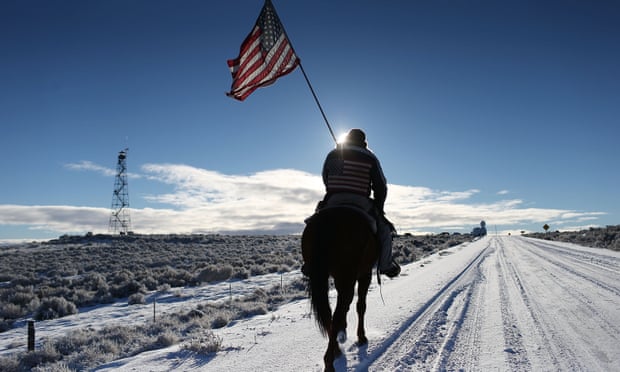 |
| Because while many may see the Bundys as a joke, they see themselves as true patriots fighting in the name of God, justice, and the American Way. And a lot of people agree with them. |
So yeah, maybe the fact that the Bundys are white has something to do with why the government didn't go in guns blazing, but I don't think it is because the Feds are racists. I think it is because the whiteness of the Bundys helps convince a lot of people that they are right, and that large number of people that support them makes killing the Bundys a very VERY bad idea.
The Bundys want to start a war. They are opposed to the rule of law, science, Native land claims, protection of the environment, and any authority beyond themselves. A violent response to their provocations brings the probability of more violence closer. We should not be feeding into the type of rhetoric that feeds this kind of violent anger.
If there is any constant theme in my writing it is about the danger of divisive politics and rhetoric. This is a prime example. The Bundys are bullies and criminals, but when you ridicule them, or call for their killing, or claim that their continued existence is proof of racism, you contribute to the factionalization of our country. Our history is replete with cautionary examples of what this kind of divisiveness leads to.
Please stop calling for the killing of the Bundys, and start hoping for the peaceful restoration of the rule of law.
 |
| Malheur is a breathtaking place. It is one of the most important habitats in the West for migratory waterfowl. If you ever get the chance, make the trip. |
Tuesday, December 29, 2015
Knife Review: Mora: Morakniv HighQ Allround Knife
Introduction:
 |
| Morakniv HighQ Allround knife with sheath |
Most of the knives I have been reviewing tend to be fairly expensive. Some of them are very expensive, but not this one. You can pick up a Morakniv HighQ Allround for less than $15. This is a quality knife that you can pick up at a disposable knife price. But in reality, you probably won't pick up this exact knife since the model that I am reviewing was recently discontinued, but there are newer models that are very similar. If you would like a handy primer on the different styles of Mora knives there is a handy one here, from Ramblin' Jim. As Jim says, at these prices you can just pick up a few and try them out. Amazon has bundles of different Mora models for sale.
The TL;DR review summary:
If you really aren't interested in reading the whole review, then let me just say that I started out just wanting to see if the Mora could handle some of the tasks that I had done with other bushcraft knives. It was such a pleasure to use I ended up carving a spoon.
 |
| This is the first spoon I have ever carved, and I did it entirely with the Mora I am reviewing here (well, I also used sandpaper, but it was the only knife I used) |
Let's Start With the Specs:
(Knife Specifications from Knife Center)
- Blade Length: 3.75" (95 mm)
- Blade Steel: High Carbon Steel, 59-60HRC
- Blade Thickness: 2 mm
- Overall Length: 8.2" (208 mm)
- Handle Material: Rubber
- Weight: 3.7 oz. (105 g)
- Made in Sweden
I'm not going to go into the specs too much here, especially since this exact knife is discontinued, but the followup models are very similar.
What I think is probably most noteworthy is the steel. This particular knife that I reviewed is not stainless, it is high carbon. I accidentally left it outside for a few weeks after I had taken the photos I used for the review, and it definitely rusted. The rust was just superficial, and it cleaned off, but it left stains. And this type of steel does stain. After using the knife for a while the steel will turn grey, even if you take care of it, that is just the way it goes. The discoloration is called a patina, and lots of people actually really like the patina. There are many discussions online devoted to different types of forced patinas, and how to get different colors. I personally prefer stainless myself, but carbon steel is often better performing than less expensive stainless steels.
Mora also has a good reputation for their heat treatment of their stainless steels, and the use Sandvik steels for their stainless. But that is not what I am reviewing, because Mora has a particularly good reputation for the heat treatment on their carbon steel blades, and my experience is that the reputation is well earned. Carbon steels might discolor easier, and they require cleaning and oiling to maintain optimally, but a good high carbon steel can have as good or superior edge holding and toughness than a stainless super-steel at a much lower price. If you want excellent performance for a low cost, and you are willing to take care of your tools, then a high-carbon steel can be an excellent choice.
A Note on the Sheath:
I really liked the sheath for this knife. It is not fancy looking, but it is not a fancy knife. The sheath is easy to clip on to your belt, but it stays on securely. The knife fits snugly into place in the sheath with no wiggle or rattle. It stays secure without needing an additional snap or loop to hold the knife in place. As an extra bonus, and showing the origin of the knife as a construction/work knife, the sheath is designed to stack with other Mora sheathes, so if you needed two different knives you could have them stacked.
Review:
Steel:
As I stated earlier, the steel is high carbon. Morakniv does not provide a more precise description than that. Whatever the exact steel recipe is, when combined with their heat treatment is makes for an outstanding performing blade steel. A lot of the hardness, edge holding, and resistance to chipping in a knife comes down to having a good heat treatment. The many decades in the making reputation of knives from Mora, Sweden is in large part due to the heat treatment.
I found the knife to hold an excellent edge, even when I abused the edge. And one of the benefits of carbon steel as opposed to stainless steel is that it is easier to sharpen. So after I managed to wear out the initial edge to the point where it just was not performing as well, it was a breeze to put a new edge on the knife.
Blade Finish:
The blade finish is nothing to write home about. It is a standard, somewhat polished, finish. The knife is a work knife, it is going to get scratched, and since it is a carbon steel blade it is going to get a patina. Some other Mora knives have coatings or special finishes, this one does not.
Blade:
So a big part of what makes this knife (and most of Mora's lineup) perform so well while maintaining sturdiness is the Scandi Ground blade. The scandi grind is a great geometry for a utility knife. Different types of tasks can be easier with different grinds, I for one strongly prefer full flat grinds for kitchen knives as an example. The scandi is especially good for wood working, which is handy for a knife you intend to use for camping or bushcraft.
A big part of the reason the scandi grind works so well for cutting into materials like wood is the lack of a secondary bevel. The primary bevel on the blade goes right to the edge, so the blade does not shoulder until the blade is at least as far in as the edge of the primary bevel. I worry that this might be getting a little jargon-rich/technical, so I will just say that I like the grind. If you want to know more about grinds I wrote about them in my article Knives: A Primer a while back. I also link to an interesting video that explains blade geometry and shouldering in more depth in that article.
The blade on this knife is pretty small. It is less than four inches long, and pretty thin. The blade feels more than solid enough for any task I asked of it, but it is not a big tank of a blade. It is a handy, nimble size, good for general tasks, but it is not a big chopper.
I did do a little batoning with the knife, just because I figured that it really wouldn't have been a big deal if the knife broke. The knife held up just fine, but with such a short blade you are pretty much limited to splitting wood that is already kindling. If you have read my other reviews then you know that I am not a fan of batoning, but it is very "in" right now.
The one big drawback to the thinness of the blade is that it ended up giving me blisters on my left hand from pressing on the back of the blade while carving.
Handle:
The handle is one of the best things about this knife. It is not pretty, or flashy, but it is comfy. The handle is plastic covered with a rubber layer. It is soft, grippy, and ergonomically excellent. This knife really feels good in the hand, even after you have been using it for quite a while.
Deployment:
This is a fixed blade, not a folder, so deployment is really just taking it out of the sheath. The sheath is well designed, and it is quick and easy to take out the knife.
Fit and Finish:
Fine for a $12 knife. This really isn't a fancy knife. All I cared about was the sharpness of the knife, and that everything solid. The bevel were even on the knife. It came very sharp. I have absolutely no complaints.
Use Review:
I took a fair number of photos, so I will let the pictures do most of the use review talking. The one thing I will say, which I feel perfectly sums up how I felt about this knife in use, is that I had originally planned to give this knife away after I was done with the review, but I ended up liking it so much that I decided to keep it. I like whittling, and it is a great whittler. It also makes a great extra backup knife. When I am out in the field, people often need to borrow a knife. The Mora is a good one to be able to loan out.
 |
| The Mora is not really a kitchen knife (though Mora does make kitchen knives) but it does fine. It's really at it's best handling paring or boning tasks, it's not a real food prep knife. |
 |
| I loved this knife for wood working. I used it here to drill out a hole for a fire board. |
 |
| It bit right into the wood for the notch. |
 |
| Made quick work of the notch. |
 |
| You can see in this picture that I ended up getting too enthusiastic with the knife. I found that it was not totally ineffective at chopping (this knife is NOT a chopper, but it did better than I expected). But the small size and light weight lulled me into not taking it seriously. I ended up chopping into my fingertip. Always remember, knives are not toys, and this one was sharp. That cut was 100% user error. My fault. |
 |
| Cut through a branch to make a spindle for a fire drill. |
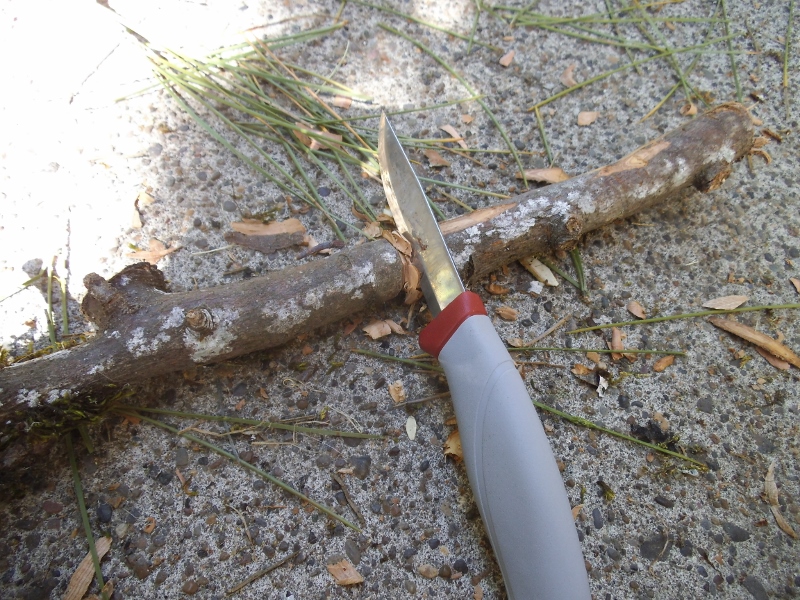 |
| This is the process of cutting through. |
 |
| Just a shot of the knife surrounded shavings and evidence of using it. |
Summary:
I highly recommend these knives.If you are looking for a good quality all around knife, and you don't want to pay a lot, this is the knife for you. Heck, even if you are willing to spend a lot of money, consider picking up a Mora, it might change your mind. They aren't fancy, they aren't flashy, but they are extremely affordable and very good quality. Frankly mine is a pleasure to use.
Moras are a great example of a quality tool that you can find for a great price. And the best part is, you can use it as roughly as you want, since even if you did manage to break the knife you are only out the cost of a couple Big Macs.
Thursday, November 19, 2015
As Human Beings, We Cannot Turn Away Syrian Refugees
In the 1940's when the family of nations turned their backs to refugees, millions of them died. In the 1970's when nations turned their backs to Cambodian refugees, millions of them died. I would like to live in a world that does not do this again.
------------------------------------------------------
I have not had time to write for this blog lately. I have more I want to say, and this topic requires much more, but this is the essence of what I want to say.
We cannot make the world a better place by allowing millions of people to die for want of a home. We cannot make the world a better place by closing our hearts and borders to refugees.
In the wake of the Paris attacks, it seems that far too many people want to just let the Aegean Sea swallow the waves of desperate humanity. Closing our eyes and hearts to the suffering of other humans will not make us safer. And denying succor to those refugees is a betrayal of fundamental humanity.
On a coldly practical level, one can certainly argue that allowing Muslims to die by the millions will be a great marketing campaign for ISIS. If one wanted to hurry along a planet razing clash of civilizations that dwarfed any previous conflict in human history, aiding in the dying of helpless Muslims would be a good way to go about it. So in the interest of the survival of our society, pure self interest should motivate you to support helping the refugees.
But we should not need to look at the political costs of abandoning humanity to understand that we cannot abandon our humanity.
There are 60 million human beings displaced right now. Our climate is in flux. War is rendering millions homeless. At no time since the end of WWII have more people been displaced. We owe it to the world's refugees to help them. Not because of what it means for us. Not because of politics. But because they are humans.
Turning our backs on the refugees is a way of murdering them. Turning our backs on millions of Syrians would be an act of negligent genocide.
The Syrian refugees, and all the other people fleeing from horrors, are people. That should be all the reason you need to know that you cannot abandon them.
------------------------------------------------------
 |
| Taken Without Permission from Facebook - Ralia, 7, and Rahaf, 13, in Beirut, Lebanon Ralia, 7, and Rahaf, 13, live on the streets of Beirut. They are from Damascus, where a grenade killed their mother and brother. Along with their father they have been sleeping rough for a year. They huddle close together on their cardboard boxes. Rahaf says she is scared of “bad boys,” at which Ralia starts crying. Copyright - Magnus Wennman / Aftonbladet / REX Shutterstock |
I have not had time to write for this blog lately. I have more I want to say, and this topic requires much more, but this is the essence of what I want to say.
We cannot make the world a better place by allowing millions of people to die for want of a home. We cannot make the world a better place by closing our hearts and borders to refugees.
In the wake of the Paris attacks, it seems that far too many people want to just let the Aegean Sea swallow the waves of desperate humanity. Closing our eyes and hearts to the suffering of other humans will not make us safer. And denying succor to those refugees is a betrayal of fundamental humanity.
On a coldly practical level, one can certainly argue that allowing Muslims to die by the millions will be a great marketing campaign for ISIS. If one wanted to hurry along a planet razing clash of civilizations that dwarfed any previous conflict in human history, aiding in the dying of helpless Muslims would be a good way to go about it. So in the interest of the survival of our society, pure self interest should motivate you to support helping the refugees.
But we should not need to look at the political costs of abandoning humanity to understand that we cannot abandon our humanity.
There are 60 million human beings displaced right now. Our climate is in flux. War is rendering millions homeless. At no time since the end of WWII have more people been displaced. We owe it to the world's refugees to help them. Not because of what it means for us. Not because of politics. But because they are humans.
Turning our backs on the refugees is a way of murdering them. Turning our backs on millions of Syrians would be an act of negligent genocide.
The Syrian refugees, and all the other people fleeing from horrors, are people. That should be all the reason you need to know that you cannot abandon them.
Sunday, October 4, 2015
Why Does the US Have the Worst Murder Rate In The Advanced World? It Does Not.
There has been another public mass shooting at a US school. This time is was in my home state of Oregon. Immediately afterward everybody fell back to their angry positions, and rather than taking a day or two to process the grief and tragedy of yet another random massacre, the angry yelling of prepared "arguments" began. I do not want to write about gun control, or gun rights, or terrorism, or enter into the "debate" in any way right now, I merely want to draw attention to a ubiquitous lie founded on racism and prejudice.
-------------------------------
I wish that the focus in the immediate aftermath of a tragedy could be on the lives lost, rather than being an excuse for the angry resumption of cultural debates. The debate is worth having, but not before we even know how many people are dead. In this case, not counting the shooter, the number is 9, and each of them has a name and a story.

The basic outlines of this "debate" should be clear to everyone. On one side you have the argument for gun control, and on the other you have the argument for gun rights. But these two basic camps are not representative of the actual arguments that are made by either side. The majority of Americans may fall into the range of people who want things like universal background checks for gun purchases, along with waiting periods, but the arguments that are made by either side of the debate have nothing to do with the middle ground. Both sides base their "arguments" on emotional appeals, distortions, half-truths, and outright falsehoods. This post is about one of those outright falsehoods, the often stated claim that the US is the only "advanced" country where this kind of violence occurs.
The claim that the US is exceptional in its rates of murder/violence/gun-violence comes in a variety of false flavors. The degree to which the various claims about US gun violence being exceptional among the nations of the world are false varies. There are the ridiculous claims that should be self evidently absurdly false to anyone, claims like "the US has the highest murder rate in the world." The US is not even among the top 50% of national murder rates. But the lie that is being circulated most aggressively right now is the various flavors of the claim that the US has the highest murder rate among advanced countries (other variations include: only country where mass shootings occur regularly, highest rate of gun deaths, highest rate of gun violence, etc.). The one thing that all of these claims has in common is that the only way that they could be considered true is if you construct a definition of "advanced" (or "developed," or "modern") that defines "advanced" as having a lower gun violence rate.
Fortunately for proponents of this idea, there is an easy group to use for this formulation, NATO (plus Japan). The term "advanced," as used, means: Majority white, Western European Dominated Culture, preferably a colonial power, and NOT Eastern European (plus Japan). Any formulation of the definition of "advanced" has to exclude Russia in order to make the statement true, since Russia has fewer guns, strict gun laws, more murders (both by rate AND by total despite having less than half the population of the US), and still has periodic mass shootings.
What would Russia have to do to be considered advanced? Would it need to have one of the largest economies in the world, Check; one of the most powerful militiaries, check; huge cultural sphere, check; a permanent seat on the UN security council, check. The list can go on, there is no definition of "advanced" that I can think of other than "Russians don't count" that could exclude Russia while including the US, unless part of the definition of "advanced" is "plays nicely with us."
Of course it goes without saying that "advanced" does not apply to brown people. Brown people live in places that are for colonization, they are incapable of being advanced. So Brazil is right out despite having the 8th largest economy in the world (7th largest if you go by Purchasing Power Parity) and being the 5th largest country by population and area.
What I am trying to drive home, is that the term "advanced" as it is used to describe countries, is not based on reality, it is based on prejudice. Countries we don't like are not considered modern, nor are countries that are non-white.
But what about Japan? Japan has a murder rate of 0.3 per 100,000 compared to the US 4.7, and they are usually included though they are not white. This is a case where cross cultural comparisons are not very reliable. First you have to understand that it is a cultural truth that in Japan all murders are solved, one can simply accept that at face value, or one can ask if perhaps some unknowable number of the suicides (which occur at twice the rate of the US) are in fact unsolved murders. It seems more likely to me that a combination of lower homicide rate and fudging of official statistics is at play.
If we combine suicides and homicides the combined rate for Japan is 20.2, the combined rate for the US is 14.8. Since the majority of gun deaths are suicides in the US, by a 2 to 1 margin, this would be a more honest comparison of the death rates from violence (if we include self harm as violence).
This reveals just a little bit of the complexity of trying to engage in cross cultural comparisons of statistics. Different cultures organize statistics differently, and different cultures have stronger aversions to different things. Some countries (*cough* China *cough*) publish official statistics that seem to have no reliable relationship to reality, and others publish numbers that seem fudged.
Some countries, for religious reasons have stronger aversions to suicide. Mexico is an example of this, they are kind of the inverse of Japan. Mexico, like most Catholic countries, has a very low suicide rate. The rate of suicide in Mexico is only 4.4, less than half that of the US. One can accept that at face value, or one can think that perhaps the true rate of suicide is fudged by lumping ambiguous or unsolved incidents in with murder (combined rate 25.9).
---------------------------------------
Making sweeping global statements about violence is extremely problematic. Particularly when one tries to make simple cross cultural comparisons of issues that are viewed differently in other cultures.
---------------------------------------
Of course, sometimes direct comparisons are possible. Some countries, like Canada, are similar enough to the US both culturally, legally, transparency, and in statistical gathering methodology to facilitate direct comparisons. Canada does have a much lower murder rate than the US, 1.6 to the US' 4.7. The Canadian suicide rate runs almost identical to the US, 10.2 to the US' 10.1 (this would seem to indicate that the ease of access to guns does not have a strong effect on suicide rates overall, but this is an even murkier subject than the gun/homicide link. I would not advise trying to draw conclusions). So we can see that even when we combine suicide and homicide, Canada does significantly better than the US.
Which brings me to my last point. Don't read this as a blanket argument against having a meaningful discussion about gun-control or the role of violence in our society. We should be trying to improve. We do have a problem. But propagating lies does not help the discussion, it simply exacerbates the Balkanization of positions on this issue.
Let's be clear here. The Umpqua shooting did not take place in a "Gun Free Zone," because Oregon colleges cannot legally be "Gun Free Zones." The pro-gun claims that this is the result of gun prohibition are every bit as false as the "advanced country" bit.
But this article is not an attempt to address gun control in the US, nor is it an attempt to address violence in the US. It is simply an attempt to call out a pervasive falsehood.
-------------------------------
I wish that the focus in the immediate aftermath of a tragedy could be on the lives lost, rather than being an excuse for the angry resumption of cultural debates. The debate is worth having, but not before we even know how many people are dead. In this case, not counting the shooter, the number is 9, and each of them has a name and a story.
----------------------------------
The basic outlines of this "debate" should be clear to everyone. On one side you have the argument for gun control, and on the other you have the argument for gun rights. But these two basic camps are not representative of the actual arguments that are made by either side. The majority of Americans may fall into the range of people who want things like universal background checks for gun purchases, along with waiting periods, but the arguments that are made by either side of the debate have nothing to do with the middle ground. Both sides base their "arguments" on emotional appeals, distortions, half-truths, and outright falsehoods. This post is about one of those outright falsehoods, the often stated claim that the US is the only "advanced" country where this kind of violence occurs.
The claim that the US is exceptional in its rates of murder/violence/gun-violence comes in a variety of false flavors. The degree to which the various claims about US gun violence being exceptional among the nations of the world are false varies. There are the ridiculous claims that should be self evidently absurdly false to anyone, claims like "the US has the highest murder rate in the world." The US is not even among the top 50% of national murder rates. But the lie that is being circulated most aggressively right now is the various flavors of the claim that the US has the highest murder rate among advanced countries (other variations include: only country where mass shootings occur regularly, highest rate of gun deaths, highest rate of gun violence, etc.). The one thing that all of these claims has in common is that the only way that they could be considered true is if you construct a definition of "advanced" (or "developed," or "modern") that defines "advanced" as having a lower gun violence rate.
Fortunately for proponents of this idea, there is an easy group to use for this formulation, NATO (plus Japan). The term "advanced," as used, means: Majority white, Western European Dominated Culture, preferably a colonial power, and NOT Eastern European (plus Japan). Any formulation of the definition of "advanced" has to exclude Russia in order to make the statement true, since Russia has fewer guns, strict gun laws, more murders (both by rate AND by total despite having less than half the population of the US), and still has periodic mass shootings.
What would Russia have to do to be considered advanced? Would it need to have one of the largest economies in the world, Check; one of the most powerful militiaries, check; huge cultural sphere, check; a permanent seat on the UN security council, check. The list can go on, there is no definition of "advanced" that I can think of other than "Russians don't count" that could exclude Russia while including the US, unless part of the definition of "advanced" is "plays nicely with us."
Of course it goes without saying that "advanced" does not apply to brown people. Brown people live in places that are for colonization, they are incapable of being advanced. So Brazil is right out despite having the 8th largest economy in the world (7th largest if you go by Purchasing Power Parity) and being the 5th largest country by population and area.
What I am trying to drive home, is that the term "advanced" as it is used to describe countries, is not based on reality, it is based on prejudice. Countries we don't like are not considered modern, nor are countries that are non-white.
But what about Japan? Japan has a murder rate of 0.3 per 100,000 compared to the US 4.7, and they are usually included though they are not white. This is a case where cross cultural comparisons are not very reliable. First you have to understand that it is a cultural truth that in Japan all murders are solved, one can simply accept that at face value, or one can ask if perhaps some unknowable number of the suicides (which occur at twice the rate of the US) are in fact unsolved murders. It seems more likely to me that a combination of lower homicide rate and fudging of official statistics is at play.
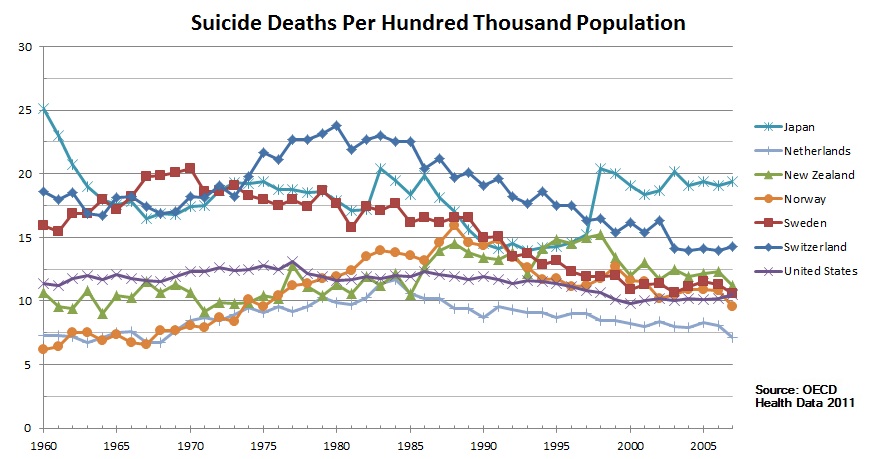 |
| Suicide rates of a few countries |
If we combine suicides and homicides the combined rate for Japan is 20.2, the combined rate for the US is 14.8. Since the majority of gun deaths are suicides in the US, by a 2 to 1 margin, this would be a more honest comparison of the death rates from violence (if we include self harm as violence).
This reveals just a little bit of the complexity of trying to engage in cross cultural comparisons of statistics. Different cultures organize statistics differently, and different cultures have stronger aversions to different things. Some countries (*cough* China *cough*) publish official statistics that seem to have no reliable relationship to reality, and others publish numbers that seem fudged.
Some countries, for religious reasons have stronger aversions to suicide. Mexico is an example of this, they are kind of the inverse of Japan. Mexico, like most Catholic countries, has a very low suicide rate. The rate of suicide in Mexico is only 4.4, less than half that of the US. One can accept that at face value, or one can think that perhaps the true rate of suicide is fudged by lumping ambiguous or unsolved incidents in with murder (combined rate 25.9).
---------------------------------------
Making sweeping global statements about violence is extremely problematic. Particularly when one tries to make simple cross cultural comparisons of issues that are viewed differently in other cultures.
---------------------------------------
Of course, sometimes direct comparisons are possible. Some countries, like Canada, are similar enough to the US both culturally, legally, transparency, and in statistical gathering methodology to facilitate direct comparisons. Canada does have a much lower murder rate than the US, 1.6 to the US' 4.7. The Canadian suicide rate runs almost identical to the US, 10.2 to the US' 10.1 (this would seem to indicate that the ease of access to guns does not have a strong effect on suicide rates overall, but this is an even murkier subject than the gun/homicide link. I would not advise trying to draw conclusions). So we can see that even when we combine suicide and homicide, Canada does significantly better than the US.
Which brings me to my last point. Don't read this as a blanket argument against having a meaningful discussion about gun-control or the role of violence in our society. We should be trying to improve. We do have a problem. But propagating lies does not help the discussion, it simply exacerbates the Balkanization of positions on this issue.
Let's be clear here. The Umpqua shooting did not take place in a "Gun Free Zone," because Oregon colleges cannot legally be "Gun Free Zones." The pro-gun claims that this is the result of gun prohibition are every bit as false as the "advanced country" bit.
But this article is not an attempt to address gun control in the US, nor is it an attempt to address violence in the US. It is simply an attempt to call out a pervasive falsehood.
Monday, September 7, 2015
The Toddler In The Surf
 |
| The Zaatari Refugee camp on the border of Jordan. Just one of the camps for the more than 4 million refugees from the Syrian Civil War. Source: The Telegraph |
There is a picture on the internet. (Click through the link if you want to see the picture, but don't say I didn't warn you) It is a picture that I cannot bring myself to look squarely at, and that I cannot bring myself to put on my blog.
It is a picture of a boy, about three years old, dead on the beach in the surf. He drowned, along with his mother and brother (though his father survived), trying to reach the safety of a place not torn apart by a civil war of unimaginable cruelty.
Perhaps this picture hits me harder than most because I have a toddler myself, but I don't think that is the only reason. The photo has inspired hundreds of thousands of words of writing. The little dead boy has inspired soul searching in Western countries. The whole world doesn't have a toddler.
I think that this little dead boy strikes a chord because the world knows that the little boy didn't hurt anyone. He wasn't a rebel. He wasn't a soldier of an evil regime gassing civilians. He was not an ISIS militant raping and enslaving women and slaughtering innocents. He wasn't even a not-so-good guy that littered and cheated on his wife. He was just a little boy, trying to reach a place where he wouldn't have to worry about people trying to kill him and his family.
But he didn't make it. Like many refugees don't make it. But a lot more people have died long before they even started to seek refuge. And that is what the Syrian refugee crisis is about, people, regular people, seeking refuge from slaughter and depravity.
 |
| Syrian Refugees entering Iraq back in 2013. Source: Times of Israel |
If you follow the news superficially it might seem like the Syrian refugee crisis is a new thing. Like it is some new humanitarian crisis that has blown up out of nowhere like a summer rainstorm. But it isn't new. It has been years in the making, and we (the West, the US, the voting public) are not innocent in this crisis. What is different about this crisis now is that it has expanded to the point where the wealthy nations can no longer ignore the human cost of their apathy and myopic meddling.
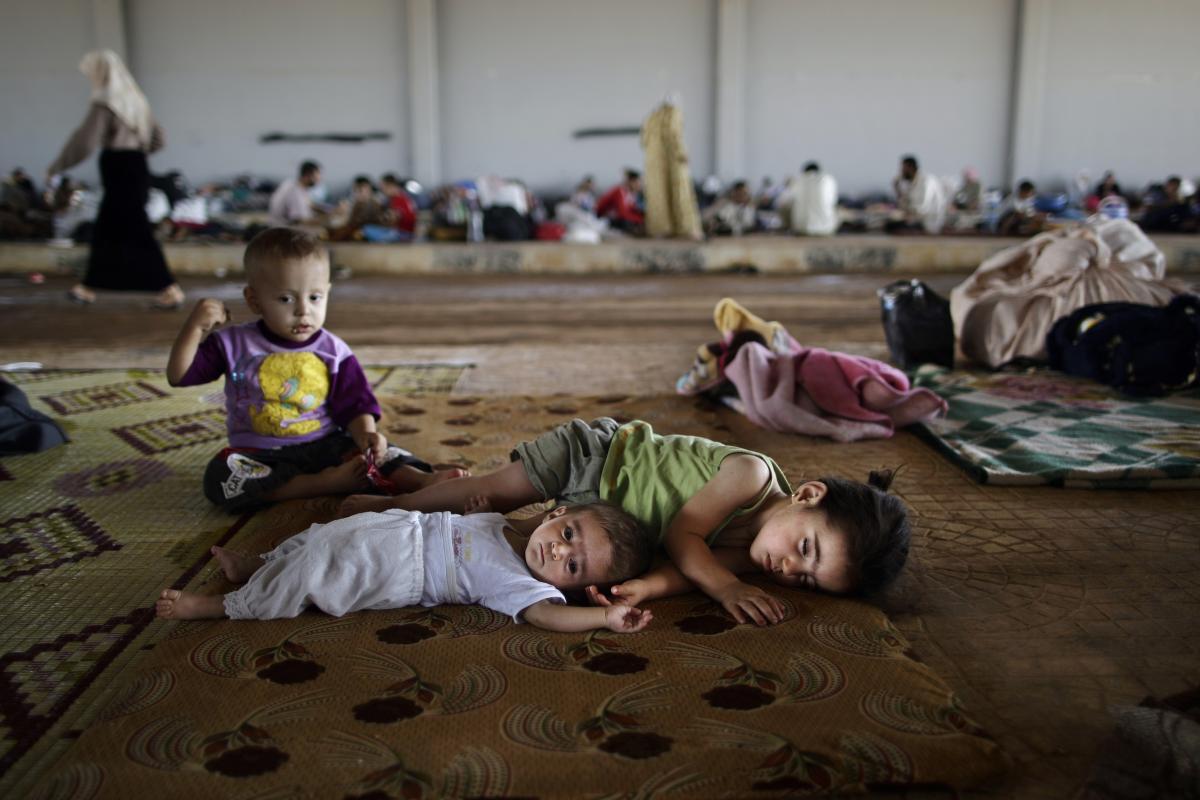 |
| Syrian Refugee children from back in 2013. Source: Occupy.com |
The challenge in trying to understand something as vastly catastrophic as the Syrian Civil War, or the concommitant rise of ISIS, is that there is always more context and more factors than can be held in any one mind at one time. The challenge is exacerbated by the inability of the human mind to truly grasp tragedies on a grand scale. The horrors of millions displaced and hundreds of thousands dead is so far beyond the scope of our ability to grasp that the human mind just resets back to zero. The death of one person can touch us profoundly, but when the numbers climb it becomes harder to truly feel the tragedy. So when we are confronted with a little dead boy face down in the surf, it hits harder than the photos of tens of thousands of tents.
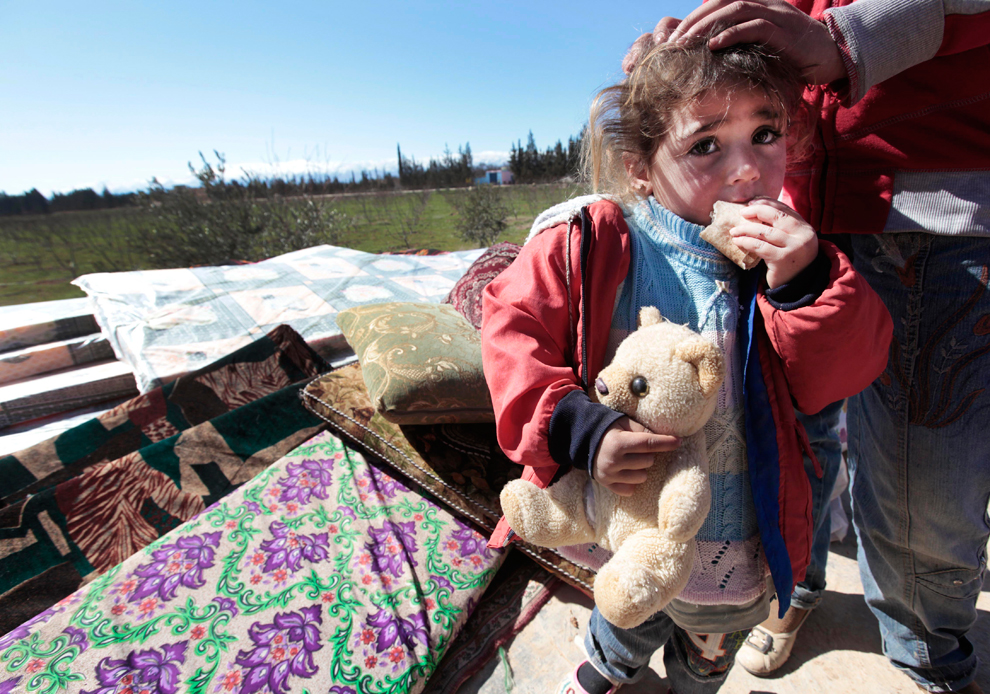 |
| Syrian refugee girl, from 2012. Source: Boston.com |
The Syrian Civil War may well have been precipitated by social stresses created by a severe drought, and that drought may have been a result of human-caused climate change. The post-apocalyptic flavor of bloodthirsty tyrants and maniacal murder-cults of movies like Mad Max seems to be made flesh in Syria. And fittingly, if Syria is an example of a nation brought to collapse by climate change this could be a whirlwind that much of the world will ultimately reap.
But the humanitarian crisis that faces the world right now cannot simply be chalked up to global forces of nature beyond human control. Global warming may have precipitated this mess, but failures of leadership here in the US and in the West at large have contributed to the ongoing nature of the disaster.
I could harp again on my hobby horse about the way that the failures of the US and the West to deal concretely with ISIS are creating a monster. But I've already written a blog post about how the US is half-assing its way to catastrophy (and if ISIS has its way we will half-ass our way into armageddon). But that would be unfair, because at this point ISIS has become too large, Iraq has become too weak, as has Syria, that a military solution to ISIS would require coherent and cohesive military and economic cooperation to avoid creating further regional destabilization. In short, we half-assed things long enough that we can't just go stomp on ISIS anymore.
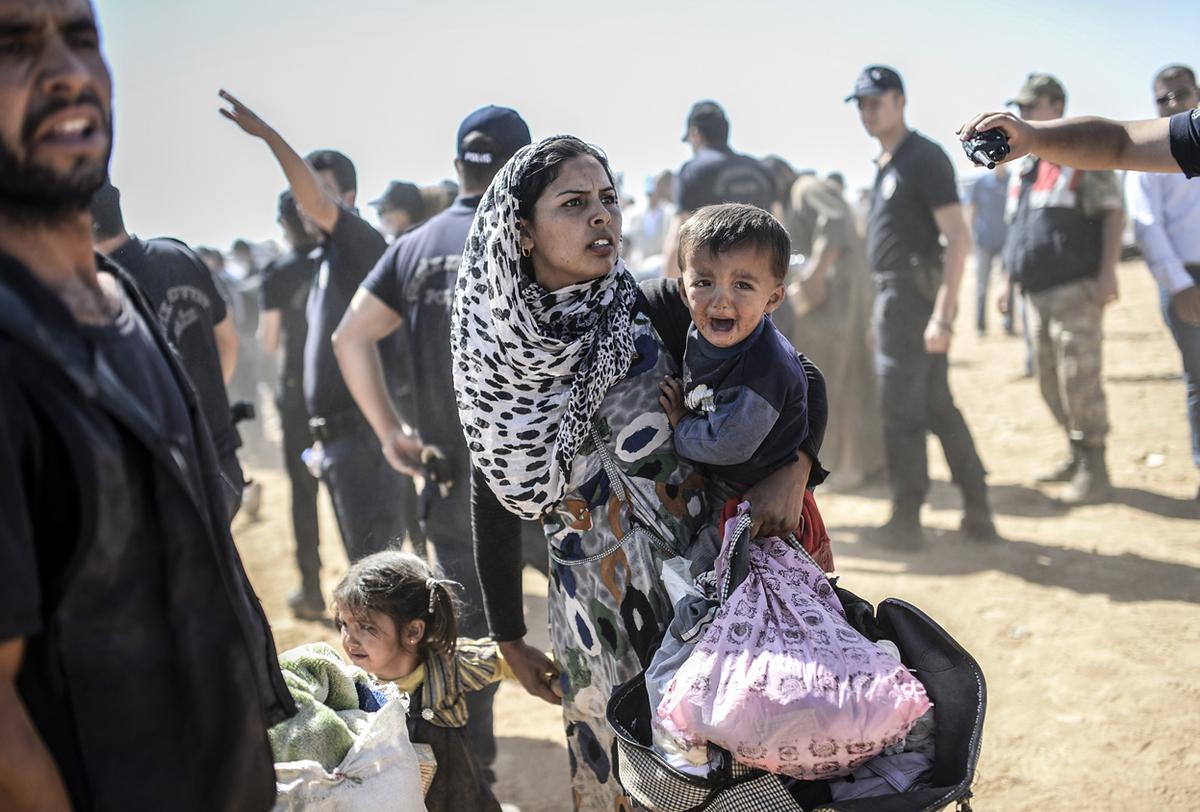 |
| A Syrian Kurdish women and children fleeing across the Turkish border to escape ISIS advance in 2014. Source: The Atlantic |
So instead I will harp on another one of my hobby horses, division politics. It is seriously arguable that the humanitarian crisis in Syria has reached its current magnitude thanks in large part to US part politics. The Syrian Civil War did not have to be allowed to spin out into a poly-polar mess of dozens of factions fighting for myriad goals. Of course avoiding the mess would have required doing two extremely politically poisonous things: One, at least tacitly supporting Assad; and Two, minimally not working against Russia.
Really, in order to avoid this current humanitarian crisis, the US could have simply stepped aside and let Russia more actively assist Assad with the brutal suppression of the Syrian uprising. It might have seemed heartless at the time, but it was already clear years ago that the rebels were no better, and probably worse, than Assad's regime.
You may recall the debate and bluster about "Red Lines" a few years ago when Obama was wanting to establish boundaries that would be unacceptable for Assad to cross. Obama was like Gandalf at the bridge in Moria saying "YOU SHALL NOT GAS!!!"
Of course it wasn't a movie, and Assad did use chemical weapons, but it looked like the rebels did too.
Both parties had been making a lot of noise about Syria and how bad Assad was. Some people said that we should back the rebels. Some people said that Obama was recklessly getting us involved in yet another Mideast military mistake. Some people said Obama was being too soft on Assad. Some people, who were very much in the minority at the time were saying, "umm, Assad might be bad and all, but this whole Arab Spring thing and the rebels in Syria might not be in our best interests."
But you have to remember that at the beginning, back in 2012, the Syrian Civil war didn't really seem like that big of a deal. The Arab Spring was bringing democracy to the Mideast. It was very popular in Washington to hop on the "Democracy good, Dictators bad" bandwagon. Getting into philosophical arguments about whether or not we should support "democratic" movements that seek to install democratically elected theocracies is the kind of nuanced debate that doesn't make for easily digestible soundbites. The shorthand we tend to use in this country is "Democracy good," but what we really mean is "Liberal Democracy Done Our Way good." After all, Hamas is the democratically elected leadership of Gaza. The Iraqi democracy, that we installed, decided to elect leaders that oppressed the Sunni minority. The examples go on, but it is the kind of thing that doesn't sound good in political debates. Whereas calling a political opponent anti-democracy does sound great in political debates.
So against this backdrop, a civil war breaking out in an Arab country that had seemed very stable seemed like... I dunno, democracy maybe, minor maybe, who knows, where is Syria anyway?
But then news reports started painting a picture of awfulness. It was sometime in 2012 that an Al Jazeera report first started really scarring my psyche with coverage of the Syrian Civil War. I had gotten into the habit of watching Al Jazeera reports on current events because the coverage often felt very immediate and raw. The day that an Al Jazeera report cut to footage of an infant bleeding out from a bullet wound convinced me that maybe I liked my news a little less raw. But once again it was the children of this war that broke my heart at the start and continue to haunt my thoughts today.
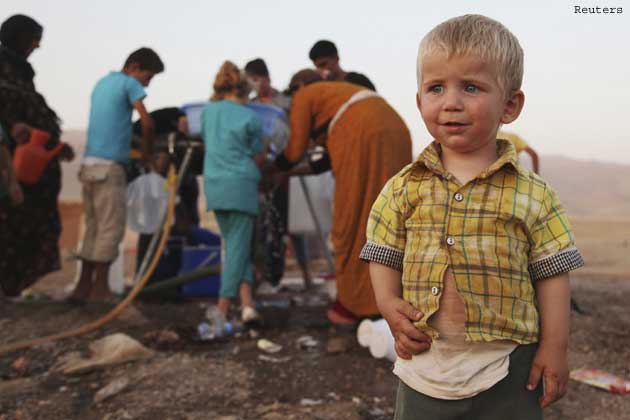 |
| A Syrian Refugee boy in Turkey. Reuters |
With all this awfulness happening, and "Dictators bad" in everyone's mind, eyes turned to Obama. What was he going to do about it? And here is where division politics in the US can take a tragedy on the other side of the planet and help it grow into a humanitarian catastrophe that destabilizes a region and then spills out over the world.
Obama couldn't just do nothing, or the Republicans would accuse him of failing to lead. But Obama couldn't just let Russia pursue their Agenda, especially since that would also help Iran. Backing Assad would have given the Republicans tremendous ammunition, plus most Democrats wouldn't feel comfortable backing a nasty dictator. So in order to back Assad, Obama would have had to risk attack on all sides domestically. But there was never going to be a realistic possibility of the US invading Syria and trying to set up another Iraq (remember, ISIS had not made the news yet, so Iraq was still being sold as a semi-success). Obama was caught between an emerging crisis and a political opposition that was poised to pounce on whatever action or inaction Obama took.
Obama essentially decided to avoid decisive action. In order to avoid entering into a politically costly war, Obama simply expanded the use of tremendously expensive air-power. Our politicians locked in their zero-sum game of musical chairs can all seem to agree that planes are really cool, and gee-whiz sci-fi technology like drones are fun ways to show how powerful the US is. So Obama "took action" by dropping bombs.
 |
| Aww Yiss!!! Mutha fukin planes 'n shit!!! Time to drop some liberty on Syria! Source: The Telegraph |
Of course you can't bomb a country into having working infrastructure and the rule of law, and pretty much all of the dozens of factions (other than the Kurds) involved in the civil war are bad guys from the US perspective, so as logic would predict, a bombing campaign that couldn't actually support a side in a conflict failed to make anything better.
 |
| Source: Russia Insider |
The US geopolitical position made standing aside a non-option, while domestic political rivalries made any meaningful action problematic. So the path of least political resistance was to drop bombs and ignore the problem as much as possible.
 |
| Back to the kids. Syrian Refugee children in Iraq. Source: Rescue.org |
And the good news is that we actually do have a variety of things we can do, even as individuals, particularly in the US. After several hundred words crapping on the US for hamfisted meddling and apathy, I think it is only fair to remind readers that we do a lot of good as well. We are far enough away from Syria, geographically, that we don't get a lot of direct refugees (the same goes for the Old World in general); however, the US does lead the world in the resettling of refugees. Generally speaking, only about 1% of the world's refugees are eligible for permanent resettlement, but the US resettles more than half of that number. Out of the entire world, the US permanently resettles more refugees than the entire rest of the world combined.
We are a country of superlatives, usually it seems like the superlatives that get focused on are things like most money spent on military, and most shootings (that one is popular to say, but not actually true by a long shot, even among developed countries), and other negative superlatives; but we are also an exceedingly generous country, and we do integrate the most refugees into our society. And unlike many nations, the US focuses on integration, not housing refugees. In many countries refugees never get to own property or integrate into society, For instance, there are many Palestinians who are third and fourth generation refugees still living in refugee camps since the 1947 war of Israeli independence. For those refugees, almost 70 years later, they are still people without a country.
And the comparison to Palestinians is potentially quite apt, because the nature of the Syrian Civil War is such that it is very possible that millions of the Syrian Refugees may never have a home to return to. Usually, most refugees are able to return to their countries of origin after some period of time, however some refugees are permanently unable to return to their homes out of fear of death and/or persecution based on religion, political opinion, race, nationality, or membership in a particular social group. Considering that both ISIS and the Syrian government seem intent on persecuting and killing large swathes of the Syrian population, it is likely that an unprecedentedly large number of Syrian Refugees may become as permanently stateless as the Palestinian refugees have. What this means in practical terms, is that the permanent resettlement of potentially millions of Syrians may be necessary to avoid an ongoing intractable conflict like the Israeli/Palestinian conflict.
 |
| Syrian refugee from Deir Ezzor with his children in tears of joy after arriving in an inflatable boat crammed with about 15 people. Source: Mirror |
It is too late to avoid the Syrian Civil War. We can't go back and undo the circumstances that led to this crisis. What we can do is try to keep this crisis from turning into a crisis that never ends. I wish that I could say that it would be possible to avoid this sort of calamity occurring again, but short of direct intervention by an omnibenevolent omniscient omnipotent force, I fail to see how all future humanitarian crises can be avoided. The best we can do is the best we can do with what we know and what we have now.
In the immediate term, here in the US, if you want to do something to help, but you don't want to spend money, you can make a difference by writing to your congresspeople. It might seem trite, but it really is a meaningful step you can take with a minimum of effort. Far more meaningful than any shared statuses or retweets. If you want to use a preset form, here is one all ready for you. That link is to support bills to help refugees, the site is the US Committee for Refugees and Immigrants at Refugees.org.
If you want to do more, and you can afford to give some money there are a number of worthwhile options. Here is an PRI article listing a number of organizations doing vital work on the Syrian refugee crisis. There are good options for donations. This article also contains a link to the Save the Children PSA which I will link to below, I think this video is profoundly affecting. It captures the reality of an everyday existence torn apart, and I think that is important to bear in mind when thinking about the Syrian crisis. Syria was not some turbulent backwater, it was for decades one of the most stable of Middle Eastern countries. It had one of the worst human rights records in the world, but it was stable. Stable enough for people to build lives that have been torn apart by this war.
Another option, if you are willing to truly take on some personal obligations, is you can consider sponsoring refugees. The US Department of State deals with Refugees, however the sponsoring of refugees is done through nine non-governmental organizations (NGOs)(per the State Department website), but as an indication of how opaque this process is, I cannot seem to find out what those "nine NGOs" are. There is some worthwhile information to be found, but the US system is confusing and decentralized enough that I feel it is beyond the scope of this blog post to try to explain how to sponsor people. That said, if you are in Oregon (as I am) Sponsors Organized to Assist Refugees (SOAR) through the Ecumenical Ministries of Oregon seems to be a viable option.
The refugee sponsorship option might actually be a better fit for organizations that you may be a part of, whether a religious community or social organization. If you are a member of an organization consider getting your organization involved in trying to help. The focus should not even necessarily be on sponsoring refugees at this time. Europe (and countries like Germany in particular) are currently seeing an enormous surge in refugees. Supporting groups like Refugees Welcome is a way to help soften the impact of the costs of caring for refugees in countries like Germany and Britain. And Charity Navigator offers a handy cheat-sheet for NGOs to donate to.
I wish that I could offer a workable solution to the entire Syrian Civil War, but I can't. But we can all do little, and not-so-little things to help. We can apply pressure on our politicians to seriously address the Syrian crisis. We can donate. Geography means that we here in the US can't give our time or labor to assist this crisis as easily, but we can try to assist those helping the refugees.
We can't make all the problems go away, but it is good to find ways to do something. There will undoubtedly be more awful images that will come from this war. The Syrian Civil War is ongoing. The refugees overflowing the Middle East and spilling onto the shores of the Mediterranean are largely landing in countries still reeling from financial crises. When we see refugees struggling with police it can feel bewildering, and that bewilderment can leave us feeling helpless.
When we are faced with images of toddlers face down in the surf it is a sickening feeling to be unable to do anything. We can't do as much as we might like, but we can do some things. I hope that this post helps you identify something that you can do. Because when we can help other human beings it makes the darkness of these kinds of tragedies feel a little lighter.
Subscribe to:
Posts (Atom)