Thursday, July 7, 2016

Correlations Between Crime, Employment, and Government (Or the lack thereof)


Hello readers, it has been far too long since I last wrote an entry for this blog.  I have been writing a lot, but all of my work has been focused toward school and projects that I hope to have published later.  Since I do not want to scoop myself on my research that means that most of what I am spending my mental energy on these days is stuff that I can't put in the blog.  However, this last term I took a statistics class, and my final project for that was actually stuff I was looking at so that I could use it in the blog.  So for your reading pleasure, here is my unedited paper:
Correlations Between Crime, Employment, and Government (Or the lack thereof)
The objective of this project was exploratory analysis.  In my non-academic writings I frequently write about crime statistics, with a special focus on homicide and gun violence statistics.  There is a wealth of well-done analyses that look various aspects of homicide rates, but there is less attention paid to the relationship that homicide has with other types of crime, or to broader societal trends.  The FBI publishes numerous in depth statistical analyses of crime rates and trends (FBI, Numerous Dates), including ones that look at rates of different types of crime compared to each other, so my goal in this project was not to duplicate those analyses, but rather to look at the relation of crime rates to employment statistics and political leadership to see if there were hidden trends I could uncover and analyze.  
In order to look at the relationships between crime, employment, and government I first had to decide on a scope.  I chose to run the analyses on the national level in order to look at broad trends.  I then needed to source my data and produce a usable dataset for analysis.  I conducted a number of descriptive time-series plots, simple Spearman’s correlations (in recognition of the non-parametric nature of much of the data), Pearson’s pairwise correlations for comparison, and ultimately decided that a Principle Component Analysis (PCA) would be the most useful tool to indicate follow up analysis directions.  
Unfortunately, the data I was using was only appropriate for PCA is I removed all but the crime rate data.  I conducted the analysis, but the results are not anything ground breaking.  While I have not seen a PCA of violent and property crime rates through time in official governmental analyses, the information I was able to glean is ultimately duplicated in a number of easily accessible sources.  My analysis failed to identify hidden trends, and my exploratory analysis failed to explore new areas of inquiry, but I was able to at least conduct sufficient correlational operations to suggest that further analysis was unlikely to result in valuable insight.  This was not the outcome I hoped to achieve, but I had been aware of the high likelihood of negative results heading into the project.

Data:

In order to find a dataset that looked at the things that I wanted to look at, on the scale I wanted to look, and at the time resolution that I wanted to use (annual) I needed to create my own dataset.  
For the national crime data, I used the Uniform Crime Reporting (UCR) statistics data tool (UCR, 2010).  This is a tool that allows individuals to access the datasets available to the FBI in order to make customized datasets.  
For the employment data I used Quandl to extract data from 1960 to 2012 (the years that the FBI had national data for the statistics I was interested in).  The Quandl data was published by the Bureau of Labor Statistics (BLS).  Quandl allowed me to take the data and extract is by the dates I needed, and to transform the data from monthly entries to annual entries (thereby obviating the need to seasonally adjust the data in R).  As will be discussed in the Variables section, I unfortunately extracted the job change data as percentage values rather than numerical values, which complicated some analyses.  
For the political data I simply used widely available information on the political affiliation of Presidents and the parties in power in Congress.   The presidential affiliation was straightforward.  I counted years in which a new president comes into office as entirely the year of the incoming president.  For Congress, due to the bicameral nature of the legislature, I used three values, Democratic control, Republican control, or split (for years that the House and Senate are controlled by different parties).  I used text data for these values.  In retrospect, I should have given these variables numerical values to facilitate analysis.  A better approach would also be to incorporate the actual numerical breakdown of party affiliation in Congress to create a finer grained analytical tool.

Variables:

  • Population – Total US population (all values are by year from 1960 to 2012 unless noted otherwise)
  • Violent crime total – Total for US
  • Murder and nonnegligent Manslaughter – Total for US
  • Forcible rape – Total for US (see forcible rape rate note)
  • Robbery – Total for US
  • Aggravated assault – Total for US
  • Property crime total – Total for US
  • Burglary – Total for US
  • Larceny-theft – Total for US
  • Motor vehicle theft – Total for US
  • Violent Crime rate – Rate per 100K
  • Murder and nonnegligent manslaughter rate – Rate per 100K
  • Forcible rape rate – Rate per 100K. Note: Due to changes in the culture and legal system regarding the willingness to report rape, as well as broadening the definition of rape (for example, during much of the time being looked at in this project a husband could not be considered to have raped his wife, regardless of whether or not she consented) treating this variable as apples to apples through time is very problematic.
  • Robbery rate – Rate per 100K
  • Aggravated assault rate – Rate per 100K
  • Property crime rate – Rate per 100K
  • Burglary rate – Rate per 100K
  • Larceny-theft rate – Rate per 100K
  • Motor vehicle theft rate – Rate per 100K
  • Employment Private Sector – Total, in thousands, of people employed by private businesses
  • Employment Change Private Sector – Total change, in percentage of total, of people employed by private businesses
  • Employment Government Sector – Total, in thousands, of people employed by government
  • Employment Change Government Sector – Total change, in percentage of total, of people employed by government
  • Presidential Party – Which political party the President belonged to by year
  • Legislative Party Majority – Which party was in power in the legislature.  This will be a three value variable: Republican, Democratic, or split.  The variable will only be assigned to a party if that party controlled both houses.


One major problem with the variables that I created, which I didn’t discover until the end of analysis, is that I incorporated employment change as a percentage of total employment change from year to year.  This meant that the numbers generated had so many decimal places that they did not function for PCA analysis.  In most years, the total employment change is such a small percentage of the total employment numbers that the percentage does not reach a rounding threshold sufficient for PCA.  Also I extracted the employment change data from 1960 to 2012, instead of 1959-2012 which meant that I had “na” values for 1960.  This meant that I lost a year’s data for some analyses.

Methods:

While the original order of some of the functions that I scripted during this project were different, as I went on I tried to reorganize my script into a more rational order of analysis types.  This reordering became increasingly important as the script started to grow over 200 lines.  By the time that the script was finished, with over 400 lines, having a logical order of functions became vital to ensuring that everything worked, especially when replacing opaque labels with easier to understand labels.
As described in the introduction, I conducted a number of descriptive time-series plots, simple Spearman’s correlations (in recognition of the non-parametric nature of much of the data), a Pearson’s pairwise correlation for comparison, and ultimately decided that a PCA would be the most useful tool to indicate follow up analysis directions.   
The first step was doing simple plots of some of the variables.  Next was running through some histograms, putting in normal lines, and running Q Plots to check for normalcy.  Unsurprisingly most of the variables were not normal.  After the Q Plots I ran through a series of simple time-series plots, which created visually useful graphs.  I followed this with Spearman’s correlations, since the text suggested Spearman’s for continuous variables that do not meet parametric assumptions.  Just for reference I ran a Pearson’s Pairwise Correlation.  I then ran a series of time-series plots that include a two-sided moving average and a LOWESS.  At first I was thinking of this as simply a prettier way to make the graphs, but it ended up being quite informative.  And the final step was running a PCA.  After switching computers this was able to produce a skree plot, which made the PCA worthwhile after all.

Results:
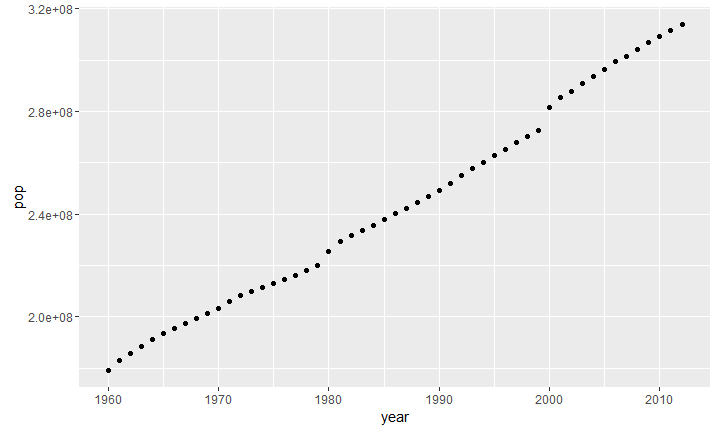
Figure 1: Population Plot
I start with the population plot, simply as an illustration of what turned out to be a thoroughly confounding variable.  The population growth in the US over the time frame of the study was so great that total to total comparisons ended up being essentially useless.  For example, here is the Spearman’s correlation between population and government employment:
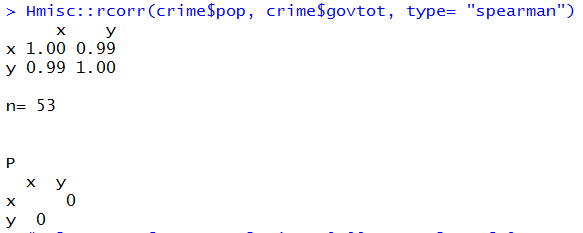
Figure 2: Spearmans Population Government Employment
The two variables have a 99 percent correlation.  As it turned out essentially every total measure had extremely high levels of correlation, primarily due to population growth.  The US went from a population of 180 Million people to 320 million over the course of the study.  This near doubling of the population made any non-rate measures effectively simply proxies for population growth.  This does not mean that all of the totals pegged to population growth, murder and crime totals actually diverged pretty sharply from the straight line:
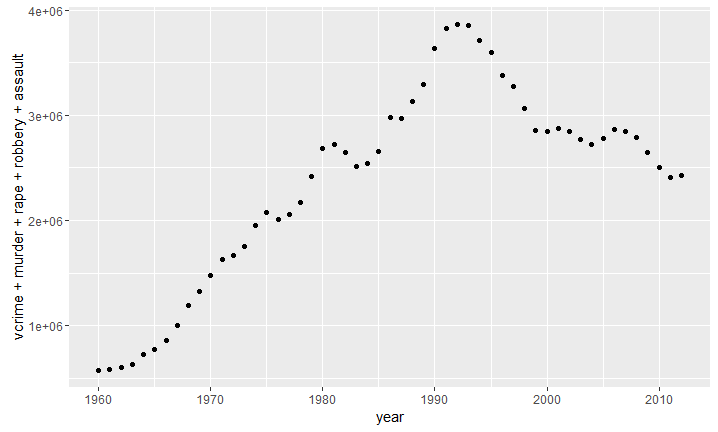
Figure 3:  All Violent Crimes Added Together
This graph is actually all violent crimes, with all of them added again.  Effectively a double picture of violent crime, I use it simply as an illustration of overall trends.  Despite constant population growth, the total numbers of crimes (not just rates) have actually dropped significantly over the past few decades.  This change is actually more pronounced for murder, where even the total numbers are currently around the numbers last seen in the early 1970’s, when the population was 120 million people less.  That said, the murder rate is actually lower now than it was at the beginning of the period being looked at, so it is clear that even in the case of murder, population is a confounding factor.
Simple Plots, Histograms, Q-Plots:
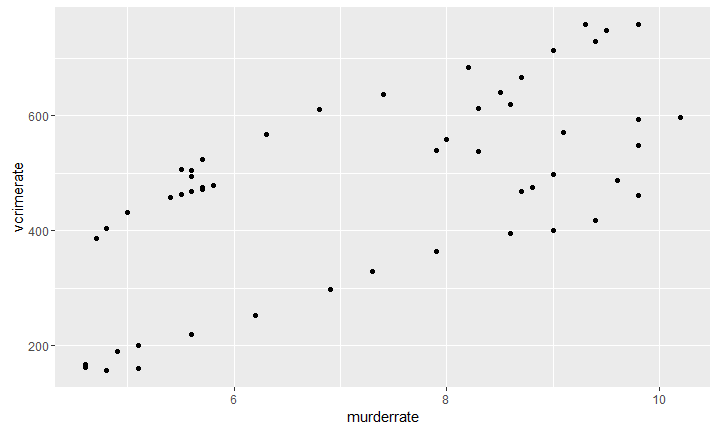
Figure 4: simple Plot of Murder and Violent crime
I include this simple plot of the violent crime rate and murder rate simply to highlight the ways that the two do not match up.  The Murder rate is extremely low both at times when the violent crime rate is low, and when it is at a medium value.
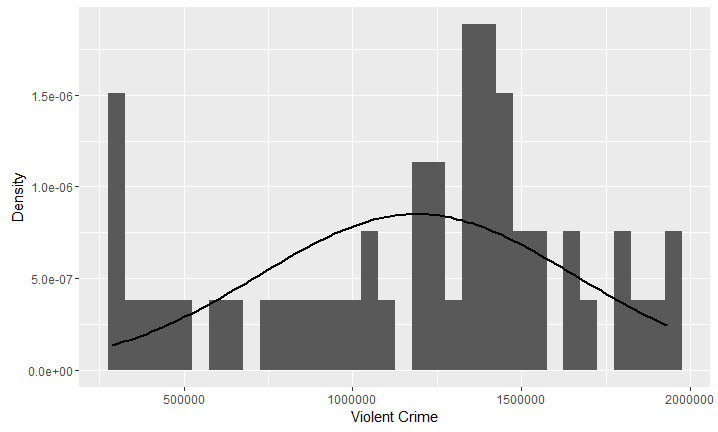
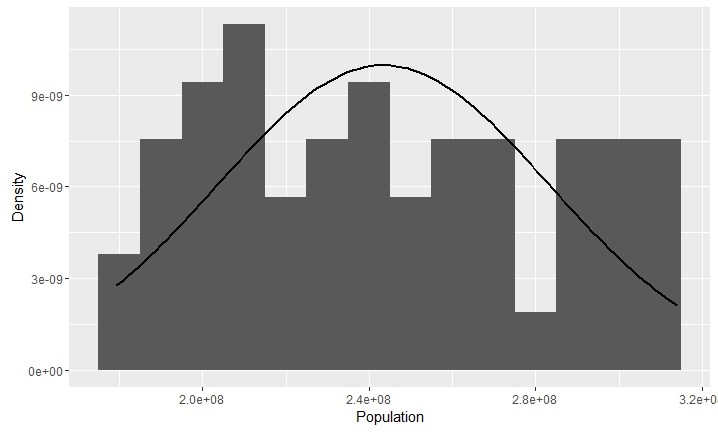
Figure 5: Violent Crime Histogram           Figure 6: Population Histogram


Generally speaking, my variables did not appear to be parametric.  As an example I include the violent crime histogram, which as you can see is pretty platykurtic.  The Population variable strangely actually seemed to be pretty normally distributed.
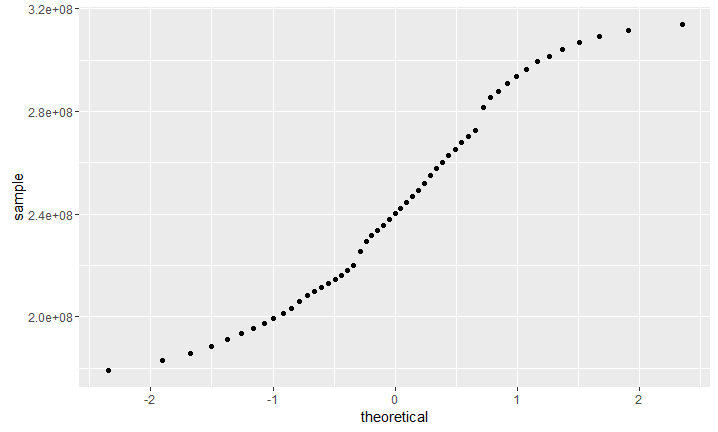
Some of the variables were more aggressively non-parametric than others.  Obviously, the categorical variables, like Congress below, were non-parametric when Q-plotted.  Surprisingly to me, the population variable still seemed fairly normal, albeit somewhat S-curved.
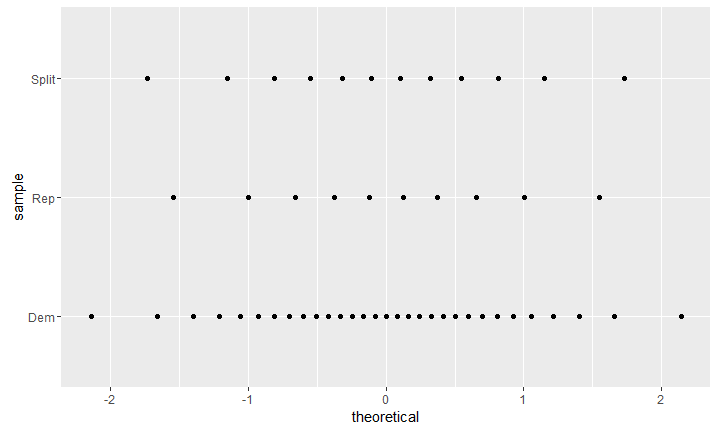
Figure 7: Congress Q-plot Figure 8: Population Q-plot
Correlations, Spearman’s and Pearson’s:
The following section is, sadly, a rather boring list of Spearman’s correlations.  So to make it a little more bearable, I will simply start with the correlation that I found most interesting, and that ultimately became the correlation I investigated most.
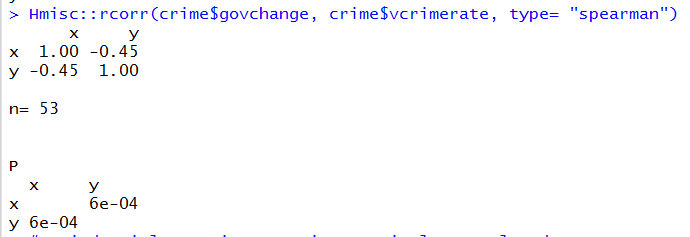
For some reason, there is a significant correlation between change in government employment numbers and the violent crime rate.  In this case, the negative correlation means that as government employment increases violent crime rates drop.  Is it possible that increased government services leads to lower crime rates? Very interesting, so I looked further.
Hmm, government employment changes negatively when Republicans control congress.  This is not surprising, since it is a part of the party plank.
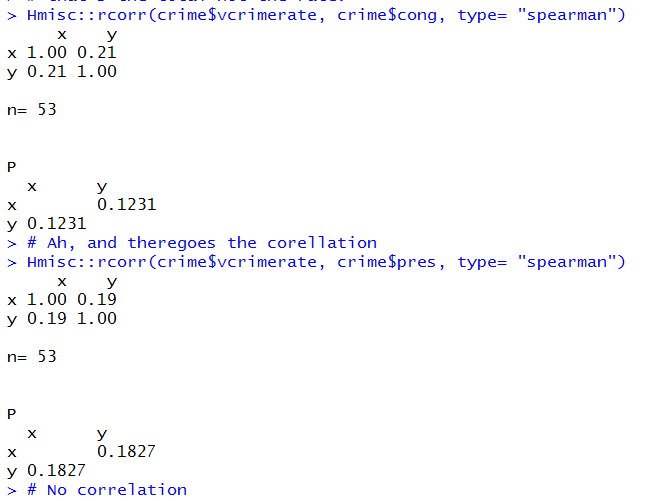
But uh oh, there is no correlation between government (President or Congress) and violent crime rates.  So even though there is a correlation between Republicans and negative government job growth, and there is also a correlation between negative government job growth and violent crime, there is not a correlation between governing party and violent crime rates.  I decided to look closer.
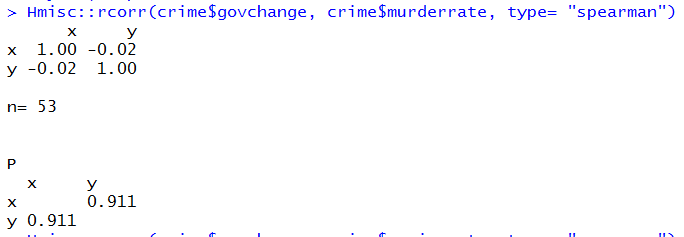
Well clearly there is no significant correlation between negative government job growth and murder rates.  Is there a correlation between murder rates and violent crime?
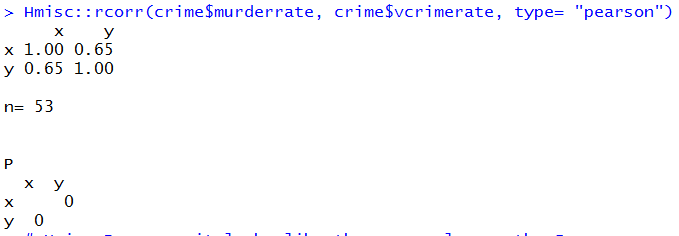
Yes, a pretty strong one, so how can murder rates not be correlated to negative government job growth?  Is there a correlation between murder rates and congress?
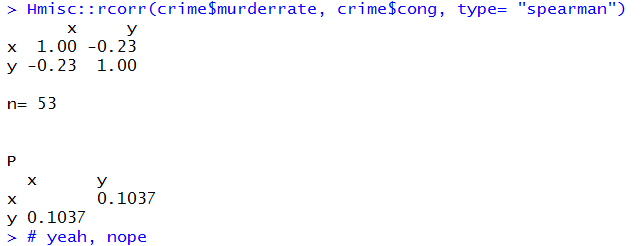
That would be a no.
At this point I decided to let the mystery of the correlations between violent crime and government employment rest for a bit.  I ran a lot of Spearman’s correlations, but I will spare you all of them except for one:
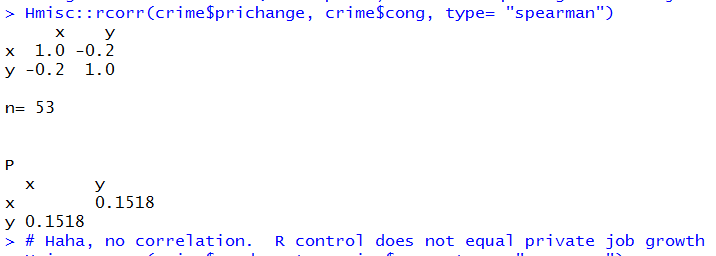

It looks like, despite the Republican reputation as the party of business there is no correlation between republican control of congress and job growth.  Based on the correlations I ran it would
seem that neither party really has any idea how to make an economy work, it appears to be mostly random.
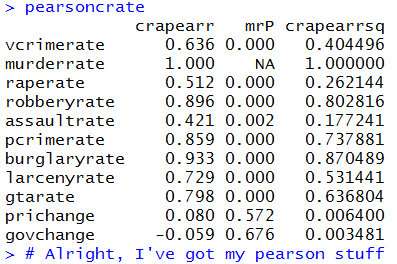


Also, just to show that I ran it, here is the Pearson’s correlation.  It took a long time, but I did not do much with it.


Time Series Plots with Two-Sided Moving Averages and LOWESS:
I spent a lot of time working on the time-series analysis, but it is a very complicated topic.  I satisfied myself with producing lots with a moving average and LOWESS.  At first I
simply assumed that this was a prettier way of plotting, but we will conclude with the graph I found most interesting and illuminating.
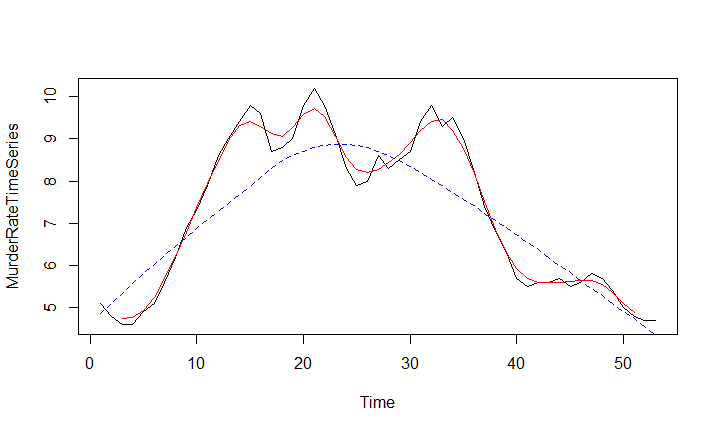
Figure 9: Murder Rate Time Series
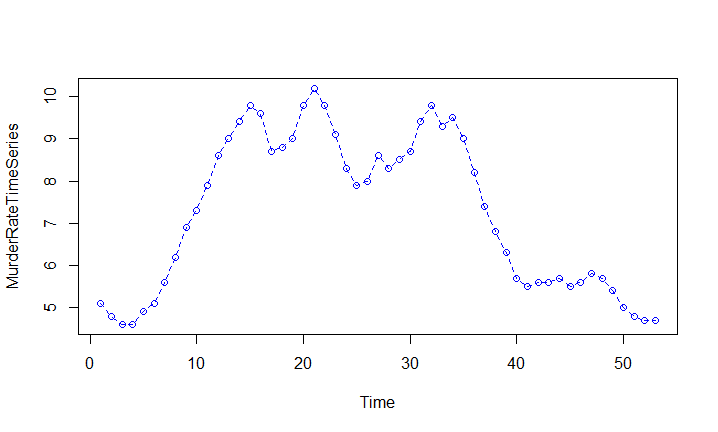
Figure 10: Murder rate with observations indicated
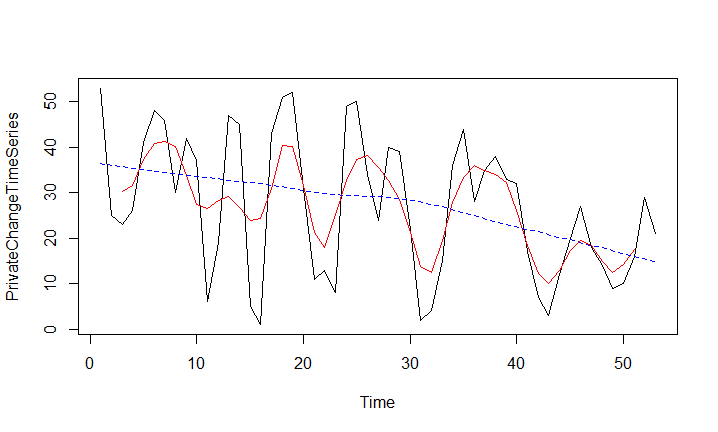
Figure 11:  private employment change
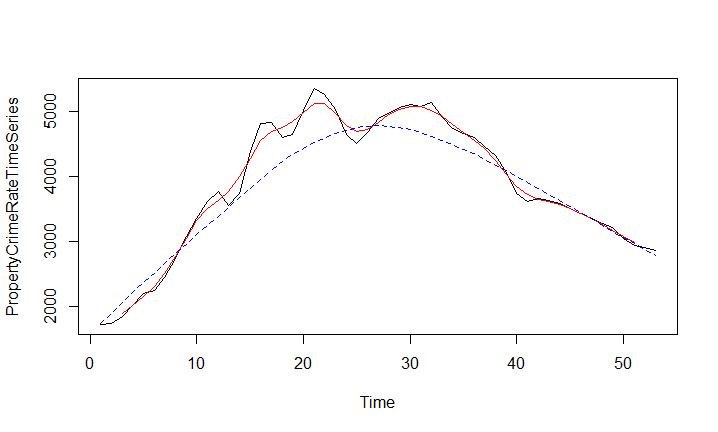
Figure 12: Property crime rate
The property crime rate graph is worth seeing, just to see how closely the following violent crime rate graph correlates to it.  This correlation is very strong.
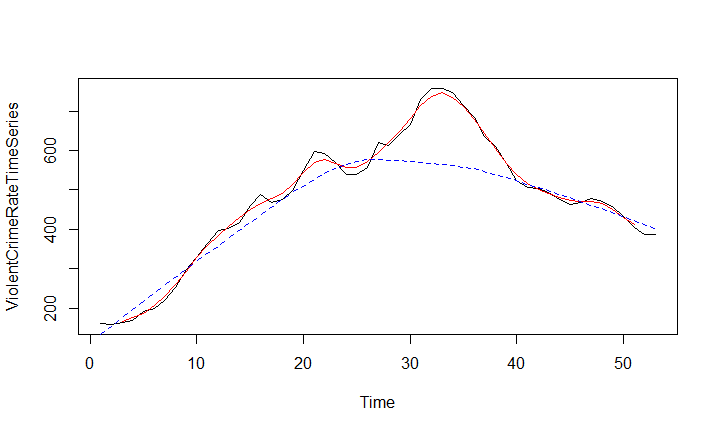
Figure 13: Violent Crime Rates
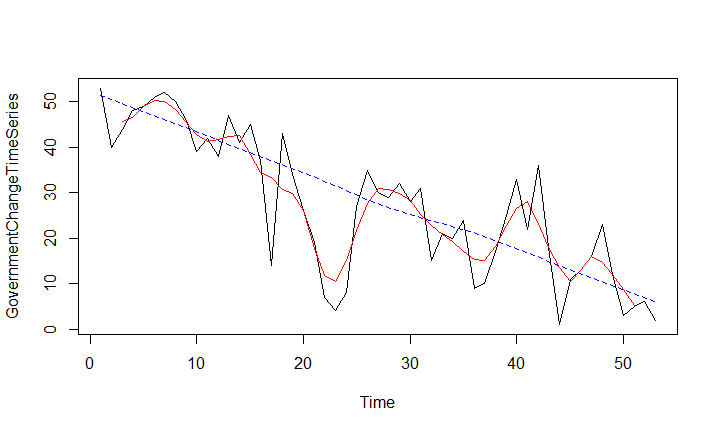
Figure 14: Government employment Change
And here finally, thanks to the LOWESS, we see the why for the negative correlation between violent crime and government change.  The change is due to the way that I extracted the Government employment change data.  Instead of extracting the numbers I extracted the percentage of change, and that means that as employment becomes more stable (percentagewise, partially due to the confounding variable of population growth and the effect on government size) the values drop.  Since violent crime rates overall went up over the course of the study, and the level of government employment instability went down, there is a negative correlation.  But I made the negative correlation.  It was my bad statistics.

Primary Component Analysis:

As a final piece of analysis I ran a PCA.  I wanted to see if there was something I had missed:
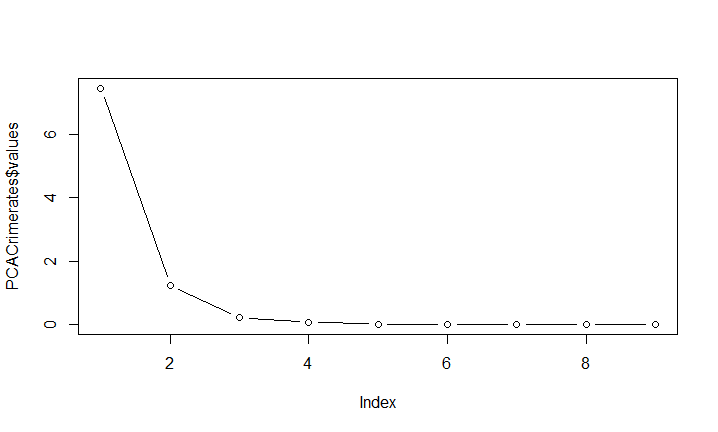
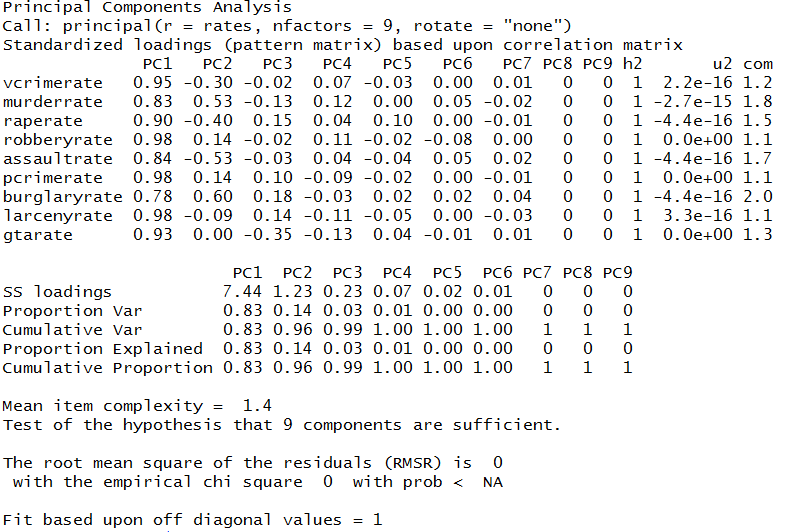
Unfortunately, thanks to the way that I extracted the change data, I had to toss it out.  Which meant that my PCA essentially just covered well covered ground analytically.  I was able to run the PCA.  Effective as a proof of concept, but a failure at trying to bring something new to the discussion.  The PCA does seem to indicate that murder and burglary are less responsible for the overall variance in the model, but the eigenvalues are still 0.83 and 0.78 respectively.  Every rate is significant.
Interestingly, looking at the inflection point, the Murder Rate is the second most important Primary Component, and looking at the eigenvalues, Murder rate and Burglary Rate are the strongest positive correlations, and bizarrely Assault Rate is negatively correlated with Murder Rate.  Assault is also the eigenvalue next least associated with violent crime rates after Murder and Burglary.  So, strangely, it looks like Murders, Assaults, and Burglary (while certainly associated with other crime rates) are the least pinned to other general rates.
Conclusion:

Ultimately, overall crime rates are strongly correlated.  This is not a very useful or insightful observation.  Also well discussed in the literature is the way that murder does not track perfectly to other rates of crime.  The most important result for me was realizing how easy it is to mess up your own data.  That at least is a useful lesson.


References:

Coghlan, A. (2010). Using R for Time Series Analysis. https://a-little-book-of-r-for-time-series.readthedocs.org/en/latest/src/timeseries.html
Zucchini, W. & Nenadi´c, O. (No Date). Time Series Analysis with R - Part I. http://www.statoek.wiso.uni-goettingen.de/veranstaltungen/zeitreihen/sommer03/ts_r_intro.pdf
Shumway, R.H. & Stoffer, D.S. (2010). An R time series quick fix. Time Series Analysis and Its Applications: With R Examples - Third Edition. http://www.stat.pitt.edu/stoffer/tsa3/R_toot.htm
FBI. (2016, Numerous Dates).  FBI Crime Statistics Home Page. US Department of Justice.  Federal Bureau of Investigation. https://www.fbi.gov/stats-services/crimestats
Bureau of Labor Statistics. (2016), (Dates extracted: 1960-2012).  BLS Employment statistics.  Quandl. https://www.quandl.com/data/BLSE/CES0500000001-Employment-All-employees-thousands-Total-private-industry
UCR. (2010). Datatool. US Department of Justice.  Federal Bureau of Investigation.  Uniform Crime Reporting Statistics. http://www.ucrdatatool.gov/


Thursday, February 4, 2016

Political Prognostication

So I just thought that I would write this out to get it on the record, especially since I am feeling like maybe I could be wrong.

I have managed to predict presidential elections correctly pretty well for the most part.  When I was 7 I predicted Dukakis would win the Presidency, and I was wrong, but other than that I have been pretty good.  Starting in 2002, I really started to feel like the social currents were so clear that it was obvious years before the election that by the time the elections came around an honest analyst would have known who was going to be elected for years ahead of time.

So I started making my predictions the October prior to the election year.  Obviously the Bush prediction was simple.  I thought the 2008 Obama prediction was also easy, since by October 2007 Obama already had a secret service detail (You don't get secret service protection unless there are credible threats against your life related to the office of the Presidency.  I figured that if people were already actively trying to murder Obama before there had even been a single primary that momentum was overwhelmingly on his side.).  Likewise, Romney clearly had the momentum in the Republican field in 2011, and even if the US was ready to elect a Mormon I have a hard time imagining it would be someone like Romney, not to mention that the electoral map was very stacked against any possibility of Republican victory.

So that was my record.  I've been able to make good calls more than a year out over the last couple elections, so that was going to be the subject of a blog post back in October,  but I didn't write it, because I no longer felt confident in my prediction.  But I decided to go ahead and share my prediction:  I predicted Hillary in 2016.

I actually originally predicted Hillary in 2016 back in 2012, but for years I saw no reason to change my prediction.  The Republicans are too busy nominating either hate mongering radicals that appeal to the extremely vocal subset of extremists within the party or bland panderers that cater to just enough regressive policies to appease the people who want to roll back freedoms for people they don't like.  When we got to 2015 with no serious Democratic challengers and passel of theocrats on the Republican side I felt very confident in my prediction.

But the Bernie Sanders happened.  He was very out of the blue for me.  My politics tend to favor more centrist candidates, so I have been pretty optimistic about Hillary--

(Parenthetical digression:  If you think that Hillary is super liberal then you have probably been pretty well indoctrinated by the decades of anti-Hillary bull that has been spouted Right Wing extremists.  Back in the early 90's you may recall that the strong opinions that Hillary held were treated as a threat to the fabric our nation since she was supposed to shut up and smile like a good woman.  Her political aspirations were seen as evidence of Bill's emasculation.  There was a popular t-shirt at the time that said "I don't trust President Clinton or Her Husband."  The fanatical and endless attacks against Hillary on all levels--political, personal, sexual, wifeliness, age, emotionality, etc. ad naseum--are pretty transparently anger about her failure to submit adequately to traditional female roles.  So you can think of Hillary as a liberal if you want, but as far as I am concerned you are wrong.  Don't drink the Kool-Aid.)

--though I will probably vote for a third party candidate as per usual myself.  But I did not expect an honestly liberal candidate to rise up on a wave of Democratic anger.

I also did not think that Republican anger could actually lead to a populist candidate rising to prominence on a platform of fascist nationalism predicated the oppression, marking, and exclusion of a religious minority.

Clearly I was wrong on both ends.  Rather than the predictable show off between Jeb/Rubio and Clinton that I expected, the primaries are turning out to be real races.

On the Republican side there is the execrable Trump who has not fizzled like I expected (I'm still hopeful that he will. His popularity leaves me scared for the spiritual health of our nation.), and the even more extreme--though not as bombastic--Cruz (Who has the same citizenship status as me, and who I think does not qualify as a Natural-born citizen.  McCain was born in US occupied and controlled territory as a part of a governmental service obligation on the part of his parents, that was a totally different ball of wax.).

And on the Democratic side you have the once-presumptive nominee, Hillary, and the very liberal upstart campaign of Bernie Sanders.  I never thought that Sanders could get this far.  At first I thought that he was just going to force Hillary leftward (and thereby open the door a little more for the Republicans), but instead he has turned into a real force in his own right.  He has somehow managed to make the liberal Democratic anger feel somewhat hopeful, and I feel like it is that hopefulness that really makes him dangerous to the status quo in the primary race.

Now I don't know who is going to win.  And that is kind of exciting, but it also kind of upsetting since I usually like to think I am pretty good at political prognostication.

But back to this last October.  I was already feeling uncertain.  But I stuck to my Hillary prediction.  I just wanted to actually publicly state my prediction so that I can't go back and retroactively ascribe foresight to myself if it turns out I was wrong.

My official prediction is Hillary, but my unofficial prediction is I'm just not sure anymore.

Sunday, January 24, 2016

Knife News: Spartan Blades SHF (Spartan Harsey Folder)

Updated 08-21-2016:  I actually wrote a review of the SHF, so if you would actually like to read what I think about the knife now that I own one, you can read it here.

Updated 07-07-2016:  I didn't really think many people were going to read this preview, but since hundreds of people have read it I thought maybe I should update so things.

If you read my knife reviews you may recall a section at the tail end of my review of the Lone Wolf Harsey T2:
When I posted my original First Impressions Review, Bill Harsey left a comment on my Facebook page informing me that he had finished up prototyping work on a new similar knife.  He said that the new one would have a titanium frame and handle (I'm not personally a big fan of metal handles, but I am willing to reserve judgement).  So this is very exciting news to me.

Unfortunately, I have no idea when this new version might come out, or who would be producing it, or what price it might be sold at.  And there is not even really a guarantee that the knife ever will enter production.  And hopefully Bill won't be mad at me for writing about his Facebook comment here.

But, if a new version of the T2 comes to fruition, I will do everything I can to review it in a timely fashion.  I'm not a particularly well known reviewer, and I don't have much of a following, so it's not like the makers would have a strong motivation to send me a tester.  And the knife will not be cheap, and heading into grad school, money is not something I am swimming in.  So even if the knife came out tomorrow, it might be a while before I could review it.  But if a new one comes out, I will let you all know.

So to sum up, the Lone Wolf T2 is my favorite knife.  I think it is just about perfect, but it is hard to buy, and the prices that they sell for these days can make it hard to justify actually using.  But stay tuned, there may be a resurrection of this knife, and that could truly be an amazing knife. 
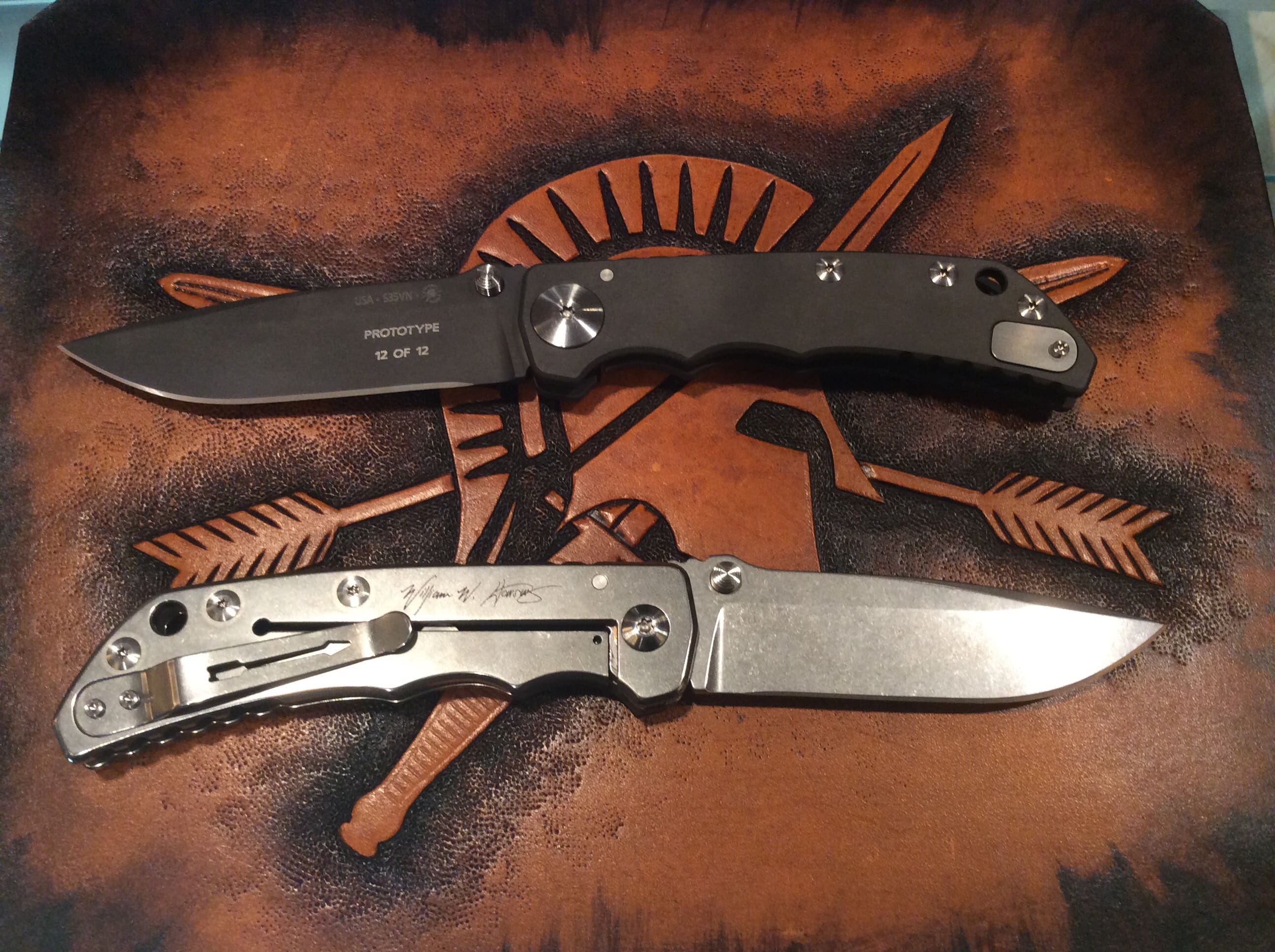
 Well the resurrection of the T2 is here in the form of the Spartan Blades SHF (Spartan Harsey Folder).
The new SHF, coming out in a stonewashed finish and black DLC (DiamondLike Coating) finish.
The exciting news is that the knife is finally being released.  The bad news is that it will be some time before I can actually get my grubby mitts on one.

Update:  I have just ordered my SHF, so I will be reviewing it soon.

The SHF is being sold for the prices of $460 for the stonewashed version and $495 for the DLC version.  Those prices, while well within the normal range for US made knives of comparable materials, mean that it is going to take me quite a while to save up the funds to spend on a knife that is essentially a new version of a knife I already have.  But I am going to buy it, it's just going to take a while.  I'm guessing probably at least six months (I don't make big bucks as a grad student, I have some non-discretionary spending coming up, and there are several conferences I need to attend in the next couple months, so six months may be overly optimistic), but I look forward to reviewing the knife when I get it.

Of course having to wait a while is not entirely bad news, but let's talk a bit about the knife first...

Materials:

Like most of the Spartan Blades catalog, the blade of the SHF is made of CPM S35VN.  I have written about this steel a few times, my summary is that it is a science-magic steel.  It's neat stuff, and Spartan Blades knows how to work with it.

The biggest change between the SHF and the T2 is that the SHF is a frame lock.  That means that part of the handle frame actually springs inward to lock the blade in place.  And then the frame is further held in place by your hand as long as you are holding the handle.

The the handle and all the non-blade hardware of the SHF is titanium, which is probably the most exciting part of this new design for me.  The screws, standoffs, blade pivot, and clip are all made out of titanium.  This should be one extraordinarily strong and solidly constructed folding knife.  I am particularly excited about the titanium pivot.  All of the points where failure might occur are going to be made of extremely strong and lightweight material (not that using a folding knife as a knife would lead to failure in a less strongly built knife, but some people like to to silly things with their knives).

Makers:

Spartan Blades is a US company based out of North Carolina.  The company was founded (and is owned) by two retired special forces soldiers, Curtis Iovito and Mark Carey.  In addition to being veteran owned, and employing other veterans, Spartan Blades uses US origin materials for their products.  Not only are the knives made in the US, the materials that make the knives are made in the US.  The sheaths for the knives are made by vendors that are also veteran owned companies that us US origin materials.  And Spartan Blades works with other US veteran owned companies.

The message here is that Spartan Blades is a company that takes "Made in America" seriously at all levels, and has a commitment to service and others who have served.  Being so resolutely US sourced does tend to mean that costs for materials and labor will be higher than if the knives were made and sourced overseas, but I would argue that the additional cost can be well worth paying.

In a country (and world) dominated by the forces of market economics, the dollars we spend are our most concrete forms of real power.  When you spend money on goods you vote with your wallet.  I am not speaking metaphorically, you really are shaping the world you live in with your spending habits.  This is not to say that it is always wrong to buy foreign made goods by any means, but it is to say that price should not always be the only consideration.  Spartan Blades is a company I like to support.

It helps, of course, that Spartan Blades makes excellent quality goods.  I have been quite thrilled with my Spartan Harsey Difensa since I purchased it.  It has actually seen a lot more use than I had initially expected.  It is just a well designed and built piece of equipment.  (And the soldier that I bought Model II for has also been quite happy with it.)

But Back To The SHF:

While I wish I could just buy a SHF right now, it might actually work out better for me to have to wait.  I am excited for the SHF, but there are things that I am not crazy about with these initial models.

The stonewashed finish

I am not crazy about metal handles.  One of my favorite things about my T2 is the wooden handles.  I like the way they feel, and to my mind they feel warmer in the hand than metal handles.  However, I know that Bill Harsey has carried a titanium handled knife for many years, and he seems to like it.  While it is a logical fallacy to simply rely on an appeal to authority, some people really are experts.  I'd count Bill as an expert.  I am willing to give a metal handled knife a chance, particularly since one of the reasons I want the SHF is for when I am working in the field.  I tend to end up working in the high desert fairly frequently, and the gritty sand can do a number on even artificial handles like derlin. The titanium should be able to stand up to that well, plus if I do need the knife repaired I can send it in to Spartan  (unlike the T2, Lone Wolf Knives doesn't exist anymore so if I mess up my knife there is no where to send it).

I like the DLC on the handle, but I really don't like black Blades on my knives. I know a lot of people really like that look, but I am hoping for the option for a stone washed blade in a black handle later this year.  Another option that I hope becomes an option this year is the Flat Dark Earth color ZRN finish. It has a nice golden tone I prefer to black.

Update:  Spartan was finally able to make space for some custom orders for the SHF, and that is why I finally bought mine today.  I will be getting a SHF with the black handle and stonewashed blade.  I have no idea when the FDE blade might be an option.

The other thing that I hope will happen sooner, rather than later, is a full flat grind option like the one on my T2.  I had some questions about the SHF, and I emailed Curtis Iovito, who was kind enough to get back to me promptly. One of the questions I asked was whether or not there would be different blade styles. He told me that there was a possibility of different styles, but there was no current plans to start working on new designs.  It will probably be longer than I want to wait before any new blade geometries come out, but I can hope.

Tip up clip.  You can go left or right, but it is tip up all the way.

One thing that I was sad to see on the SHF was the obligatory tip up clip. I really like the design of the tip down clip on the T2 (though it was one of the aspects of the T2 that I have read the most complaints about online, there are a lot of people that prefer tip up). Despite the large size of the clip on the T2, I have found it to be very unobtrusive in the hand, I worry that the SHF clip will be less comfortable. We will just have to see.

Update:  I got to handle the SHF folders at the Oregon Knife Collectors Association Show this spring, and I found the clip to be totally unobtrusive in the hand.  I seriously did not notice it when I held the knife.  I have also realized that most of the pants that I wear in the field have flaps on the back pockets, so the front pocket carry is going to be actually a plus for me.

Colored hardware

The last thing that I am looking forward to is the different colored hardware that has been shown in the prototype photos that Spartan Blades has put out. The gold and blue colored screws, standoffs, and thumbstuds look like a neat way to add some visual spark to the SHF.

But enough of my rambling on about a knife I haven't actually had a chance to hold.  I've given Spartan Blades enough free advertising for today. I just wanted to share my excitement at the news that the new SHF is finally coming out.


Friday, January 15, 2016

Not Racism, Or At Least Not Entirely: Why the Malheur Occupiers are Still Alive

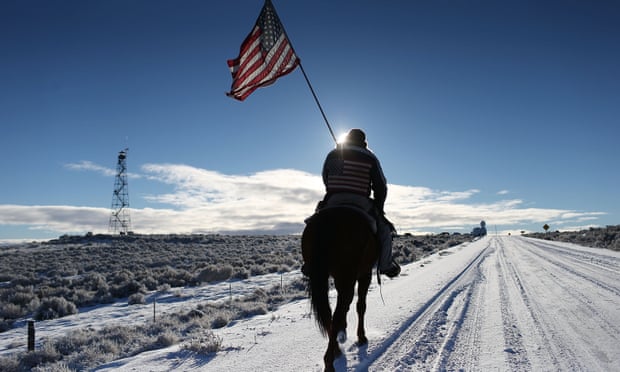
I will go into more depth here, but I will summarize why the Federal forces are taking a kid gloves approach to the the militants who are currently occupying the Malheur National Wildlife Refuge, and I will do it with an image.
This little girl was Baylee Almon.  She was one year and one day old when this picture was taken in 1995.  She didn't get any more days.

That image is of Baylee Almon in the arms of a firefighter who pulled her from the wreckage of the Oklahoma City Federal building after the deadliest terrorist attack on American soil, other than 9/11.  That bombing attack, which killed 168 people (19 of whom were under the age of 6) and injured 680 others, was carried out in retaliation for the violent responses to anti-government militants earlier in the 1990's.
The Oklahoma City Bombing

Is the reluctance of the FBI to start slaughtering occupiers due to racism?  I would argue no, it is due to the very high body counts that have historically resulted from violent suppression of anti-government extremists, and the high chance of retaliatory terrorism.

The extreme-right brand of anti-government militancy is closely tied to extreme religious conservatism as well.  Despite our society's fixation on Islamic terrorism, it is actually Christian terrorism that historically was responsible for more deaths in the US.  One need merely look at the ongoing incidents of Anti-Abortion Violence for examples.  Murder, abductions, arson, bombings, and ramming buildings with cars are all actions that continue to occur.  Just a month and a half ago three people were killed in a shooting attack on a Planned Parenthood.

This is not to say that the Bundy Militants are abortion clinic bombers, but they are a part of a broader cultural segment that views the use of violence and threats to force their views on others as acceptable.  Of course, one could argue that the people arguing that the government should go in and kill all the occupiers are doing the same.  And I would argue that there is a great degree of truth to that, but there is a difference.  One side is arguing that only non-governmental groups and individuals have the right to kill and seize through force of arms in pursuit of political goals, and the other side argues that only governmental groups and individuals have the right to kill and seize through force of arms in pursuit of political goals.  Both sides are essentially arguing that people who disagree with them should be killed or at least threatened with violence, the disagreement is just on who is allowed to kill and threaten people.

Back in the early 1990's the Federal government clearly acted on the assumption that violent suppression of anti-government groups was the way to go.  This led first to the Ruby Ridge standoff.  A violent and deadly episode that resulted in acquittal for the people who were charged, but not before an agent, a dog, and a boy were killed.  There was a wrongful death suit that followed as well.

The End of the Waco Seige

The next year another anti-government/religious group got into a dispute with the Federal government.  This time it was the Branch Davidians in Waco Texas.  In this case, the Branch Davidians were suspected of stockpiling weapons... in a state where it was not a crime to stockpile weapons.  The end result was 82 dead Branch Davidians (76 in the fiery end, 5 in a shootout, and one other killed by agents) and 4 dead agents.  A large number of the dead in this case were also children.

The Oklahoma City Bombing was in 1995.  The massive scale of that violence shook the nation.

The next year, 1996, when Federal forces again had a confrontation with anti-government/religious extremists things went a little differently.  This time it was the Montana Freemen.  The standoff was resolved peacefully.  After 5 agent deaths and scores of anti-government types dead in two years the Federal government had decided that perhaps using a softer approach might be more effective.  A long period of relative peace between anti-government types and the government ensued for almost 20 years.

Enter the Bundys.

In 2014, 20 years of law-breaking on the part of Cliven Bundy resulted in the government trying to get him to stop illegally grazing his cattle on Federally owned land.  This led to a standoff between armed anti-government/Christian forces and Federal agents.  Including snipers aiming their weapons at agents.  The Feds backed down, and the Bundys kept breaking the law.  They are still using those federal lands without a permit.

(As an aside, under the land laws that apply most everywhere in the English speaking world, if anyone other than the government owned the land Cliven Bundy is using, at this point he would have a very strong adverse possession case, particularly after facing down the government.  The Bundys and their philosophical kin make frequent appeals to common law, and under common law the fact that the Feds backed down fully legitimized their flouting of federal regulations, as well as giving them possession of the land they have been unlawfully using.)

Part of the problem is that the roots of the anti-government/Christian movement go back a long way in our country's history.  How long you ask?  How about 1791?

In 1791, three years after the ratification of the US Constitution, Western Ranchers Farmers rose up against the federal government in opposition to what they saw as unconstitutional abuse of power in the form of taxing whiskey.  This was called the Whiskey Rebellion.  And from that point on the US government was pretty consistent in using lethal force to suppress acts of open rebellion.

When John Brown seized the Harpers Ferry Armory the Feds brought the hammer.  This raid helped trigger the US Civil War (itself often cast by supporters of the Confederacy as a dispute over Federal Government power), and most people today side with John Brown as an abolitionist, but we should not lose sight of the fact that John Brown was a religiously motivated extremist with a history of terroristic actions and violence in support of his abolitionist cause.  And while John Brown may have been on the anti-slavery side of the debate, it is worth considering what he was trying to do.  He was trying to start a conflict to end slavery.  He was successful.  Not directly, but as a martyr.

As a martyr John Brown's cause gained strength.  A martyr cannot be discredited.  The ideas that a martyr stands for are bulletproof.  The violent response by the government helped bring about the Civil War.

And that, I think, is part of the mindset that motivated the Bundys.  They see themselves as Godly and moral men fighting for a just cause, and if they are martyred they could trigger violence that could convulse our nation.

The Bundys are the inheritors of a cultural mindset that celebrates the Christian individual, and reviles the rule of law.  This mindset extends to the American Revolution, and after the failures of the Articles of Confederation, it was only three years after the United States became a country that armed conflict resulted from this mindset.  Even the concept of Manifest Destiny, that led to the current territorial extent of the Lower 48 states was tied to a Christian ideology that legitimized the use of force to drive people (Indians) from their homes.  And this anti-government/Christian ideology is on full display in the Republican Presidential nomination race.

(If you want yet another example, take a look at the Bath School Disaster.  The deadliest school massacre in US history was not committed with a gun, it was a bomb set off by a man angry about taxes.  Children often pay the price of this kind of violence.)

The Bundys may be threatening bullies and criminals, but there are a LOT of people in this country that agree with them.  And when the federal government has come down hard on people who stood for movements that had a lot of support it has led to a lot of blood.

After the blood and reprisals of the early 1990's the US government adopted a set of tactics that sought to impose the rule of law, and imprisonment on anti-government militants.  By imprisoning the Freemen they were rendered powerless.  They were not martyrs, they were criminals.  As long as this strategy kept working things didn't get as bloody as they had been,

But then in 2014, the kid gloves approach didn't result in the restoration of the rule of law.  It resulted in the victory of the Bundys, at gunpoint.  The Bundys threatened the US government with violence and the US government backed down.

The Bundys were empowered.

On January 2nd the Bundy opposition to the rule of law took a scary new turn.  After hijacking the cause of a real injustice (the Hammonds), the Bundys seized the Malheur National Wildlife Refuge station.  Now they are stealing and damaging federal property.  They are tearing down fences.  They are making roads across wildlife habitat and archaeological sites.  They are poaching.  Beyond the simple illegal occupation of the site (and of course promoting armed insurrection) there is no shortage of laws the Bundys are breaking now.

Just a small helping of destruction of Federal property...

While the Bundys may claim to be peaceful, they are armed, and if we are being honest, most of the militants at the refuge probably get a lot more range time in than your average law enforcement personnel (despite what you may have seen in movies, guns are not magic, they require practice to use well, and having a badge doesn't make someone a crack shot).  If we were talking about the Bundys standing up to the US Army this wouldn't matter.  With a couple thousand dollars expended in transportation and material costs an artillery strike could end the occupation without any need for soldiers to put themselves at risk.

But that is not what we are talking about.

The Feds want to resolve this by restoring the rule of law.  If the Feds kill all the militants at the Malheur National Wildlife Refuge they will create martyrs.  Martyrs that have a lot of people who agree with them.  And that kind of bloodbath has historically resulted in more bloodbaths.  And more violence  And terrorism (the real kind).

Because while many may see the Bundys as a joke, they see themselves as true patriots fighting in the name of God, justice, and the American Way.  And a lot of people agree with them.
If the Feds can resolve this by arresting and jailing the Bundys and their compatriots, there is a real chance to defuse this dangerous escalation before it turns into the kind of blood we saw two decades ago.

So yeah, maybe the fact that the Bundys are white has something to do with why the government didn't go in guns blazing, but I don't think it is because the Feds are racists.  I think it is because the whiteness of the Bundys helps convince a lot of people that they are right, and that large number of people that support them makes killing the Bundys a very VERY bad idea.

The Bundys want to start a war.  They are opposed to the rule of law, science, Native land claims, protection of the environment, and any authority beyond themselves.  A violent response to their provocations brings the probability of more violence closer.  We should not be feeding into the type of rhetoric that feeds this kind of violent anger.

If there is any constant theme in my writing it is about the danger of divisive politics and rhetoric.  This is a prime example.  The Bundys are bullies and criminals, but when you ridicule them, or call for their killing, or claim that their continued existence is proof of racism, you contribute to the factionalization of our country.  Our history is replete with cautionary examples of what this kind of divisiveness leads to.

Please stop calling for the killing of the Bundys, and start hoping for the peaceful restoration of the rule of law.

Malheur is a breathtaking place.  It is one of the most important habitats in the West for migratory waterfowl.  If you ever get the chance, make the trip.


Tuesday, December 29, 2015

Knife Review: Mora: Morakniv HighQ Allround Knife

Introduction:
Morakniv HighQ Allround knife with sheath

When I started doing these knife reviews, a part of my motivation was to provide suggestions for affordable good quality knives.  In that vein, I am finally getting around to reviewing a Mora knife.  If you were to spend far too many hours reading about various types of knives for camping and bushcraft on various knife forums (as some of us do), there would be certain knife brands that you would hear mentioned repeatedly as top performers.  The Mora knives are absolutely one that I read people raving about, but what I didn't realize at first was that they are also extremely affordable.  When it comes to affordability in a general purpose knife, I don't think you can really beat a Mora.

Most of the knives I have been reviewing tend to be fairly expensive.  Some of them are very expensive, but not this one.  You can pick up a Morakniv HighQ Allround for less than $15.  This is a quality knife that you can pick up at a disposable knife price.  But in reality, you probably won't pick up this exact knife since the model that I am reviewing was recently discontinued, but there are newer models that are very similar.  If you would like a handy primer on the different styles of Mora knives there is a handy one here, from Ramblin' Jim.  As Jim says, at these prices you can just pick up a few and try them out.  Amazon has bundles of different Mora models for sale.


The TL;DR review summary: 


If you really aren't interested in reading the whole review, then let me just say that I started out just wanting to see if the Mora could handle some of the tasks that I had done with other bushcraft knives.  It was such a pleasure to use I ended up carving a spoon.

This is the first spoon I have ever carved, and I did it entirely with the Mora I am reviewing here (well, I also used sandpaper, but it was the only knife I used)


Let's Start With the Specs:


(Knife Specifications from Knife Center)


  • Blade Length: 3.75" (95 mm)
  • Blade Steel: High Carbon Steel, 59-60HRC
  • Blade Thickness: 2 mm
  • Overall Length: 8.2" (208 mm)
  • Handle Material: Rubber
  • Weight: 3.7 oz. (105 g)
  • Made in Sweden

I'm not going to go into the specs too much here, especially since this exact knife is discontinued, but the followup models are very similar.  

What I think is probably most noteworthy is the steel.  This particular knife that I reviewed is not stainless, it is high carbon.  I accidentally left it outside for a few weeks after I had taken the photos I used for the review, and it definitely rusted.  The rust was just superficial, and it cleaned off, but it left stains.  And this type of steel does stain.  After using the knife for a while the steel will turn grey, even if you take care of it, that is just the way it goes.  The discoloration is called a patina, and lots of people actually really like the patina.  There are many discussions online devoted to different types of forced patinas, and how to get different colors.  I personally prefer stainless myself, but carbon steel is often better performing than less expensive stainless steels.  

Mora also has a good reputation for their heat treatment of their stainless steels, and the use Sandvik steels for their stainless.  But that is not what I am reviewing, because Mora has a particularly good reputation for the heat treatment on their carbon steel blades, and my experience is that the reputation is well earned.  Carbon steels might discolor easier, and they require cleaning and oiling to maintain optimally, but a good high carbon steel can have as good or superior edge holding and toughness than a stainless super-steel at a much lower price.  If you want excellent performance for a low cost, and you are willing to take care of your tools, then a high-carbon steel can be an excellent choice. 


A Note on the Sheath:


I really liked the sheath for this knife.  It is not fancy looking, but it is not a fancy knife.  The sheath is easy to clip on to your belt, but it stays on securely.  The knife fits snugly into place in the sheath with no wiggle or rattle.  It stays secure without needing an additional snap or loop to hold the knife in place.  As an extra bonus, and showing the origin of the knife as a construction/work knife, the sheath is designed to stack with other Mora sheathes, so if you needed two different knives you could have them stacked.


Review:


Steel:


As I stated earlier, the steel is high carbon.  Morakniv does not provide a more precise description than that.  Whatever the exact steel recipe is, when combined with their heat treatment is makes for an outstanding performing blade steel.  A lot of the hardness, edge holding, and resistance to chipping in a knife comes down to having a good heat treatment.  The many decades in the making reputation of knives from Mora, Sweden is in large part due to the heat treatment.

I found the knife to hold an excellent edge, even when I abused the edge.  And one of the benefits of carbon steel as opposed to stainless steel is that it is easier to sharpen.  So after I managed to wear out the initial edge to the point where it just was not performing as well, it was a breeze to put a new edge on the knife.


Blade Finish:


The blade finish is nothing to write home about.  It is a standard, somewhat polished, finish.  The knife is a work knife, it is going to get scratched, and since it is a carbon steel blade it is going to get a patina.  Some other Mora knives have coatings or special finishes, this one does not.


Blade:


So a big part of what makes this knife (and most of Mora's lineup) perform so well while maintaining sturdiness is the Scandi Ground blade.  The scandi grind is a great geometry for a utility knife.  Different types of tasks can be easier with different grinds, I for one strongly prefer full flat grinds for kitchen knives as an example.  The scandi is especially good for wood working, which is handy for a knife you intend to use for camping or bushcraft.

A big part of the reason the scandi grind works so well for cutting into materials like wood is the lack of a secondary bevel.  The primary bevel on the blade goes right to the edge, so the blade does not shoulder until the blade is at least as far in as the edge of the primary bevel.  I worry that this might be getting a little jargon-rich/technical, so I will just say that I like the grind.  If you want to know more about grinds I wrote about them in my article Knives: A Primer a while back.  I also link to an interesting video that explains blade geometry and shouldering in more depth in that article.

The blade on this knife is pretty small.  It is less than four inches long, and pretty thin.  The blade feels more than solid enough for any task I asked of it, but it is not a big tank of a blade.  It is a handy, nimble size, good for general tasks, but it is not a big chopper.

I did do a little batoning with the knife, just because I figured that it really wouldn't have been a big deal if the knife broke.  The knife held up just fine, but with such a short blade you are pretty much limited to splitting wood that is already kindling.  If you have read my other reviews then you know that I am not a fan of batoning, but it is very "in" right now.

The one big drawback to the thinness of the blade is that it ended up giving me blisters on my left hand from pressing on the back of the blade while carving.


Handle:


The handle is one of the best things about this knife.  It is not pretty, or flashy, but it is comfy.  The handle is plastic covered with a rubber layer.  It is soft, grippy, and ergonomically excellent.  This knife really feels good in the hand, even after you have been using it for quite a while.


Deployment:


This is a fixed blade, not a folder, so deployment is really just taking it out of the sheath.  The sheath is well designed, and it is quick and easy to take out the knife.


Fit and Finish:


Fine for a $12 knife.  This really isn't a fancy knife.  All I cared about was the sharpness of the knife, and that everything solid.  The bevel were even on the knife.  It came very sharp.  I have absolutely no complaints.


Use Review:


I took a fair number of photos, so I will let the pictures do most of the use review talking.  The one thing I will say, which I feel perfectly sums up how I felt about this knife in use, is that I had originally planned to give this knife away after I was done with the review, but I ended up liking it so much that I decided to keep it.  I like whittling, and it is a great whittler.  It also makes a great extra backup knife.  When I am out in the field, people often need to borrow a knife.  The Mora is a good one to be able to loan out.


The Mora is not really a kitchen knife (though Mora does make kitchen knives) but it does fine.  It's really at it's best handling paring or boning tasks, it's not a real food prep knife.


I loved this knife for wood working.  I used it here to drill out a hole for a fire board.


It bit right into the wood for the notch.


Made quick work of the notch.


You can see in this picture that I ended up getting too enthusiastic with the knife.  I found that it was not totally ineffective at chopping (this knife is NOT a chopper, but it did better than I expected).  But the small size and light weight lulled me into not taking it seriously.  I ended up chopping into my fingertip.  Always remember, knives are not toys, and this one was sharp.  That cut was 100% user error.  My fault.


Cut through a branch to make a spindle for a fire drill.


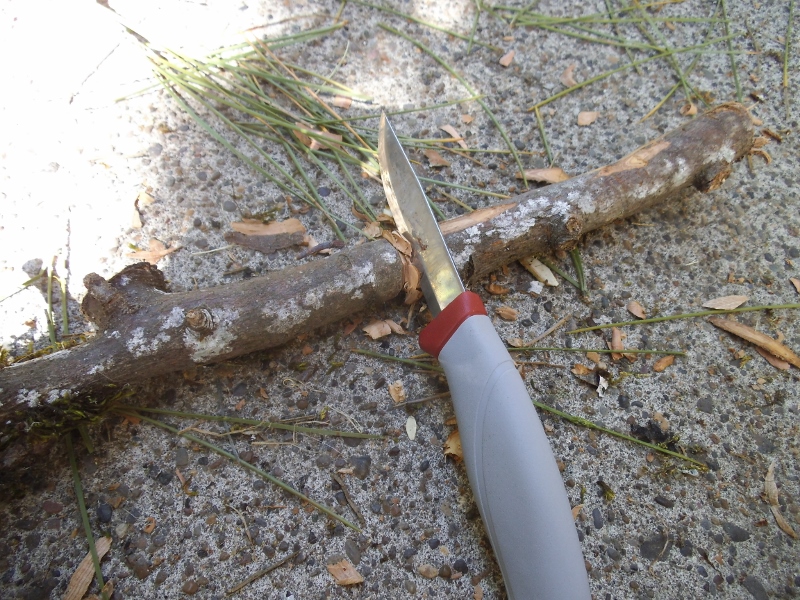
This is the process of cutting through.


Just a shot of the knife surrounded shavings and evidence of using it.


Summary:

I highly recommend these knives.

If you are looking for a good quality all around knife, and you don't want to pay a lot, this is the knife for you.  Heck, even if you are willing to spend a lot of money, consider picking up a Mora, it might change your mind.  They aren't fancy, they aren't flashy, but they are extremely affordable and very good quality.  Frankly mine is a pleasure to use.

Moras are a great example of a quality tool that you can find for a great price.  And the best part is, you can use it as roughly as you want, since even if you did manage to break the knife you are only out the cost of a couple Big Macs.